NVIDIA Speeds AI Robots from Sim to Production
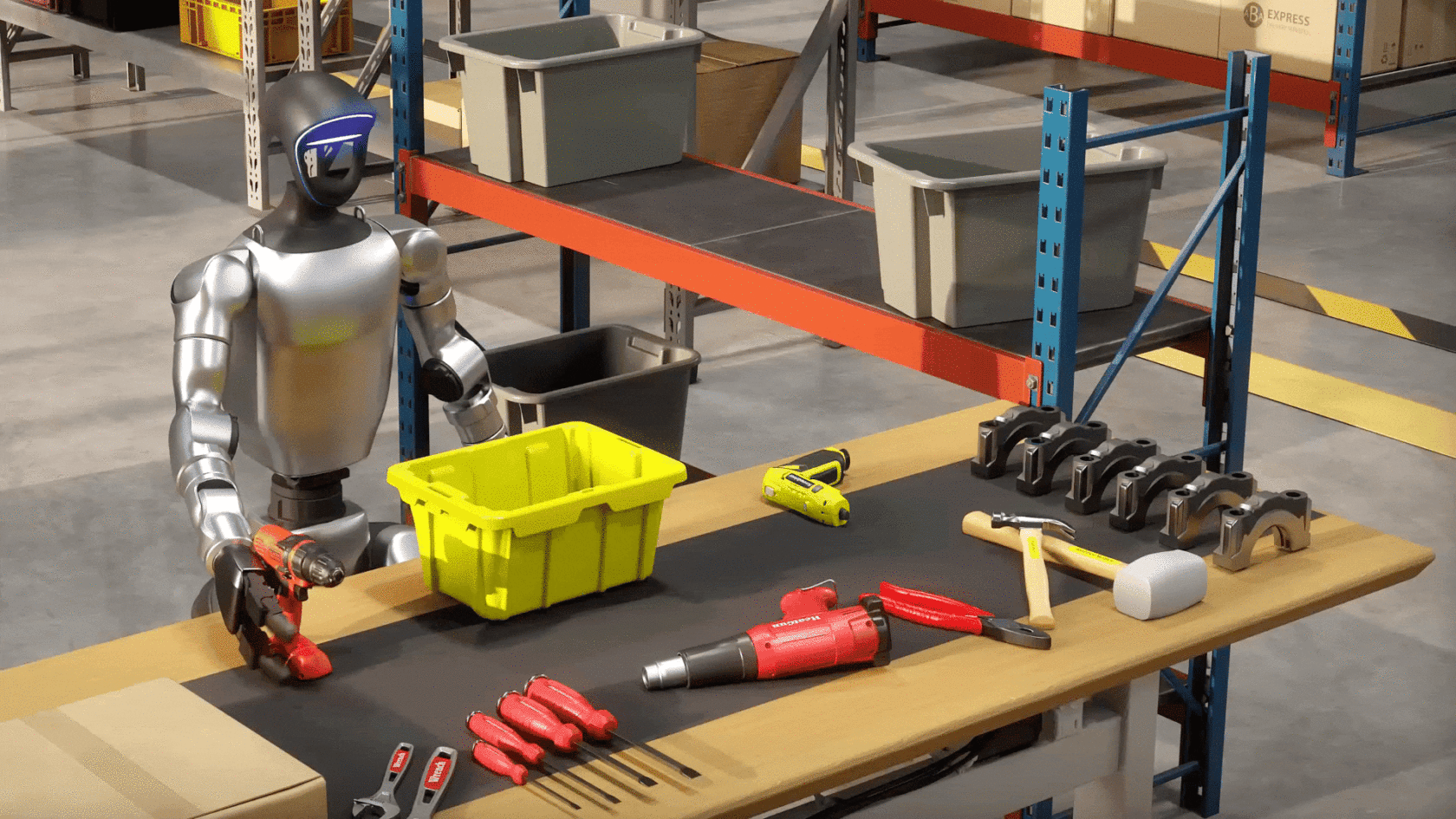
💡NVIDIA open tools slash sim-to-real gap for building production AI robots faster
⚡ 30-Second TL;DR
What Changed
Latest open models for robot AI development
Why It Matters
This lowers barriers for AI robotics developers, enabling quicker iteration from virtual training to deployment. Open-source nature democratizes advanced robot building, potentially boosting industry adoption.
What To Do Next
Visit NVIDIA Blog to download open models and test robot simulation workflows today.
Key Points
- •Latest open models for robot AI development
- •Frameworks unify simulation, robot learning, embedded compute
- •Accelerates full cloud-to-physical robot workflows
- •Enables sim-to-production pipeline for robotics
🧠 Deep Insight
Background and context from public sources — not the original article. 9 sources cited.
🔑 Enhanced Key Takeaways
- •NVIDIA announced collaborations with ABB Robotics, FANUC, YASKAWA, AGIBOT, Boston Dynamics, Caterpillar, Franka Robotics, Humanoid, LG Electronics, and NEURA Robotics to deploy new AI-driven robots across industrial, surgical, and humanoid applications.[1][2][4]
- •New open models released include NVIDIA Cosmos Transfer 2.5, Cosmos Predict 2.5, Cosmos Reason 2, Isaac GR00T N1.6 (a vision-language-action model for humanoid full-body control), alongside Isaac Lab-Arena for benchmarking and OSMO for cloud-native orchestration, all available on Hugging Face and GitHub.[2][3][4]
- •Integration with Hugging Face's LeRobot framework connects NVIDIA's 2 million robotics developers to 13 million AI builders, while new hardware like Jetson T4000 ($1,999 at volume, 4x prior performance) and IGX Thor support edge deployment.[2][4]
- •NVIDIA Cosmos world models enable high-fidelity neural simulation and synthetic data generation to address data gaps in physical AI, used by partners like Paratas AI for training operating room robots.[1][5]
🛠️ Technical Deep Dive
- •Isaac GR00T N1.6 is an open reasoning vision-language-action (VLA) model for humanoid robots, integrating NVIDIA Cosmos Reason for enhanced contextual understanding and full-body control.[3][4]
- •Isaac Lab-Arena is an open-source GitHub framework for large-scale robot policy evaluation in simulation, compatible with benchmarks like Libero and Robocasa, developed with Lightwheel.[4]
- •OSMO is a cloud-native orchestration framework unifying robotic development workflows from simulation to deployment.[2]
- •Jetson T4000 module, based on Blackwell architecture, provides 4x performance over previous generation for $1,999 (1,000-unit volume); IGX Thor extends to industrial edge, available March 2026.[2]
- •Cosmos world models support neural simulation for generating synthetic data, combined with Isaac Lab, Newton (GPU-accelerated differentiable physics), for scalable robot training.[5]
🔮 Future ImplicationsAI analysis grounded in cited sources
⏳ Timeline
📎 Sources (9)
Factual claims are grounded in the sources below. Forward-looking analysis is AI-generated interpretation.
- business20channel.tv — Nvidia Abb Fanuc Advance Physical AI in Robotics by 2026 17 March 2026
- ng.investing.com — Nvidia Unveils New AI Models and Robotics Tech at Ces 2026 93ch 2274909
- blogs.nvidia.com — Open Models Data Tools Accelerate AI
- investor.nvidia.com — Default
- youtube.com — Watch
- nvidianews.nvidia.com — Nvidia Announces Open Physical AI Data Factory Blueprint to Accelerate Robotics Vision AI Agents and Autonomous Vehicle Development
- youtube.com — Watch
- rockingrobots.com — Nvidia at Ces 2026 Robots Become the Next Platform for Physical AI
- mobileworldlive.com — Nvidia Unveils Family of Open AI Models for Avs Robots
Weekly AI Recap
Read this week's curated digest of top AI events →
👉Related Updates
AI-curated news aggregator. All content rights belong to original publishers.
Original source: NVIDIA Blog ↗
This is a summary, not the original. Read the source, or get the weekly briefing.
Weekly AI briefing
One email a week. Unsubscribe anytime.