Nvidia DLSS 5 Conquers Uncanny Valley
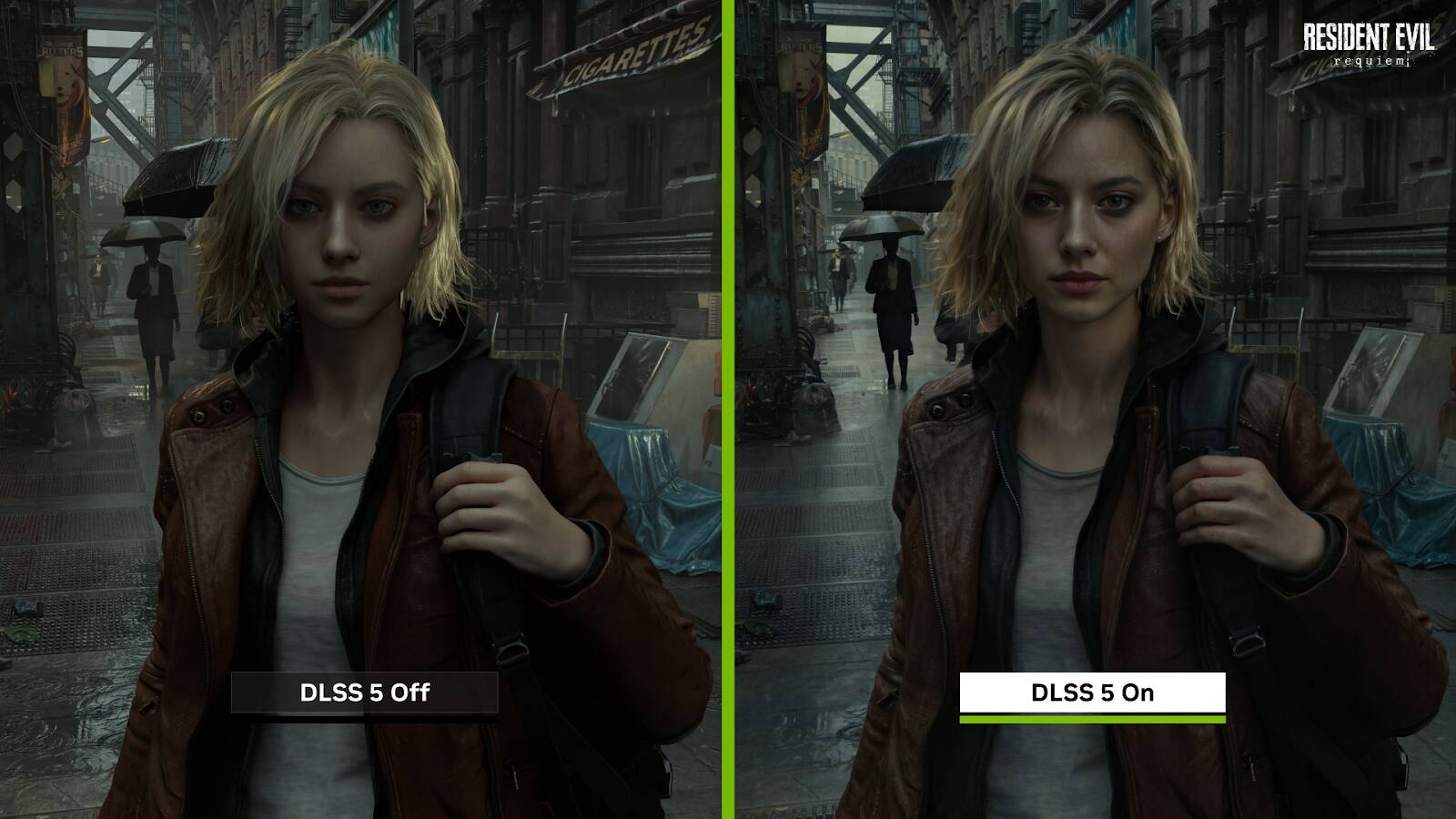
💡DLSS 5's AI fixes uncanny valley in games – must-read for graphics AI devs.
⚡ 30-Second TL;DR
What Changed
DLSS 5 enhances human faces in games to movie-realistic quality
Why It Matters
DLSS 5 could transform game development by enabling photorealism on consumer GPUs, reducing compute needs via AI. AI graphics practitioners gain a powerful tool for immersive experiences, potentially influencing non-gaming visuals.
What To Do Next
Test DLSS 5 beta in supported Nvidia RTX games for AI upscaling benchmarks.
Key Points
- •DLSS 5 enhances human faces in games to movie-realistic quality
- •Addresses uncanny valley issues like lifeless eyes and smooth skin
- •Latest AI image upscaler from Nvidia, teased at GTC
- •Brings characters 'stepped out of a movie screen'
🧠 Deep Insight
Background and context from public sources — not the original article. 6 sources cited.
🔑 Enhanced Key Takeaways
- •DLSS 5 is positioned as Nvidia's most significant graphics breakthrough since real-time ray tracing in 2018, with Jensen Huang calling it 'the GPT moment for graphics'—marking a fundamental shift from performance optimization to AI-driven visual synthesis[4][5]
- •The technology uses a real-time neural rendering model trained on scene semantics (characters, hair, fabric, skin) to generate temporally stable, frame-to-frame consistent outputs—unlike generative AI models that produce unpredictable results[2][4]
- •DLSS 5 will launch in Fall 2026 exclusively for RTX 50-series GPUs, with major publishers including Ubisoft, Bethesda, Capcom, Tencent, and Warner Bros. already committed to integration[4]
- •The technology operates on minimal inputs (color and motion vectors per frame) and scales computationally with resolution, enabling up to 4K real-time rendering while preserving original game geometry, textures, and artistic intent[2][5]
- •Demonstrated implementations show dramatic improvements in subsurface scattering on skin, fabric sheen, and light-material interactions across titles including Resident Evil Requiem, Hogwarts Legacy, Assassin's Creed Shadows, and Starfield[2]
📊 Competitor Analysis▸ Show
| Feature | DLSS 5 | AMD FSR 4.5 | Intel XeSS | Notes |
|---|---|---|---|---|
| Technology Type | AI Neural Rendering | Spatial Upscaling | Spatial Upscaling | DLSS 5 focuses on lighting/materials, not frame rate |
| Real-time Capability | Yes, up to 4K | Yes | Yes | DLSS 5 unique in semantic scene understanding |
| GPU Support | RTX 50-series (Fall 2026) | RDNA 2+ | Arc GPUs | DLSS 5 single-GPU only at launch |
| Market Preference | 50% of PC gamers prefer DLSS 4.5 over FSR | Declining share | Minimal adoption | DLSS maintains dominance[4] |
🛠️ Technical Deep Dive
- •Input pipeline: Accepts game engine color data and motion vectors per frame; no additional geometry or texture preprocessing required[5]
- •Neural model training: End-to-end trained on billions of surfaces and light sources to recognize scene semantics including front-lit, back-lit, and overcast environmental conditions[5]
- •Output characteristics: Generates temporally stable, frame-to-frame consistent imagery anchored to source 3D content; handles subsurface scattering, fabric sheen, and complex light-material interactions[5]
- •Integration method: Plugs into game engines via Nvidia Streamline framework (same as existing DLSS and Reflex technologies); provides developer controls for intensity, color grading, and masking[6]
- •Rendering compatibility: Works with standard rasterized games, ray-traced titles, and path-traced experiences; higher fidelity input yields better material response and shading[2]
- •Computational scaling: Cost scales with resolution; designed for single-GPU operation at launch with scalability characteristics still under evaluation[2]
🔮 Future ImplicationsAI analysis grounded in cited sources
⏳ Timeline
📎 Sources (6)
Factual claims are grounded in the sources below. Forward-looking analysis is AI-generated interpretation.
- neowin.net — Nvidia Unveils Dlss 5 Calls It the Gpt Moment for Graphics
- digitalfoundry.net — Nvidias New Dlss 5 Brings Photo Realistic Lighting to Rtx 50 Series
- tomsguide.com — Nvidia Gtc 2026 Live
- Tom's Hardware — Nvidia Debuts Dlss 5 for Increased Visual Fidelity in Games AI Infused Tech Transforms Pixels with Photorealistic Lighting and Materials
- nvidianews.nvidia.com — Nvidia Dlss 5 Delivers AI Powered Breakthrough in Visual Fidelity for Games
- NVIDIA — Dlss5 Breakthrough in Visual Fidelity for Games
Weekly AI Recap
Read this week's curated digest of top AI events →
👉Related Updates
AI-curated news aggregator. All content rights belong to original publishers.
Original source: The Register - AI/ML ↗
This is a summary, not the original. Read the source, or get the weekly briefing.
Weekly AI briefing
One email a week. Unsubscribe anytime.