🐯虎嗅•Stalecollected in 10m
Nvidia China AI Share Drops to Zero
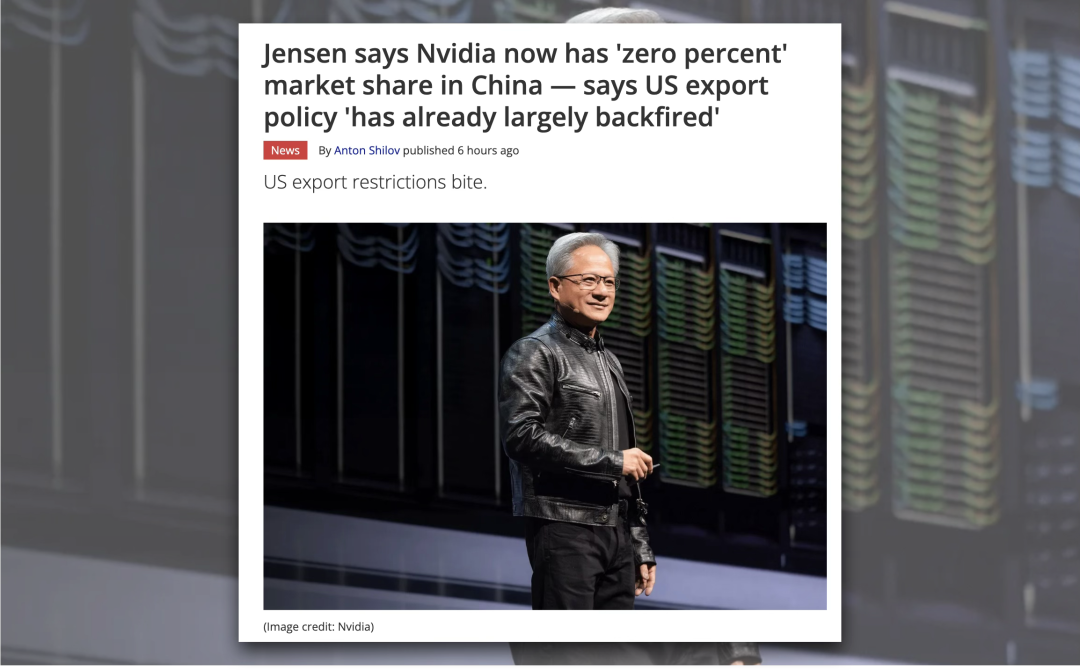
💡Nvidia loses China AI market; Huawei clusters rival GB200—geopolitical shift for infra builders.
⚡ 30-Second TL;DR
What Changed
Nvidia China high-end AI chip share from 95% to 0% by 2026
Why It Matters
US chip bans accelerated China's self-reliant AI infrastructure, reducing Nvidia dominance and forcing global AI practitioners to consider alternatives like Huawei for cost-effective scaling amid geopolitical risks.
What To Do Next
Benchmark Huawei Ascend 910C clusters against Nvidia GB200 for your next large-scale training job.
Who should care:Enterprise & Security Teams
Key Points
- •Nvidia China high-end AI chip share from 95% to 0% by 2026
- •US bans prompted China shift to domestic: Huawei CANN, Cambricon, Moore Threads
- •Huawei CM384 cluster: 384x Ascend 910C, 300 PFLOPS BF16, beats Nvidia NVL72 in compute/memory
- •DeepSeek V4 migrates to Huawei chips, breaking CUDA dependency
- •Chinese AI chip firms market cap hits 1.3T RMB
🧠 Deep Insight
AI-generated analysis for this event.
🔑 Enhanced Key Takeaways
- •The transition away from Nvidia has forced a massive architectural pivot in Chinese data centers, moving from proprietary CUDA-based stacks to heterogeneous computing environments utilizing the Ascend-CANN (Compute Architecture for Neural Networks) framework.
- •US export controls have triggered a 'sovereignty premium' in the Chinese market, where state-backed enterprises are prioritizing domestic silicon regardless of short-term performance parity, effectively insulating local firms from global market price fluctuations.
- •The shift has catalyzed the development of high-speed interconnect technologies within China, specifically the 'Ascend-Link' protocol, which is now being optimized to match the throughput of Nvidia's NVLink for large-scale cluster training.
📊 Competitor Analysis▸ Show
| Feature | Nvidia NVL72 (GB200) | Huawei Ascend 910C Cluster |
|---|---|---|
| Interconnect | NVLink Switch System | Ascend-Link |
| Software Stack | CUDA | CANN |
| Peak BF16 (Cluster) | ~1.4 Exaflops | ~1.2 Exaflops (est.) |
| Memory Bandwidth | 8 TB/s per node | 7.2 TB/s per node |
🛠️ Technical Deep Dive
- •Huawei Ascend 910C utilizes a 5nm process node, optimized for high-density matrix multiplication operations common in Transformer-based LLMs.
- •The CANN (Compute Architecture for Neural Networks) framework acts as a hardware abstraction layer, allowing models like DeepSeek V4 to execute without direct CUDA calls by mapping operations to Ascend-specific TBE (Tensor Boost Engine) kernels.
- •The CM384 cluster architecture employs a hierarchical topology, utilizing a custom RDMA-over-Converged-Ethernet (RoCE) implementation to minimize latency across the 384-node fabric.
🔮 Future ImplicationsAI analysis grounded in cited sources
Nvidia will permanently lose its dominant position in the Chinese AI infrastructure market.
The deep integration of the CANN software ecosystem into Chinese enterprise workflows creates a high switching cost that makes a return to Nvidia hardware unlikely even if export bans were lifted.
Chinese AI chip firms will achieve parity in training efficiency with Nvidia by 2027.
The rapid iteration cycle of the Ascend series, combined with massive state-led R&D investment, is closing the software-hardware optimization gap faster than historical industry benchmarks.
⏳ Timeline
2022-10
US Bureau of Industry and Security (BIS) implements initial high-end AI chip export restrictions.
2023-10
US updates export controls, further restricting Nvidia's A800 and H800 chips from the Chinese market.
2024-08
Huawei begins large-scale deployment of the Ascend 910C to major Chinese cloud providers.
2025-03
DeepSeek announces full migration of its training infrastructure to domestic Ascend clusters.
2026-02
Nvidia reports China revenue share dropping to near-zero levels in quarterly earnings call.
📰
Weekly AI Recap
Read this week's curated digest of top AI events →
👉Related Updates


AI-curated news aggregator. All content rights belong to original publishers.
Original source: 虎嗅 ↗