Nvidia CEO: National security overrides commercial interests
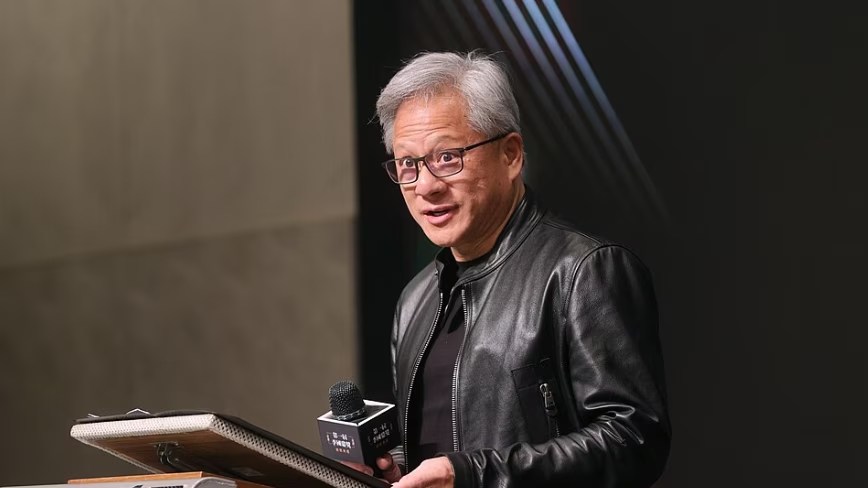
Nvidia's stance on export controls clarifies the future of global AI hardware access and compliance risks.
30-Second TL;DR
What Changed
Nvidia will prioritize US national security regulations over sales.
Why It Matters
Stricter adherence to export controls may force AI developers in restricted regions to rely on domestic alternatives or cloud-based access to compute.
What To Do Next
Review your supply chain and cloud provider's regional compliance policies to ensure your AI infrastructure remains resilient to export control shifts.
Key Points
- •Nvidia will prioritize US national security regulations over sales.
- •Jensen Huang dismissed chip smuggling as a non-viable strategy for AI development.
- •The company remains committed to compliance with export controls.
Deep Insight
AI-generated analysis for this event — not the original article.
Enhanced Key Takeaways
- •Nvidia has faced significant revenue pressure in the Chinese market due to the U.S. Department of Commerce's tightening of export controls on high-end AI accelerators like the H100 and A100.
- •The company developed 'China-specific' variants, such as the H20, designed to comply with U.S. performance density regulations while maintaining some market presence.
- •Jensen Huang's stance aligns with the 'Small Yard, High Fence' strategy adopted by U.S. policymakers to restrict China's access to advanced semiconductor manufacturing equipment and AI compute.
- •Nvidia has increased its lobbying efforts in Washington to balance compliance with the need to maintain a competitive edge in global markets without alienating key stakeholders.
- •The smuggling of chips often involves complex networks using shell companies and intermediaries, which Nvidia actively monitors and reports to U.S. authorities to mitigate legal risks.
Competitor Analysis
- Nvidia (H20/H100)
- CUDA Ecosystem/AI Training
- AMD (MI300X)
- High-Memory Capacity/Inference
- Intel (Gaudi 3)
- Cost-Efficiency/Open Standards
- Nvidia (H20/H100)
- Compliance-focused variants
- AMD (MI300X)
- Limited by U.S. Export Controls
- Intel (Gaudi 3)
- Compliance-focused variants
- Nvidia (H20/H100)
- Dominant (Market Leader)
- AMD (MI300X)
- Strong Challenger
- Intel (Gaudi 3)
- Emerging Alternative
| Feature | Nvidia (H20/H100) | AMD (MI300X) | Intel (Gaudi 3) |
|---|---|---|---|
| Primary Focus | CUDA Ecosystem/AI Training | High-Memory Capacity/Inference | Cost-Efficiency/Open Standards |
| China Strategy | Compliance-focused variants | Limited by U.S. Export Controls | Compliance-focused variants |
| Market Position | Dominant (Market Leader) | Strong Challenger | Emerging Alternative |
Technical Deep Dive
- Nvidia's compliance strategy involves reducing the Total Processing Performance (TPP) and performance density of chips to fall below U.S. regulatory thresholds.
- The H20 accelerator utilizes a modified architecture that significantly lowers interconnect bandwidth compared to the H100, limiting its effectiveness in massive cluster training.
- Export-compliant chips often rely on software-level optimizations within the CUDA stack to maintain usability for inference tasks despite hardware limitations.
- Smuggled chips often lack access to official Nvidia driver updates, firmware support, and the proprietary software ecosystem, rendering them less efficient for large-scale AI model deployment.
Future ImplicationsAI analysis grounded in cited sources
Timeline
- 2022-09U.S. government restricts Nvidia from exporting A100 and H100 chips to China.
- 2023-10U.S. updates export controls, further tightening performance thresholds for AI chips.
- 2024-01Nvidia begins production of the H20 chip, specifically designed to comply with U.S. export rules.
- 2025-05Nvidia reports continued compliance efforts amid evolving geopolitical trade tensions.
Weekly AI Recap
Read this week's curated digest of top AI events →
Related Updates


AI-curated news aggregator. All content rights belong to original publishers.
Original source: The Next Web (TNW) ↗
This is a summary, not the original. Read the source, or get the weekly briefing.
The weekly digest
One email a week. Unsubscribe anytime.