Nvidia BlueField-4 STX Fixes AI Agent Storage Bottleneck
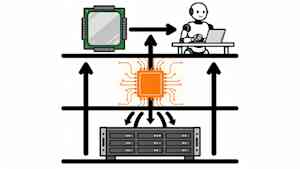
💡5x faster KV cache for agents—fixes storage bottleneck in long-context inference.
⚡ 30-Second TL;DR
What Changed
Inserts context memory layer between GPUs and storage for KV cache
Why It Matters
Closes throughput gap for multi-step AI agents, enabling persistent context without GPU stalls. Storage vendors can now build AI-native systems, boosting Nvidia ecosystem.
What To Do Next
Download DOCA Memo reference software to prototype STX context caching in your storage stack.
Key Points
- •Inserts context memory layer between GPUs and storage for KV cache
- •5x token throughput, 4x energy efficiency, 2x data ingestion speed
- •BlueField-4 processor with Vera CPU and ConnectX-9 SuperNIC; includes DOCA Memo software
🧠 Deep Insight
Background and context from public sources — not the original article. 9 sources cited.
🔑 Enhanced Key Takeaways
- •BlueField-4 STX is the first rack-scale implementation of NVIDIA's modular storage architecture, with the NVIDIA CMX context memory storage platform serving as the initial deployment vehicle for enterprises and cloud providers[1][2].
- •Early adopters spanning diverse infrastructure providers—CoreWeave, Crusoe, IREN, Lambda, Mistral AI, Nebius, Oracle Cloud Infrastructure, and Vultr—have committed to deploying STX, indicating broad industry validation across cloud, AI, and edge computing segments[1][2].
- •The BlueField-4 processor integrates a 64-core Grace CPU with ConnectX-9 SuperNIC supporting 800G networking and 126 billion transistors, enabling hardware-accelerated offloading of data integrity, encryption, and KV cache management with PCIe Gen6 capability expected for 2026 availability[3][9].
- •STX addresses a fundamental infrastructure gap: traditional data centers lack real-time responsiveness for agentic AI workflows that require continuous access to massive context windows and working memory across multiple reasoning steps, tools, and sessions[2].
- •The architecture achieves 4x energy efficiency versus traditional CPU storage and 2x faster data ingestion rates for enterprise AI workloads, with availability targeted for H2 2026 through partner platforms[1][4].
🛠️ Technical Deep Dive
- •BlueField-4 Processor Specifications: 64-core Grace CPU (Arm Neoverse V2 architecture), ConnectX-9 SuperNIC with 800Gbps networking, 126 billion transistors, PCIe Gen6 capable, manages NVMe SSDs and offloads data integrity/encryption for KV cache[3][9]
- •CMX Context Memory Platform: Extends GPU memory with high-performance context layer, delivers up to 5x tokens per second versus traditional storage, enables high-bandwidth shared KV cache layer optimized for LLM and agentic AI workflows[1][2][6]
- •STX Architecture Stack: Vera Rubin platform acceleration, Spectrum-X Ethernet networking, DOCA software framework, NVIDIA AI Enterprise software, NVIDIA ConnectX-9 SuperNIC integration for seamless GPU memory extension across POD[1][2][5]
- •Performance Metrics: 5x token throughput improvement, 4x energy efficiency gain over CPU architectures, 2x faster data ingestion (pages per second), optimized for long-context reasoning and multi-turn agent inference[1][2][4]
- •KV Cache Optimization: STX provides persistent context storage for multi-turn AI agents, enables high-speed sharing across node clusters, boosts KV cache capacity, and improves responsiveness while supporting efficient scaling of long-context inference[7]
🔮 Future ImplicationsAI analysis grounded in cited sources
⏳ Timeline
📎 Sources (9)
Factual claims are grounded in the sources below. Forward-looking analysis is AI-generated interpretation.
- barchart.com — Nvidia Launches Bluefield 4 Stx Storage Architecture with Broad Industry Adoption
- nvidianews.nvidia.com — Nvidia Launches Bluefield 4 Stx Storage Architecture with Broad Industry Adoption
- servethehome.com — Nvidia Bluefield 4 with 64 Arm Cores and 800g Networking Announced for 2026
- stocktitan.net — Nvidia Launches Blue Field 4 Stx Storage Architecture with Broad Vavwn0je9pm8
- nvidianews.nvidia.com — Nvidia Vera Rubin Platform
- NVIDIA — Cmx
- investor.nvidia.com — Default
- nvidianews.nvidia.com — Space Computing
- naddod.com — Nvidia Bluefield 4 Dpu Powers Gigascale AI Factories
Weekly AI Recap
Read this week's curated digest of top AI events →
👉Related Updates


AI-curated news aggregator. All content rights belong to original publishers.
Original source: VentureBeat ↗
This is a summary, not the original. Read the source, or get the weekly briefing.
Weekly AI briefing
One email a week. Unsubscribe anytime.