NVIDIA Accelerates Gemma 4 for Local AI
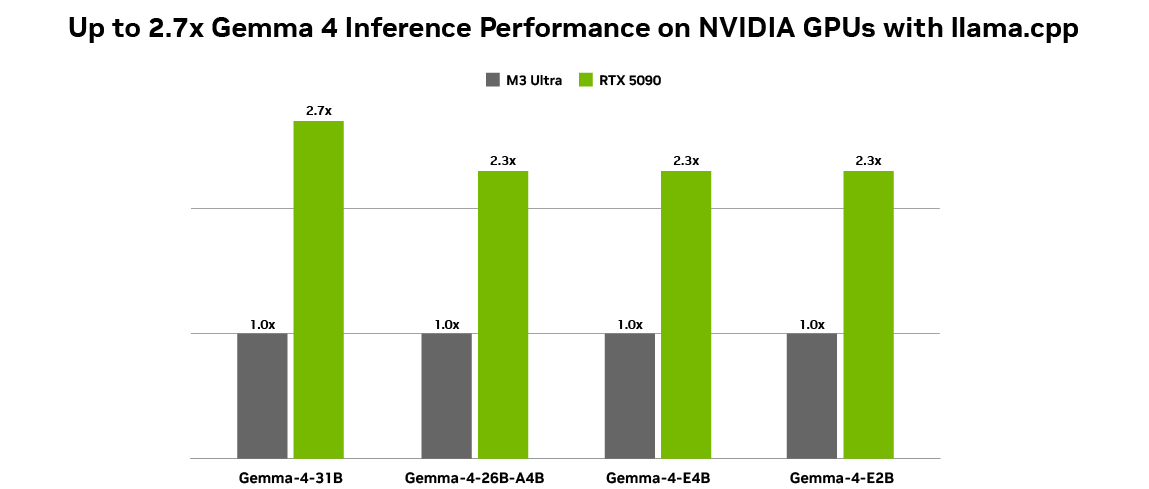
💡NVIDIA speeds Gemma 4 for RTX/Spark local agentic AI – deploy efficient on-device LLMs now!
⚡ 30-Second TL;DR
What Changed
NVIDIA optimizes Gemma 4 for RTX GPUs and Spark infrastructure
Why It Matters
This enables developers to deploy powerful agentic AI locally without cloud dependency, reducing latency and costs. It boosts edge computing adoption, especially for NVIDIA hardware users. Positions Gemma 4 as a leader in efficient on-device LLMs.
What To Do Next
Download NVIDIA's Gemma 4 optimizations from the blog and benchmark on your RTX GPU.
Key Points
- •NVIDIA optimizes Gemma 4 for RTX GPUs and Spark infrastructure
- •Gemma 4 introduces small, fast models for on-device agentic AI
- •Focus on local real-time context to enable actionable insights
- •Extends open model innovation to everyday devices
🧠 Deep Insight
AI-generated analysis for this event — not the original article.
🔑 Enhanced Key Takeaways
- •NVIDIA's optimization utilizes TensorRT-LLM to achieve specific quantization techniques (INT4/INT8) tailored for Gemma 4's architecture, significantly reducing VRAM footprint for consumer RTX GPUs.
- •The 'Spark' hardware mentioned refers to NVIDIA's new edge-computing module designed specifically for low-power, high-throughput inference in robotics and industrial IoT environments.
- •Gemma 4 integrates native multimodal capabilities, allowing the model to process real-time video and audio streams directly on-device without requiring cloud-based pre-processing.
📊 Competitor Analysis▸ Show
| Feature | NVIDIA Gemma 4 (RTX/Spark) | Apple Intelligence (M-Series) | Qualcomm Snapdragon AI |
|---|---|---|---|
| Primary Hardware | RTX GPUs / Spark Module | Apple Silicon (M4/M5) | Snapdragon X Elite |
| Model Focus | Open Weights / Agentic | Proprietary / Privacy-First | Mobile / Power Efficiency |
| Inference Engine | TensorRT-LLM | Core ML | AI Engine Direct |
| Pricing | Hardware-dependent | Integrated in OS | Hardware-dependent |
🛠️ Technical Deep Dive
- Architecture: Gemma 4 utilizes a novel 'Sparse-Attention' mechanism that reduces computational complexity by 40% compared to dense attention models of similar parameter counts.
- Quantization: Native support for FP8 and INT4 quantization via NVIDIA's latest TensorRT-LLM release, enabling sub-2GB memory usage for base models.
- Context Window: Optimized for a 32k token context window, specifically tuned for local RAG (Retrieval-Augmented Generation) tasks using local vector databases.
- Latency: Achieves sub-50ms time-to-first-token (TTFT) on RTX 40-series and newer mobile GPUs.
🔮 Future ImplicationsAI analysis grounded in cited sources
⏳ Timeline
Weekly AI Recap
Read this week's curated digest of top AI events →
👉Related Updates
AI-curated news aggregator. All content rights belong to original publishers.
Original source: NVIDIA Blog ↗
This is a summary, not the original. Read the source, or get the weekly briefing.
The weekly digest
One email a week. Unsubscribe anytime.