NPO, CPO, XPO Vie for Data Center Control
💡Data center shift to optics efficiency critical for scaling AI compute clusters.
⚡ 30-Second TL;DR
What Changed
AI clusters shift focus to network efficiency over raw compute
Why It Matters
Winners could slash AI training latency and costs, reshaping data center builds for hyperscalers. Laggards risk obsolescence in AI infrastructure race.
What To Do Next
Benchmark CPO vs XPO throughput in your next AI cluster network simulation.
Key Points
- •AI clusters shift focus to network efficiency over raw compute
- •NPO, CPO, XPO emerge as contenders for data center optics leadership
- •Competition centers on high-speed interconnects for AI scaling
🧠 Deep Insight
AI-generated analysis for this event — not the original article.
🔑 Enhanced Key Takeaways
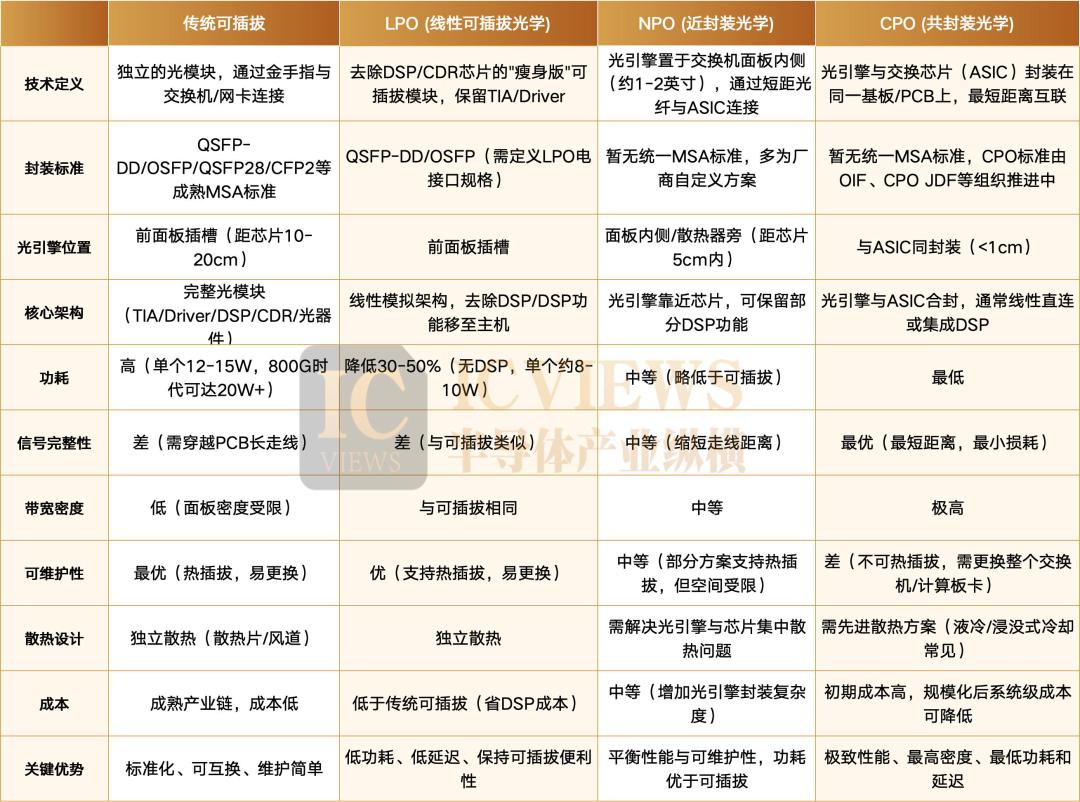
- •NPO (Near-Packaged Optics) serves as a bridge technology, placing optical engines on the same substrate as the ASIC but outside the package, offering a balance between thermal management and signal integrity compared to CPO.
- •CPO (Co-Packaged Optics) integrates the optical engine directly inside the switch or GPU package, significantly reducing power consumption per bit by eliminating the need for long electrical traces to the front-panel pluggable transceivers.
- •XPO (often referring to eXternal or Cross-connect Pluggable Optics) represents an emerging modular approach that aims to decouple the laser source from the optical engine to improve reliability and simplify field maintenance in high-density AI clusters.
📊 Competitor Analysis▸ Show
| Feature | NPO (Near-Packaged) | CPO (Co-Packaged) | XPO (External/Pluggable) |
|---|---|---|---|
| Integration Level | Substrate-level (external to package) | Die-level (inside package) | Modular/External |
| Thermal Management | Moderate (easier than CPO) | Challenging (high density) | Best (decoupled) |
| Power Efficiency | High | Highest | Moderate |
| Serviceability | Moderate | Low (requires module swap) | High (field replaceable) |
🛠️ Technical Deep Dive
- •NPO utilizes high-density electrical interconnects (e.g., organic substrates) to connect the ASIC to the optical engine, typically within a 10-20mm distance.
- •CPO architectures rely on silicon photonics integration, often using 3D packaging techniques like TSVs (Through-Silicon Vias) to connect the optical die directly to the compute die.
- •The primary technical bottleneck for CPO remains the 'laser-on-board' reliability issue, where high temperatures from the GPU/ASIC degrade laser performance, driving the industry toward XPO or remote laser source configurations.
- •Interconnect bandwidth density targets for these technologies are currently scaling toward 51.2 Tbps and 102.4 Tbps switch capacities to support massive GPU-to-GPU communication.
🔮 Future ImplicationsAI analysis grounded in cited sources
⏳ Timeline
Weekly AI Recap
Read this week's curated digest of top AI events →
👉Related Updates
AI-curated news aggregator. All content rights belong to original publishers.
Original source: 钛媒体 ↗
This is a summary, not the original. Read the source, or get the weekly briefing.
Weekly AI briefing
One email a week. Unsubscribe anytime.