NIO's Q1 2026 Earnings: Profitability and New Product Pipeline
💡NIO's strategy to maintain margins via high-end SUV product mix during an industry downturn is a key market signal.
⚡ 30-Second TL;DR
What Changed
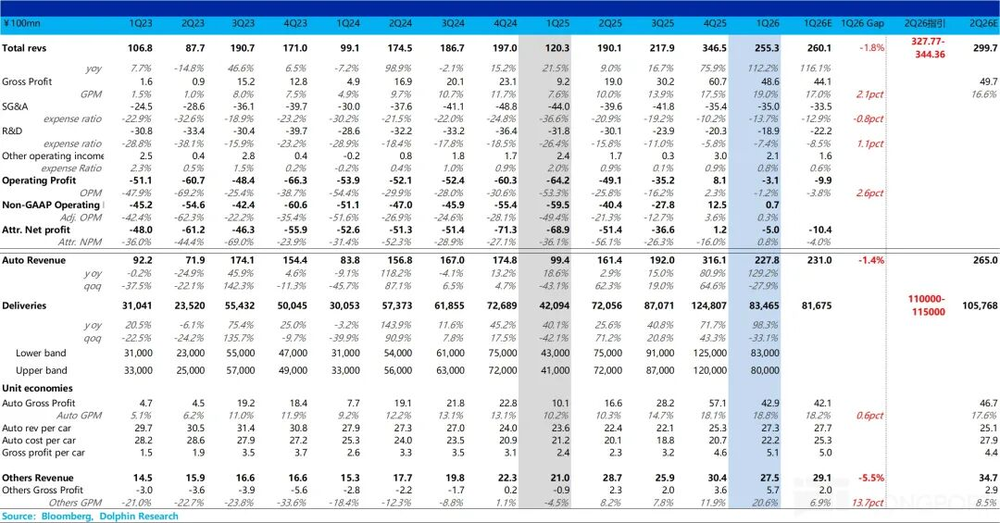
Q1 2026 revenue reached 25.5 billion RMB, with a strong 18.8% vehicle margin.
Why It Matters
NIO's ability to maintain high margins through product mix optimization despite industry-wide cost pressures serves as a case study for EV manufacturers. The success of the ES9 will be critical for the company's valuation re-rating.
What To Do Next
Monitor the monthly delivery data of the ES9 to validate if high-end SUV demand can offset rising raw material costs in the EV sector.
Key Points
- •Q1 2026 revenue reached 25.5 billion RMB, with a strong 18.8% vehicle margin.
- •Strategic shift toward high-end SUVs (ES9, ES7) to optimize product mix and maintain margins.
- •Q2 2026 guidance projects 110k-115k deliveries, driven by new model launches.
- •Commitment to Non-GAAP profitability in 2026 through strict R&D and SG&A cost control.
🧠 Deep Insight
Web-grounded analysis with 33 cited sources.
🔑 Enhanced Key Takeaways
- •NIO's Q1 2026 deliveries of 83,465 vehicles nearly doubled year-over-year, demonstrating the effectiveness of its multi-brand strategy across NIO, Onvo, and Firefly segments.
- •The company achieved a positive adjusted net profit (non-GAAP) of RMB 43.5 million in Q1 2026, marking a significant financial turning point attributed to stringent cost controls and an optimized product mix.
- •The flagship ES9 SUV, initially revealed in January 2026 and with pre-sales starting in April 2026, is designed to target business users and shares advanced technologies, including a 900V high-voltage architecture and steer-by-wire system, with the ET9 sedan.
- •NIO's sub-brand Onvo launched its L80 five-seat electric SUV on May 15, 2026, strategically priced to undercut Tesla's Model Y and built on the NT 3.0 platform with a 900-volt architecture, offering up to 2,840 liters of cargo space.
- •Cost optimization measures, including the implementation of a CBU (Core Business Unit) mechanism and substantial reductions in R&D and SG&A expenses (e.g., R&D expenses fell 44.3% year-over-year in Q4 2025), were crucial in achieving the Q1 2026 profitability.
📊 Competitor Analysis▸ Show
| Feature/Model | NIO ES9 | Onvo L80 | Tesla Model Y | Li Auto L9 |
|---|---|---|---|---|
| Category | Full-size Luxury EV SUV | Large 5-seat EV SUV | Mid-size EV SUV | Full-size EREV SUV |
| Pricing (RMB) | 528,000 - 658,000 (pre-sale) | 242,800 - 279,800 (launch) | ~260,000 - 368,900 (China pricing, estimated based on L80 undercutting) | ~459,800 (2024 model, for context) |
| Platform | NT 3.0, 900V architecture | NT 3.0, 900V architecture | Tesla platform | Li Auto platform |
| Battery (kWh) | 102 kWh NMC (CLTC range 600-620 km) | Expected 85 kWh (CLTC range 605 km for L90, comparable for L80) | Various, e.g., 60 kWh to 80 kWh for Model Y | EREV (range extender electric vehicle) |
| 0-100 km/h | 4.3 seconds | RWD: 5.9s, AWD: 4.7s | 3.7 - 6.9 seconds | 5.3 seconds |
| Key Features | Steer-by-wire, active suspension, rear-wheel steering, executive lounge interior, 15.6" AMOLED screen, 48" thin screen, 42-point massage seats | Largest 5-seat SUV cargo space in China (2,840L), dual-track smart driving (vision-only or LiDAR+NX9031 chip), battery swap compatible | Autopilot, Supercharging network, minimalist interior | Extended Range Electric Vehicle, large screens, family-focused features |
| Target Market | High-end luxury, business users | Mainstream family replacement demand | Premium-to-mass EV transition | Premium family SUV segment |
🛠️ Technical Deep Dive
- NT 3.0 Platform & 900V Architecture: The NIO ES9 and Onvo L80 are built on NIO's NT 3.0 platform and feature a 900-volt high-voltage architecture, enabling ultra-fast 600 kW charging, capable of adding 255 km of range in just 5 minutes for the ES9.
- Autonomous Driving Systems:
- Aquila Super Sensing: Features 33 high-performance sensing units, including 11 high-resolution cameras (8-megapixel), 1 ultralong-range high-resolution LiDAR, 5 millimeter-wave radars, 12 ultrasonic sensors, and 2 high-precision positioning units (V2X and ADMS). It generates 8 gigabytes of data per second.
- Adam Super Computing: Utilizes four NVIDIA DRIVE Orin SoCs, providing a total computing power of 1,016 TOPS.
- Shenji NX9031 Chip: NIO's in-house developed 5 nm automotive-grade AI chip, first used in the ET9 sedan (March 2025), with performance comparable to four Nvidia Orin-X processors. It has 32 Cortex-A78AE and Cortex-A65AE cores.
- Dual-track strategy for Onvo L80: Entry Pro trim uses a pure-vision system with an Nvidia Orin-X chip, while Max+ and Ultra+ trims deploy the Shenji NX9031 chip with LiDAR and 30 sensors.
- Battery Swap Technology: NIO's third-generation swap stations can change a battery in about four minutes. The fourth-generation Power Swap Station 4.0, operational since June 2024, supports automated battery swaps for multiple brands and models, accommodates 23 batteries, and can perform up to 480 swaps per day.
- SkyOS: NIO's AI-powered full-domain operating system for smart EVs, based on a 1+4+N architecture covering intelligent driving, smart cabin, and vehicle control.
- AI Smart Chassis: Connects intelligent chassis, assisted and intelligent driving, and digital cockpit to detect road bumps in advance for a more comfortable ride.
🔮 Future ImplicationsAI analysis grounded in cited sources
⏳ Timeline
📎 Sources (33)
Factual claims are grounded in the sources below. Forward-looking analysis is AI-generated interpretation.
- tipranks.com
- investing.com
- stocktitan.net
- wikipedia.org
- youtube.com
- carnewschina.com
- globalchinaev.com
- electrek.co
- carnewschina.com
- gasgoo.com
- gasgoo.com
- zacks.com
- electroiq.com
- youtube.com
- cnevpost.com
- gasgoo.com
- matrixbcg.com
- wikipedia.org
- nio.com
- nio.com
- autovistagroup.com
- motion-mag.com
- insead.edu
- nio.com
- shs-conferences.org
- nio.com
- nio.com
- youtube.com
- businessmodelcanvastemplate.com
- seekingalpha.com
- alphaquery.com
- cnevpost.com
- alphaspread.com
Weekly AI Recap
Read this week's curated digest of top AI events →
👉Related Updates


AI-curated news aggregator. All content rights belong to original publishers.
Original source: 虎嗅 ↗