New High-Resolution X-ray View of M87* Black Hole
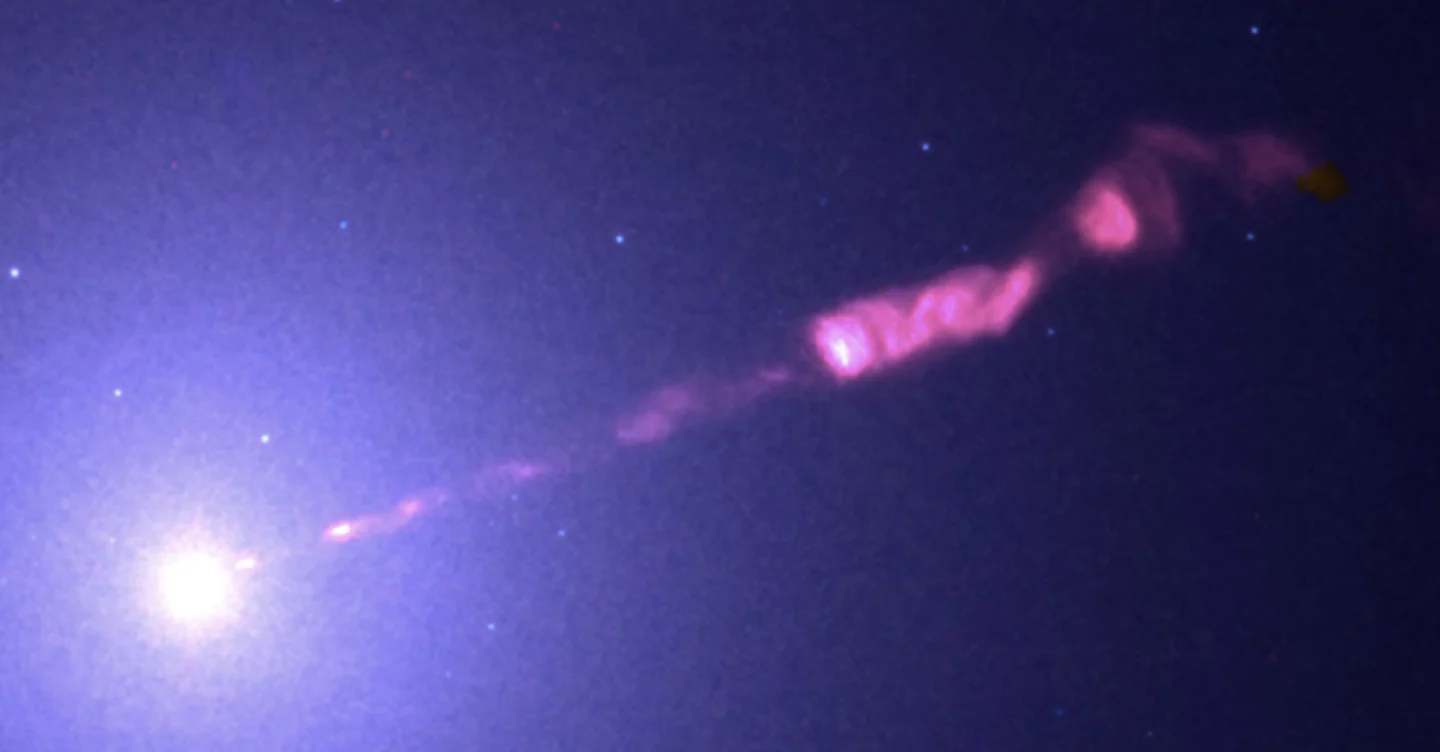
💡See how advanced imaging and data processing are unlocking secrets of the universe.
⚡ 30-Second TL;DR
What Changed
Collaboration between international astronomers and NASA
Why It Matters
High-fidelity astronomical data processing often pushes the boundaries of AI-based image reconstruction and signal processing algorithms.
What To Do Next
Explore the open datasets from Chandra to practice applying super-resolution AI models on scientific imagery.
Key Points
- •Collaboration between international astronomers and NASA
- •Highest resolution X-ray imaging of M87* jet to date
- •Advances understanding of black hole plasma dynamics
🧠 Deep Insight
AI-generated analysis for this event — not the original article.
🔑 Enhanced Key Takeaways
- •The new observations utilize Chandra's Advanced CCD Imaging Spectrometer (ACIS) to map the high-energy particle acceleration zones within the jet, which extends over 5,000 light-years.
- •Data integration techniques combined Chandra's X-ray data with radio observations from the Very Large Array (VLA) to correlate magnetic field structures with particle emission sites.
- •The study provides evidence for 'in-situ' particle acceleration, suggesting that magnetic reconnection events within the jet, rather than just the initial launch, sustain the high-energy emission.
- •Researchers identified specific 'knots' in the jet structure where shock waves compress the plasma, significantly increasing X-ray luminosity compared to surrounding regions.
- •This imaging campaign helps resolve the 'cooling problem' in M87, explaining how the jet prevents the surrounding hot gas from cooling and forming stars at rates predicted by standard models.
🛠️ Technical Deep Dive
- Instrument: Chandra X-ray Observatory Advanced CCD Imaging Spectrometer (ACIS).
- Angular Resolution: Approximately 0.5 arcseconds, allowing for the separation of jet features previously blurred in lower-resolution surveys.
- Spectral Range: 0.3 to 10 keV, targeting synchrotron radiation emitted by ultra-relativistic electrons.
- Data Processing: Multi-wavelength image registration using sub-pixel event repositioning (SER) to enhance spatial fidelity beyond the standard pixel scale.
🔮 Future ImplicationsAI analysis grounded in cited sources
⏳ Timeline
Weekly AI Recap
Read this week's curated digest of top AI events →
👉Related Updates



AI-curated news aggregator. All content rights belong to original publishers.
Original source: cnBeta (Full RSS) ↗
This is a summary, not the original. Read the source, or get the weekly briefing.
Weekly AI briefing
One email a week. Unsubscribe anytime.