New Framework for Measuring Gravitational Waves in Expanding Universe
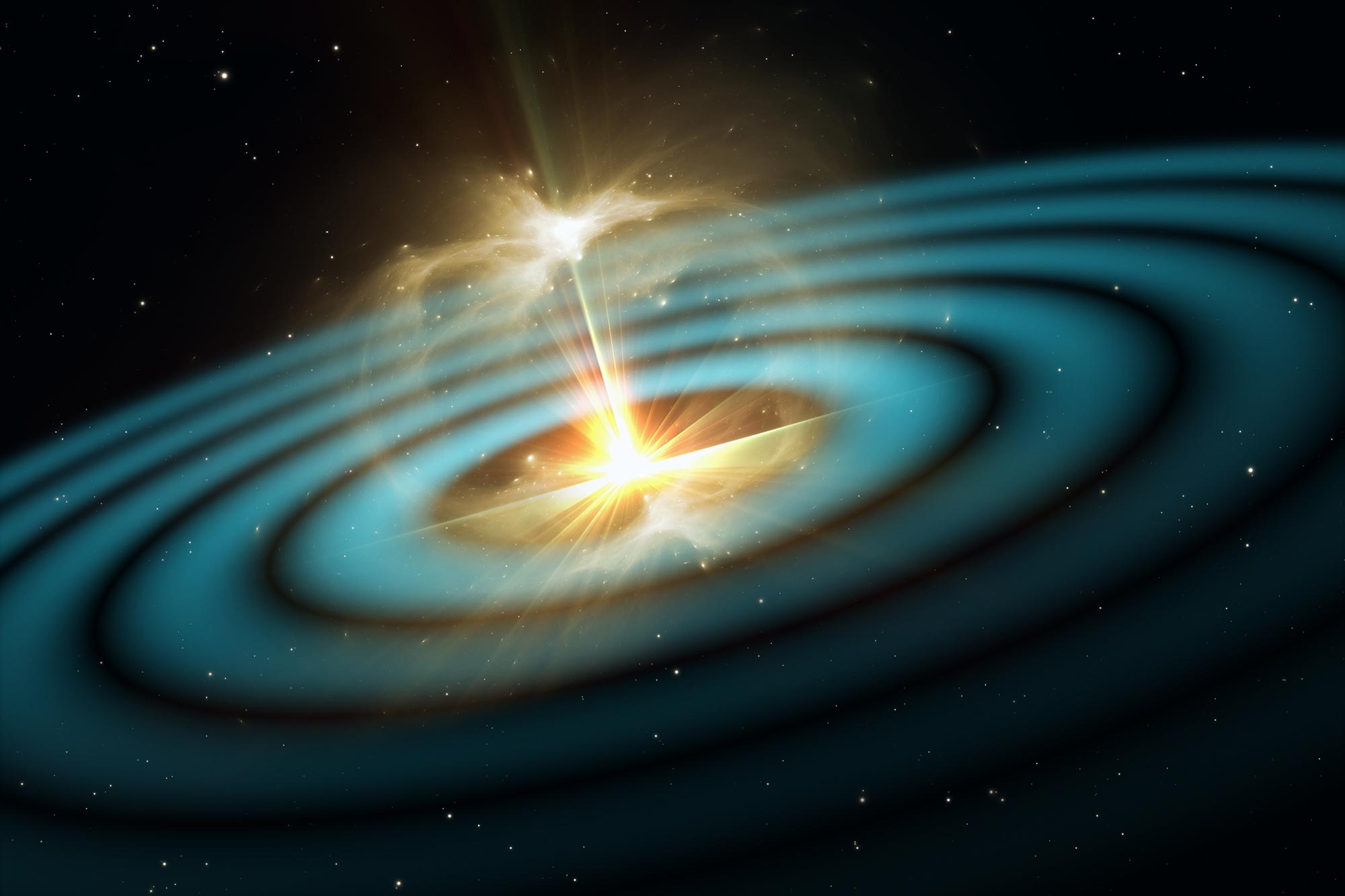
💡A breakthrough in theoretical physics that refines how we process complex, dynamic signal data in space.
⚡ 30-Second TL;DR
What Changed
Developed a detector-based theoretical framework for gravitational waves
Why It Matters
This framework could improve the accuracy of data processing for large-scale physics simulations, which are increasingly relevant to AI-driven scientific discovery.
What To Do Next
If you are working on physics-informed neural networks (PINNs), review how this framework handles non-static spacetime metrics.
Key Points
- •Developed a detector-based theoretical framework for gravitational waves
- •Accounts for the expansion of the universe in signal measurement
- •Enhances precision for future cosmological observation missions
🧠 Deep Insight
Background and context from public sources — not the original article. 3 sources cited.
🔑 Enhanced Key Takeaways
- •The framework addresses the challenge of distinguishing gravitational wave signals from the dynamic, expanding background of the universe, where matter distribution and density fluctuations constantly influence spacetime.
- •It models a realistic experimental setup using two freely falling test masses, such as atomic clocks, connected by a light beam, to define what a gravitational wave detector actually measures.
- •The theoretical advancement provides a coordinate-independent derivation of observable quantities, including effects up to second order in cosmic fluctuations, ensuring that predictions are not artifacts of mathematical descriptions.
- •This new approach aims to establish a common language for theorists and experimentalists, bridging the gap between abstract gravitational field components and actual detector recordings.
- •The framework is particularly relevant for guiding the search for primordial gravitational waves and has direct implications for future missions like the Laser Interferometer Space Antenna (LISA) and pulsar timing arrays.
🛠️ Technical Deep Dive
- The framework is 'detector-based,' meaning it focuses on the measurable quantities a real experiment would record, rather than abstract mathematical definitions of gravitational fields.
- It models a system of two freely falling test masses (e.g., atomic clocks) connected by a light beam.
- The core measurement involves detecting changes in the travel time or frequency of light between these test masses caused by a passing gravitational wave.
- The observable quantities are derived in a coordinate-independent manner, ensuring that the results are physical and not dependent on the chosen mathematical coordinate system.
- The derivation includes effects up to second order in cosmic fluctuations, allowing for precise calculations within an expanding spacetime.
- In the limit of 'quiet spacetime,' the framework reproduces the familiar signals measured by existing ground-based interferometers.
🔮 Future ImplicationsAI analysis grounded in cited sources
⏳ Timeline
📎 Sources (3)
Factual claims are grounded in the sources below. Forward-looking analysis is AI-generated interpretation.
Weekly AI Recap
Read this week's curated digest of top AI events →
👉Related Updates
AI-curated news aggregator. All content rights belong to original publishers.
Original source: cnBeta (Full RSS) ↗
This is a summary, not the original. Read the source, or get the weekly briefing.
The weekly digest
One email a week. Unsubscribe anytime.