Navy Factory Prints Drones and 1,000+ Spares
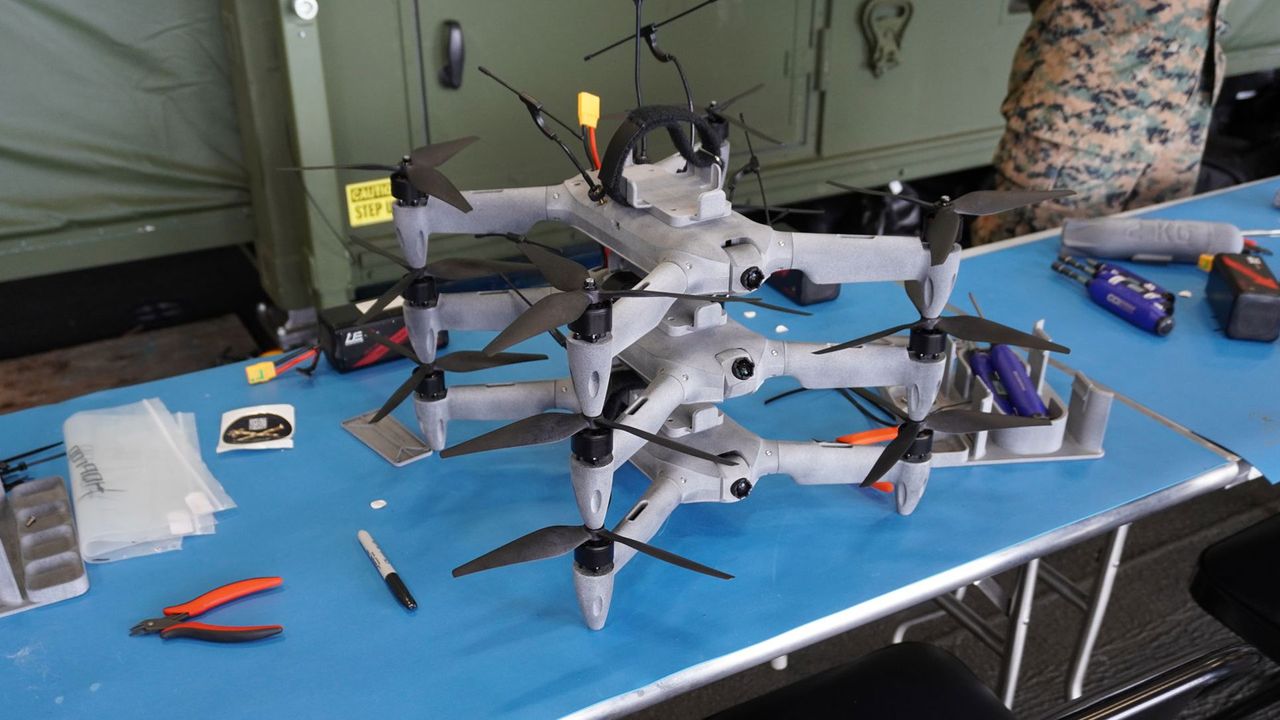
💡A carrier-based factory proved drones and critical hardware can be produced at sea.
⚡ 30-Second TL;DR
What Changed
The onboard factory fabricated a dozen flight-ready drones.
Why It Matters
This demonstrates how additive manufacturing can reduce logistics dependencies for autonomous systems and military robotics. Similar containerized production models could support remote AI hardware deployments where replacement parts and drones must be produced locally.
What To Do Next
Audit your edge-AI hardware bill of materials and identify which replacement parts could be produced through containerized additive manufacturing.
Key Points
- •The onboard factory fabricated a dozen flight-ready drones.
- •More than 1,000 parts were produced, including Apache helicopter spares.
- •Production continued aboard the carrier despite rough seas and 12-foot waves.
- •The FPV drones reportedly reached speeds of 80 mph.
🧠 Deep Insight
AI-generated analysis for this event.
🔑 Enhanced Key Takeaways
- •The initiative is part of the U.S. Navy's 'Print the Fleet' program, which aims to reduce reliance on complex, long-lead-time supply chains by leveraging additive manufacturing at sea.
- •The containerized factory utilized a combination of Fused Deposition Modeling (FDM) and other industrial-grade 3D printing technologies capable of handling high-performance polymers and composite materials.
- •The project specifically addressed the 'tyranny of distance' in the Indo-Pacific theater, demonstrating that critical maintenance can be performed forward-deployed rather than returning to a land-based port.
- •The 1,000+ parts produced included non-structural components, seals, and specialized brackets, which were validated for airworthiness and operational use by onboard engineering teams.
- •The deployment of the containerized factory was supported by the Naval Postgraduate School's Consortium for Additive Manufacturing Research, which provided the technical oversight for the onboard printing operations.
🛠️ Technical Deep Dive
- The containerized system utilizes ruggedized, vibration-dampened 3D printers designed to maintain print precision despite the pitch and roll of a vessel in 12-foot seas.
- The FPV drones were manufactured using carbon-fiber-reinforced filaments to achieve the necessary strength-to-weight ratio for 80-mph flight performance.
- The factory employs a digital twin workflow, where CAD files are transmitted via secure satellite links to the ship, allowing for on-demand design updates or emergency part creation.
- Material inventory management is handled through a specialized software suite that tracks print success rates, material fatigue, and structural integrity data for every part produced.
🔮 Future ImplicationsAI analysis grounded in cited sources
⏳ Timeline
Weekly AI Recap
Read this week's curated digest of top AI events →
👉Related Updates




AI-curated news aggregator. All content rights belong to original publishers.
Original source: Tom's Hardware ↗