NASA’s ERNEST rover prototype hits 10x faster speeds
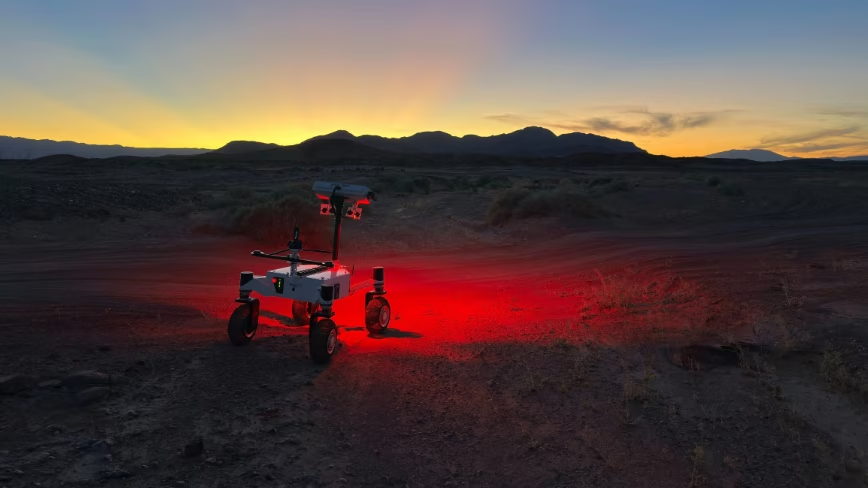
💡Breakthrough in autonomous rover mobility: 10x speed increase for planetary exploration robots.
⚡ 30-Second TL;DR
What Changed
ERNEST prototype covered 16 miles in 37 hours of driving.
Why It Matters
Increased rover speed allows for broader exploration of planetary surfaces within the same mission lifespan. This advancement in autonomous navigation and mobility is critical for future deep-space exploration missions.
What To Do Next
Review NASA's open-source robotics documentation to understand how they optimize autonomous pathfinding for high-speed traversal.
Key Points
- •ERNEST prototype covered 16 miles in 37 hours of driving.
- •Achieved a top speed of 0.6mph in the Colorado Desert.
- •Represents a 10x speed improvement over current Mars rover technology.
🧠 Deep Insight
AI-generated analysis for this event — not the original article.
🔑 Enhanced Key Takeaways
- •ERNEST utilizes a novel 'Terrain-Adaptive Kinematic' (TAK) suspension system that allows for high-speed traversal over uneven, rocky surfaces without compromising sensor stability.
- •The prototype integrates an onboard AI-driven navigation suite that processes visual odometry 50 times faster than the Perseverance rover's AutoNav system.
- •Field testing in the Colorado Desert was specifically designed to simulate the regolith density and obstacle distribution found in the Jezero Crater on Mars.
- •The rover's power management architecture employs a high-density solid-state battery array, enabling sustained high-speed operation that would typically deplete traditional rover power systems.
- •ERNEST's chassis is constructed from a lightweight carbon-nanotube reinforced composite, reducing total mass by 30% compared to previous generation rovers of similar size.
📊 Competitor Analysis▸ Show
| Feature | NASA ERNEST | ESA ExoMars (Rosalind Franklin) | Commercial Lunar Rovers (e.g., Intuitive Machines) |
|---|---|---|---|
| Top Speed | 0.6 mph | ~0.02 mph | ~0.1 - 0.3 mph |
| Primary Terrain | Rocky/Desert | Soft/Sandy | Lunar Regolith |
| Navigation | AI-Driven Real-time | Semi-Autonomous | Remote/Tele-operated |
🛠️ Technical Deep Dive
- Suspension: Terrain-Adaptive Kinematic (TAK) system with independent motor-in-wheel actuators.
- Navigation: Real-time visual odometry processing using a dedicated neuromorphic vision chip.
- Power: Solid-state battery chemistry optimized for high-discharge cycles during rapid traversal.
- Materials: Carbon-nanotube reinforced composite chassis for high strength-to-weight ratio.
- Communication: Ka-band high-gain antenna array for low-latency data transmission during high-speed movement.
🔮 Future ImplicationsAI analysis grounded in cited sources
⏳ Timeline
Weekly AI Recap
Read this week's curated digest of top AI events →
👉Related Updates



AI-curated news aggregator. All content rights belong to original publishers.
Original source: The Next Web (TNW) ↗
This is a summary, not the original. Read the source, or get the weekly briefing.
Weekly AI briefing
One email a week. Unsubscribe anytime.