MyClaw Launches Managed OpenClaw Agent
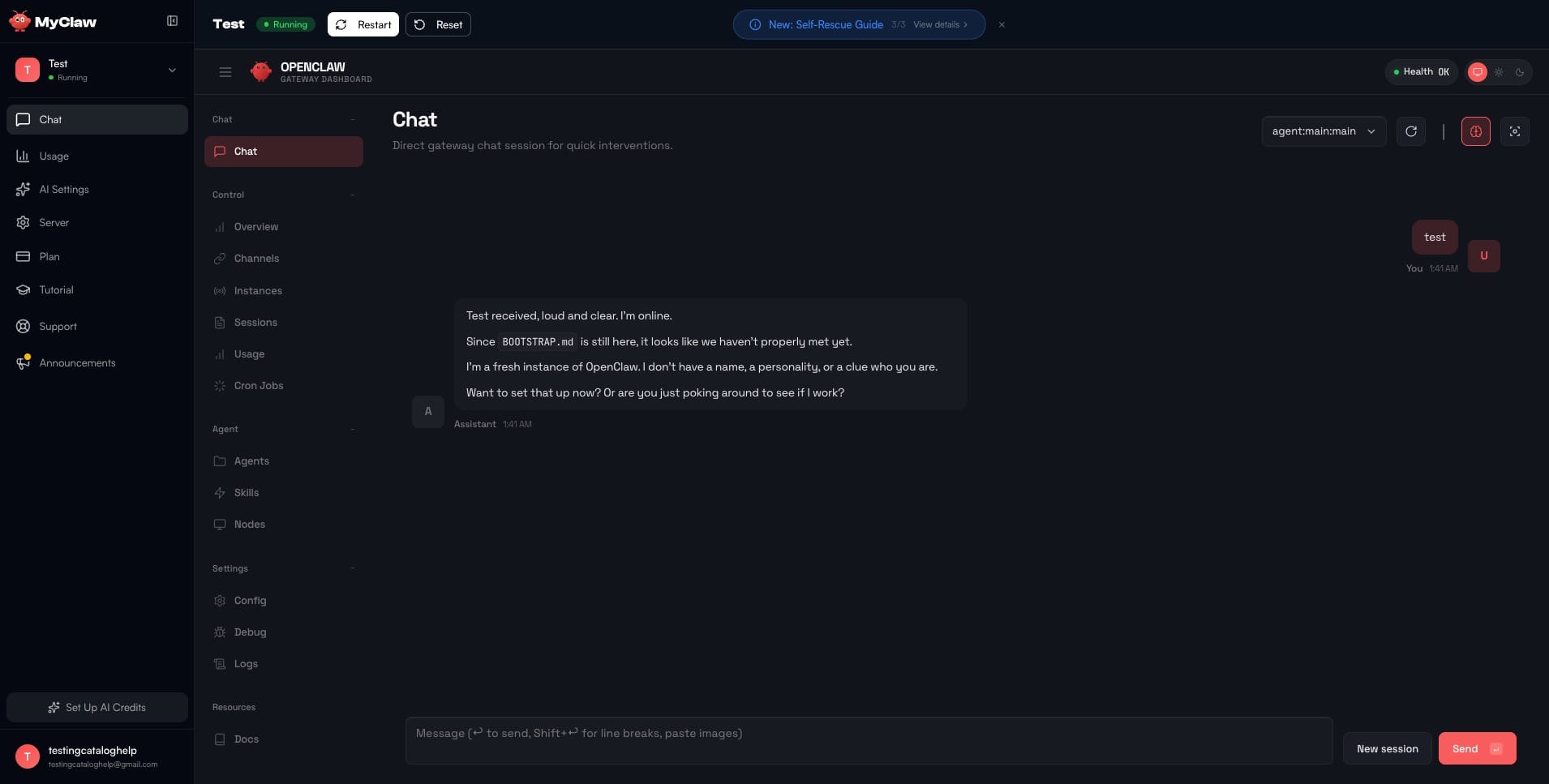
💡Managed cloud OpenClaw agent: instant 24/7 personal AI, no setup needed (78 chars)
⚡ 30-Second TL;DR
What Changed
MyClaw introduces cloud-managed OpenClaw agent
Why It Matters
This launch simplifies access to OpenClaw AI for users by removing infrastructure management, potentially accelerating adoption among developers and businesses needing reliable AI agents.
What To Do Next
Sign up at MyClaw to deploy your always-on OpenClaw agent instantly.
Key Points
- •MyClaw introduces cloud-managed OpenClaw agent
- •Always-on availability 24/7
- •Instantly ready for personal use
- •Fully managed service eliminates setup
- •Hosted entirely in the cloud
🧠 Deep Insight
Background and context from public sources — not the original article. 6 sources cited.
🔑 Enhanced Key Takeaways
- •MyClaw provides managed cloud hosting for OpenClaw, eliminating operational friction through automated updates, security management, and scaling[1]
- •OpenClaw is an open-source, self-hosted autonomous AI agent that executes real-world tasks across messaging platforms (WhatsApp, Telegram, Discord, Slack, Signal, iMessage) with persistent memory and context[2][4]
- •MyClaw's service model emphasizes always-on availability with no downtime, daily backups, encrypted access, and isolated container infrastructure for each instance[1]
- •OpenClaw supports extensive integrations including workflow automation, code/dev tools, browser control, file management, smart home control (Home Assistant), and APIs across Slack, Discord, GitHub, and databases[1]
- •The platform features a modular skills system with hundreds of community-built extensions available through ClawHub registry, enabling customization without coding[3]
📊 Competitor Analysis▸ Show
| Aspect | MyClaw (OpenClaw) | Traditional AI Assistants | Self-Hosted Alternatives |
|---|---|---|---|
| Deployment | Managed cloud (24/7) | Cloud-based SaaS | User-managed infrastructure |
| Data Privacy | Encrypted, isolated containers | Third-party servers | Full user control |
| Setup Friction | Minimal (plan selection) | Account creation | High (Docker, VPS setup) |
| Customization | Modular skills system | Limited | Extensive but complex |
| Real-world Actions | Browser control, file access, system commands | Limited to API calls | Full system access |
| Messaging Integration | Native multi-platform support | Limited or API-dependent | Configurable |
| Cost Model | Compute-based tiering | Per-message or subscription | Infrastructure costs only |
🛠️ Technical Deep Dive
• OpenClaw architecture: Local-first Gateway design maintaining control and execution on user infrastructure, with optional cloud management via MyClaw[2][4] • AI Model Flexibility: Supports multiple providers including Anthropic Claude (Opus 4.5), OpenAI, and local models[5] • Browser Automation: Integrates Chrome Developer Tools and Playwright MCP (Model Context Protocol) for web automation, form filling, and session persistence[5] • Persistent Memory System: Maintains long-term context across sessions with memory transfer capabilities between agents (Codex, Cursor, Manus)[4] • Security Implementation: DM pairing, allowlists, optional per-session sandboxing, and encrypted access controls[2] • Multi-channel Gateway: Supports WhatsApp, Telegram, Discord, Slack, Signal, iMessage, and WebChat with group chat capability[2][4] • Skills Framework: Modular plugin system with bundled, managed, and workspace-specific extensions; agents can write their own skills[4] • Deployment Options: Cross-platform support (Mac, Windows, Linux) with CLI, desktop, and mobile node configurations[2] • Multi-agent Routing: Session isolation and workspace segmentation for handling multiple use cases simultaneously[2]
🔮 Future ImplicationsAI analysis grounded in cited sources
OpenClaw and MyClaw represent a paradigm shift toward decentralized, user-controlled AI infrastructure that could disrupt traditional SaaS models[4]. The combination of self-hosting flexibility with managed cloud options positions this technology as a potential operating system-level standard for personal AI[6]. The modular skills ecosystem and persistent memory capabilities enable autonomous workflows that extend beyond reactive chatbots, potentially automating significant portions of knowledge work. The emphasis on data ownership and on-premises execution addresses growing privacy concerns, while the hackable, extensible architecture could enable rapid innovation cycles compared to closed-source competitors. Industry observers suggest this model could fundamentally reshape how organizations approach AI deployment and integration[4].
⏳ Timeline
📎 Sources (6)
Factual claims are grounded in the sources below. Forward-looking analysis is AI-generated interpretation.
Weekly AI Recap
Read this week's curated digest of top AI events →
👉Related Updates
AI-curated news aggregator. All content rights belong to original publishers.
Original source: TestingCatalog ↗
This is a summary, not the original. Read the source, or get the weekly briefing.
Weekly AI briefing
One email a week. Unsubscribe anytime.