💰钛媒体•Stalecollected in 4h
Musk's tech ecosystem outpaces G7 economic output
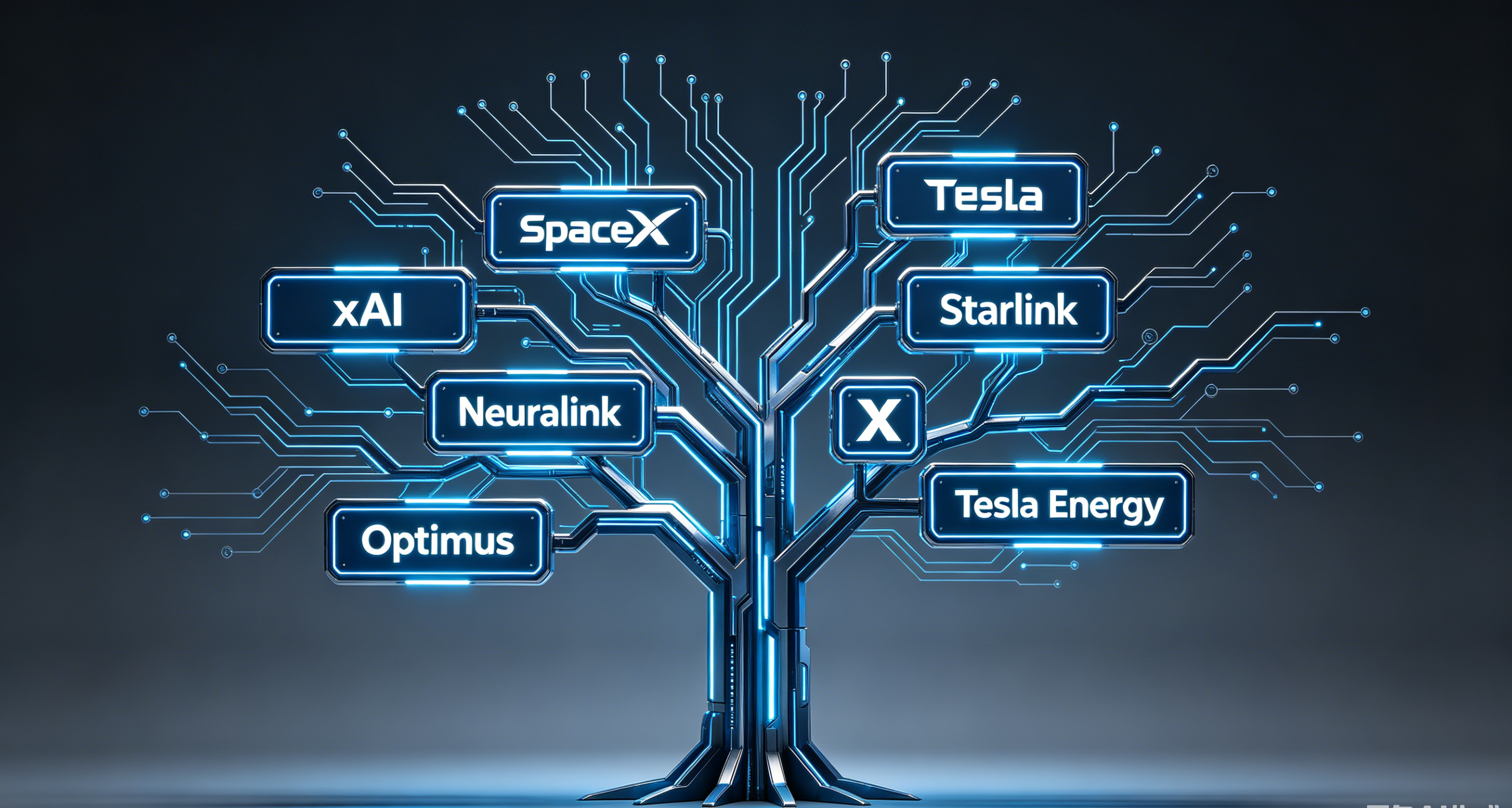
💡See how Musk's massive compute and robotics strategy is reshaping the global AI landscape.
⚡ 30-Second TL;DR
What Changed
Musk's ventures demonstrate unprecedented scale in tech development
Why It Matters
This highlights the growing power of private tech conglomerates in shaping global infrastructure and AI development.
What To Do Next
Monitor xAI's Grok API and Tesla's FSD data releases to understand the trajectory of their integrated AI-robotics stack.
Who should care:Founders & Product Leaders
Key Points
- •Musk's ventures demonstrate unprecedented scale in tech development
- •The iterative 'game-like' approach to R&D accelerates innovation
- •Comparison of corporate valuation against national GDP metrics
🧠 Deep Insight
Web-grounded analysis with 23 cited sources.
🔑 Enhanced Key Takeaways
- •Elon Musk's ventures, particularly SpaceX and Tesla, are described as creating entire ecosystems of production, driving demand for new supply chains (e.g., batteries, software, charging infrastructure, components for satellites), and generating millions of jobs, leading to an "explosion in the global economy" through a multiplier effect.
- •SpaceX's valuation alone is approaching the trillion-dollar mark, especially after the xAI merger in February 2026, with an IPO target of $1.75 trillion to $2 trillion, significantly contributing to the overall economic impact of Musk's ecosystem.
- •The recent merger of xAI with SpaceX at a $1.25 trillion valuation highlights a strategic pivot towards deep AI integration across the ecosystem, aiming to leverage AI infrastructure for Starlink, autonomous systems, and data centers, with Musk predicting an "explosion in the global economy" fueled by ubiquitous AI and robotics.
- •Musk's companies employ a vertically integrated model, which, while driving innovation, also presents challenges such as significant capital investment requirements for R&D and manufacturing, regulatory hurdles (e.g., FDA for Neuralink, NHTSA for Tesla FSD), and ongoing legal battles over labor practices and safety.
- •The iterative 'game-like' R&D approach is evident in the rapid development and testing cycles of Starship and the continuous, supervised public deployment of Tesla's FSD, which relies on millions of real-world driving clips for training its end-to-end neural network.
🛠️ Technical Deep Dive
- SpaceX Starship: A fully reusable transportation system, standing 120 meters tall (Starship spacecraft + Super Heavy booster) with a 9-meter diameter. It has a payload capacity of 100-150 metric tons to Low Earth Orbit (LEO) in a reusable configuration, and up to 250 metric tons expendable. The system is powered by Raptor engines (33 on Super Heavy, 6 on Starship upper stage) using liquid methane (CH4) and liquid oxygen (LOX) propellants. It features a large 1,000 cubic meter payload volume and is constructed from stainless steel.
- Tesla Full Self-Driving (FSD) (Supervised) v13: This system has transitioned from a rules-based approach to an end-to-end neural network that directly processes camera video input to output driving controls. It processes full-resolution camera video at approximately 36 frames per second on Hardware 4 vehicles and utilizes over four times the training data compared to FSD 12. Key technical advancements include a claimed 2x lower photon-to-control latency and a new "Cortex" cluster for increased back-end training compute. The system relies on eight cameras for 360-degree visibility, including main field of view, fisheye, and telephoto lenses, and employs an Occupancy Network for 3D environment perception and a Bird's Eye View (BEV) space representation.
- Neuralink N1 Implant: A small, hermetically sealed brain-computer interface device, measuring approximately 23mm by 8mm. It contains 128 flexible polyimide threads, each with 8 electrodes, totaling 1,024 recording sites (earlier versions had 64 threads). These threads are exceptionally thin, at 4-6 microns, and are inserted into the cerebral cortex by the R1 surgical robot. Custom Application-Specific Integrated Circuit (ASIC) chips within the implant process neural signals at up to 20 kHz per channel, compressing data up to 200 times for wireless Bluetooth transmission. The device is powered by an onboard battery that is inductively recharged.
🔮 Future ImplicationsAI analysis grounded in cited sources
Musk's ecosystem will continue to drive significant global economic restructuring.
His companies are actively creating new industries and supply chains (e.g., space economy, EV infrastructure, neurotechnology), forcing traditional sectors to adapt and shifting geopolitical economic power towards 'lithium/rare earth-technology' systems.
The integration of AI will accelerate the development and impact of Musk's ventures, potentially leading to unprecedented economic growth.
The xAI merger with SpaceX and Musk's statements at Davos 2026 indicate a strong focus on ubiquitous AI and robotics as a primary driver for an 'explosion in the global economy.'
Regulatory and ethical challenges will intensify as Musk's companies push technological boundaries.
Ongoing legal battles, FDA scrutiny for Neuralink, and safety concerns surrounding Tesla's FSD highlight the increasing regulatory and ethical complexities associated with his high-risk, rapid development approach.
⏳ Timeline
2003-07
Tesla Motors, Inc. incorporated.
2006
SpaceX launched its first Falcon 1 rocket.
2016
Neuralink and The Boring Company were founded.
2022-10
Elon Musk acquired Twitter for $44 billion, taking it private and later rebranding it to X.
2024-01
Neuralink successfully implanted its N1 device in its first human patient.
2026-02
xAI merged with SpaceX, forming a combined entity valued at approximately $1.25 trillion.
📎 Sources (23)
Factual claims are grounded in the sources below. Forward-looking analysis is AI-generated interpretation.
📰
Weekly AI Recap
Read this week's curated digest of top AI events →
👉Related Updates
AI-curated news aggregator. All content rights belong to original publishers.
Original source: 钛媒体 ↗