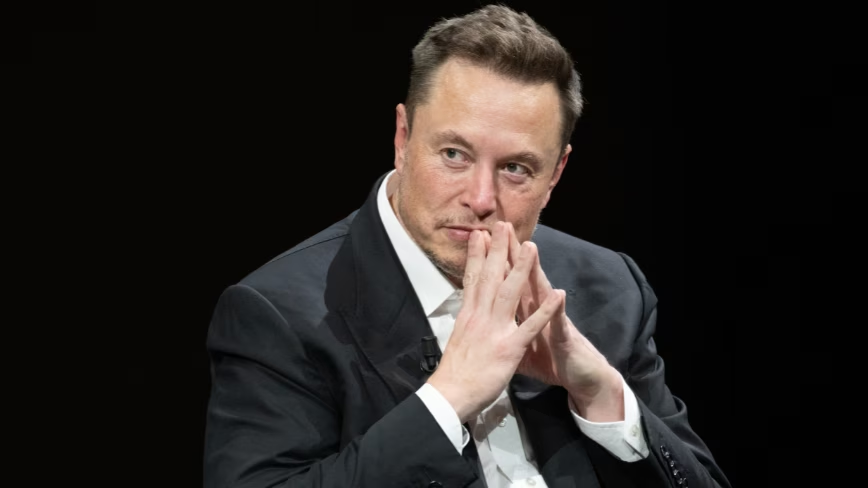
Musk projects $1tn annual revenue for SpaceX by 2030
💡Understand the scale of capital flowing into space infrastructure, a critical backbone for future global AI networks.
⚡ 30-Second TL;DR
What Changed
SpaceX recently completed the largest stock-market debut on record.
Why It Matters
This massive valuation signals a shift in capital allocation toward space-based AI and communication infrastructure. It suggests long-term stability for Starlink and related AI-driven satellite operations.
What To Do Next
Monitor SpaceX's Starlink API and satellite data availability as they scale infrastructure for global connectivity.
Key Points
- •SpaceX recently completed the largest stock-market debut on record.
- •Musk projects revenue to hit $1 trillion annually by 2030.
- •Growth is expected to accelerate further into 2031.
- •The valuation reflects high market confidence in space-based infrastructure.
🧠 Deep Insight
Background and context from public sources — not the original article. 29 sources cited.
🔑 Enhanced Key Takeaways
- •SpaceX's recent IPO was the largest in history, valuing the company at over $2 trillion, significantly surpassing initial estimates.
- •Elon Musk retains substantial control over SpaceX, holding 82.4% of the company's voting power following its public debut.
- •Starlink, SpaceX's satellite internet service, was the company's sole profitable segment in 2025, contributing $11.4 billion to its total revenue of $18.7 billion.
- •Wall Street analysts' projections for SpaceX's 2030 revenue, such as Morgan Stanley's $330 billion and Goldman Sachs' $474 billion, are considerably lower than Elon Musk's $1 trillion forecast.
📊 Competitor Analysis▸ Show
| Feature/Category | SpaceX | United Launch Alliance (ULA) | Arianespace | Rocket Lab | Blue Origin | Amazon (Project Kuiper) | AST SpaceMobile |
|---|---|---|---|---|---|---|---|
| Primary Services | Launch, Satellite Internet (Starlink), AI | Launch (Govt. contracts) | Launch (European Govt./Commercial) | Small/Medium-lift Launch | Heavy-lift Launch, Space Tourism | Satellite Internet | Space-based Cellular Broadband |
| Launch Cost (LEO) | $1,500–$2,720/kg (Falcon 9/Heavy) | $4,044/kg (Vulcan) | $9,167/kg (Ariane 5G) | $19,039/kg (Electron) | $60M–$90M/launch (New Glenn) | N/A | N/A |
| Reusability | Full booster reusability (Falcon 9/Heavy), Full (Starship goal) | Partial (future Vulcan updates) | None (Ariane 6) | Partial (Neutron in 2025) | Planned for New Glenn | N/A | N/A |
| Market Share (Launch) | >50% global launches (2024), 82% (2023-25 average) | Significant U.S. government contracts | Historically 30-40% (2014), declining | Leader for smallsats | Emerging, scaling to compete | N/A | N/A |
| Satellite Internet Speed | 45-280 Mbps (typical), up to 400 Mbps | N/A | N/A | N/A | N/A | Targeting comparable speeds | Developing cellular broadband |
| Satellite Internet Latency | ~25 ms (LEO) | N/A | N/A | N/A | N/A | Targeting low latency (LEO) | N/A |
| Satellite Internet Data | Unlimited (Standard), 2TB/month (Priority) | N/A | N/A | N/A | N/A | N/A | N/A |
| Satellite Internet Price (Monthly) | Starts $50-$55 (Residential), hardware $349 | N/A | N/A | N/A | N/A | N/A | N/A |
| Key Differentiators | Cost efficiency, high launch cadence, Starlink constellation, Starship development | Legacy government contracts, reliability | European sovereignty, GEO focus | Small/medium payload focus, Neutron development | Heavy-lift, space tourism, deep funding | Backed by Amazon, potential service bundling | Direct-to-cell service |
🛠️ Technical Deep Dive
- Starlink Satellites:
- Size & Weight: Approximately 2.8 meters in length, 1.4 meters in width, 0.2 meters in thickness, and weigh around 260 kilograms.
- Propulsion: Utilize krypton-powered ion thrusters for maneuvering and deorbiting, making Starlink the first argon-propelled spacecraft flown in space.
- Antennas: Feature a phased array antenna system for communication, using Ku-band for user links and Ka-band for gateway links.
- Inter-satellite Links: Equipped with three space lasers (Optical Intersatellite Links or ISLs) operating at up to 200 Gbps, forming a global internet mesh. These use near-infrared laser communications at approximately 1550 nm wavelength.
- Solar Panels: Each satellite has a single solar array that extends to about 8 meters in length once in orbit. Newer versions feature dual solar arrays.
- Orbit: Operate in Low Earth Orbit (LEO) at an altitude of about 550 km, significantly lower than traditional geostationary satellites, which reduces latency.
- V3 Starlink Satellites: Designed for Starship launch, these will offer 1 Tbps downlink and 160 Gbps uplink capacity, with nearly 4 Tbps of combined RF and laser backhaul capacity. Each V3 satellite weighs around 1900 kg, allowing 54 satellites per Starship launch.
- Starship Launch Vehicle:
- Configuration: A two-stage, fully reusable, super heavy-lift launch vehicle consisting of the Super Heavy first stage (booster) and the Starship second stage (ship).
- Engines: Powered by Raptor engines, which are methane-oxygen fueled. The Raptor 2 is a more powerful and efficient version, with Raptor 3 being the next-generation engine.
- Payload Capacity (LEO): Capable of carrying 100-150 tons in a fully reusable configuration and up to 250 tons when expendable. Block 3 and Block 4 versions are designed for 100 tons and 200 tons to LEO, respectively.
- Reusability: Designed for full and rapid reusability, with plans to catch both the Super Heavy booster and the Starship upper stage using tower arms at the launch site.
- Hot Staging: Implemented after initial test flights, where the second stage fires its engines before separating from the first stage, providing added thrust.
- Dimensions: Block 1 stands at 121.3 meters tall, with Block 4 projected to reach 142 meters.
- Development: As of May 27, 2026, Starship has undergone 12 launches with 7 successes and 5 failures across Block 1, Block 2, and Block 3 versions.
🔮 Future ImplicationsAI analysis grounded in cited sources
⏳ Timeline
📎 Sources (29)
Factual claims are grounded in the sources below. Forward-looking analysis is AI-generated interpretation.
- wikipedia.org
- jpost.com
- theguardian.com
- cbsnews.com
- forbes.com
- mitrade.com
- binance.com
- tradingkey.com
- sacra.com
- fool.com
- benzinga.com
- spacexstock.com
- uchicago.edu
- fool.com
- matrixbcg.com
- sphericalinsights.com
- starlink.com
- satelliteinternet.com
- quora.com
- starlink.com
- cnet.com
- installpros.io
- sprintwave.co.uk
- reddit.com
- wikipedia.org
- wikipedia.org
- spacex.com
- seekingalpha.com
- washingtonpost.com
Weekly AI Recap
Read this week's curated digest of top AI events →
👉Related Updates



AI-curated news aggregator. All content rights belong to original publishers.
Original source: The Next Web (TNW) ↗
This is a summary, not the original. Read the source, or get the weekly briefing.
Weekly AI briefing
One email a week. Unsubscribe anytime.