MiniMax and Zhipu AI valuation gap widens significantly
💡Understand the shifting market dynamics of China's top AI models to inform your infrastructure choices.
⚡ 30-Second TL;DR
What Changed
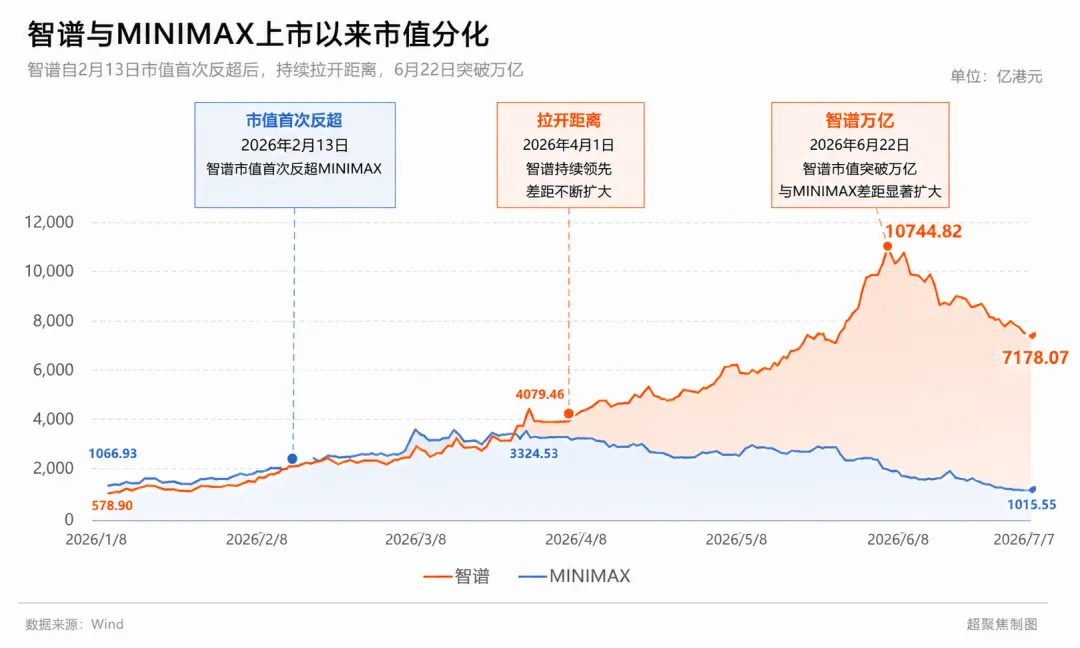
600 billion HKD valuation gap emerged in under 6 months
Why It Matters
The widening gap suggests a 'flight to quality' or specific platform preference among institutional investors in the Chinese AI market.
What To Do Next
Evaluate the API stability and ecosystem support of Zhipu AI vs MiniMax before committing to a long-term LLM provider.
Key Points
- •600 billion HKD valuation gap emerged in under 6 months
- •Investors are re-evaluating the potential of different AI paths
- •Highlights the volatility and high stakes of the LLM race
🧠 Deep Insight
AI-generated analysis for this event — not the original article.
🔑 Enhanced Key Takeaways
- •MiniMax has pivoted heavily toward multimodal agentic workflows, prioritizing real-time voice and video interaction capabilities over pure text-based LLM performance.
- •Zhipu AI's valuation surge is largely attributed to its 'GLM-4' ecosystem and its aggressive integration into enterprise-grade B2B infrastructure, securing major state-owned enterprise contracts.
- •The valuation divergence is exacerbated by MiniMax's recent expansion into international markets, specifically targeting Southeast Asian and North American developer ecosystems, which carries higher burn rates.
- •Investors are increasingly favoring Zhipu AI's 'model-as-a-service' (MaaS) platform stability compared to MiniMax's more experimental, consumer-facing product suite.
- •Regulatory scrutiny in China regarding data compliance for generative AI has impacted the two companies differently, with Zhipu AI's closer alignment with domestic research standards providing a perceived 'regulatory moat'.
📊 Competitor Analysis▸ Show
| Feature | MiniMax (abab series) | Zhipu AI (GLM series) | Moonshot AI (Kimi) |
|---|---|---|---|
| Core Focus | Multimodal/Agentic | Enterprise/MaaS | Long-context/Consumer |
| Pricing Model | Usage-based/Token | Tiered Enterprise/API | Token-based/Freemium |
| Key Benchmark | High-speed inference | Reasoning/Coding | Long-context retrieval |
🛠️ Technical Deep Dive
- MiniMax utilizes a proprietary Mixture-of-Experts (MoE) architecture optimized for low-latency multimodal token generation.
- Zhipu AI's GLM-4 employs a unique General Language Model architecture that integrates bidirectional and autoregressive attention mechanisms.
- Both companies have shifted toward sparse activation models to reduce computational overhead during inference.
- Implementation involves custom-built distributed training frameworks designed to bypass hardware limitations imposed by export controls.
🔮 Future ImplicationsAI analysis grounded in cited sources
⏳ Timeline
Weekly AI Recap
Read this week's curated digest of top AI events →
👉Related Updates



AI-curated news aggregator. All content rights belong to original publishers.
Original source: 钛媒体 ↗
This is a summary, not the original. Read the source, or get the weekly briefing.
The weekly digest
One email a week. Unsubscribe anytime.