Microsoft Phi-4 15B Self-Thinking Multimodal AI
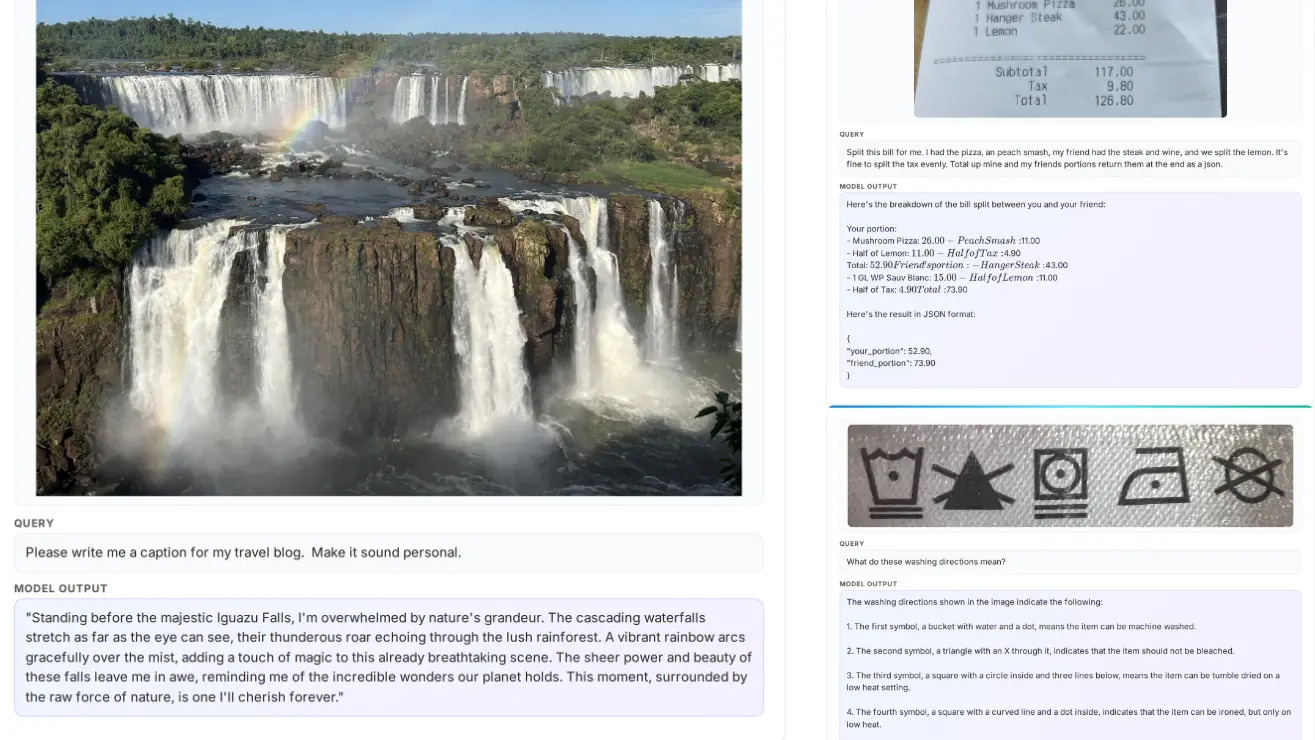
💡Open 15B multimodal that self-decides thinking—pioneers efficient reasoning for vision/math tasks.
⚡ 30-Second TL;DR
What Changed
Open-source 15B parameter multimodal model released by Microsoft
Why It Matters
This model lowers barriers for deploying advanced multimodal AI locally, enabling researchers and builders to experiment with efficient reasoning without massive compute. It challenges larger proprietary models in niche high-difficulty tasks.
What To Do Next
Download Phi-4 15B weights from Hugging Face and test on math-vision benchmarks like MMMU.
Key Points
- •Open-source 15B parameter multimodal model released by Microsoft
- •Autonomously decides reasoning depth for efficiency
- •Optimized for image description and UI element positioning
- •Handles complex mathematical reasoning tasks
🧠 Deep Insight
Background and context from public sources — not the original article. 8 sources cited.
🔑 Enhanced Key Takeaways
- •Phi-4-Reasoning-Vision-15B uses a mid-fusion architecture combining the Phi-4-Reasoning language model backbone with the SigLIP-2 vision encoder, enabling efficient multimodal processing with manageable training and inference costs[1][4].
- •The model employs dynamic resolution vision encoding with up to 3,600 visual tokens and bidirectional intra-image attention, specifically optimized for high-resolution tasks like GUI grounding and fine-grained document analysis[1].
- •Training utilized a carefully curated mixture of reasoning and non-reasoning data through Supervised Fine-Tuning, with data sources including bottom-up seed sites, multi-agent solvers, and validated trajectories for UI understanding and safety instruction-following[2].
- •The model demonstrates strong performance on mathematical and scientific reasoning benchmarks, with MathVista_MINI scoring 75.2 and AI2D_TEST scoring 84.8, while maintaining competitive general multimodal understanding capabilities[2][3].
📊 Competitor Analysis▸ Show
| Feature | Phi-4-Reasoning-Vision-15B | Comparable Models |
|---|---|---|
| Parameters | 15B (compact) | Typically 30B-70B+ |
| Vision Tokens | Up to 3,600 (dynamic resolution) | Variable |
| Reasoning Mode | Hybrid (selective chain-of-thought) | Typically always-on or always-off |
| Primary Strengths | Math reasoning, GUI grounding, OCR | General multimodal understanding |
| Inference Latency | Low (NoThink mode available) | Higher for reasoning-capable models |
| Training Efficiency | Trained with less compute than similar-sized VLMs | Higher compute requirements typical |
| MathVista_MINI Score | 75.2 | Competitive with larger models[2][3] |
🛠️ Technical Deep Dive
- Architecture: Mid-fusion design combining Phi-4-Reasoning language model backbone with SigLIP-2 vision encoder[1]
- Vision Processing: Dynamic resolution vision encoder converting images into visual tokens (up to 3,600 tokens) projected into language model embedding space[1]
- Attention Mechanism: Bidirectional attention applied within images (intra-image) to improve spatial reasoning without overfitting risks of broader bidirectional schemes[1]
- Reasoning Framework: Hybrid system using
<think>...</think>blocks for extended chain-of-thought reasoning on mathematical and scientific tasks, with<nothink>tags for direct inference on perception-focused tasks[1] - Training Data: Mixture of reasoning and non-reasoning data from bottom-up seed sites, multi-agent solvers, grounding datasets, UI understanding datasets, and safety/instruction-following datasets[2]
- Inference Optimization: Three thinking modes switchable at runtime to dynamically balance accuracy and latency[3]
🔮 Future ImplicationsAI analysis grounded in cited sources
⏳ Timeline
📎 Sources (8)
Factual claims are grounded in the sources below. Forward-looking analysis is AI-generated interpretation.
- Hugging Face — Phi 4 Reasoning Vision 15b
- ai.azure.com — Phi 4 Reasoning Vision 15b
- techcommunity.microsoft.com — 4499210
- Microsoft — Phi 4 Reasoning Vision and the Lessons of Training a Multimodal Reasoning Model
- startuphub.ai — Microsoft S Phi 4 Reasoning Vision 15b Compact AI Model
- GitHub — Phi 4 Vision
- neowin.net — Microsoft Releases Phi 4 15b an Open Weight AI Model That Chooses When to Think
- builds.modular.com — 15b
Weekly AI Recap
Read this week's curated digest of top AI events →
👉Related Updates

AI-curated news aggregator. All content rights belong to original publishers.
Original source: cnBeta (Full RSS) ↗
This is a summary, not the original. Read the source, or get the weekly briefing.
Weekly AI briefing
One email a week. Unsubscribe anytime.