Meta's TRIBE v2 Predicts Brain Reactions to Media
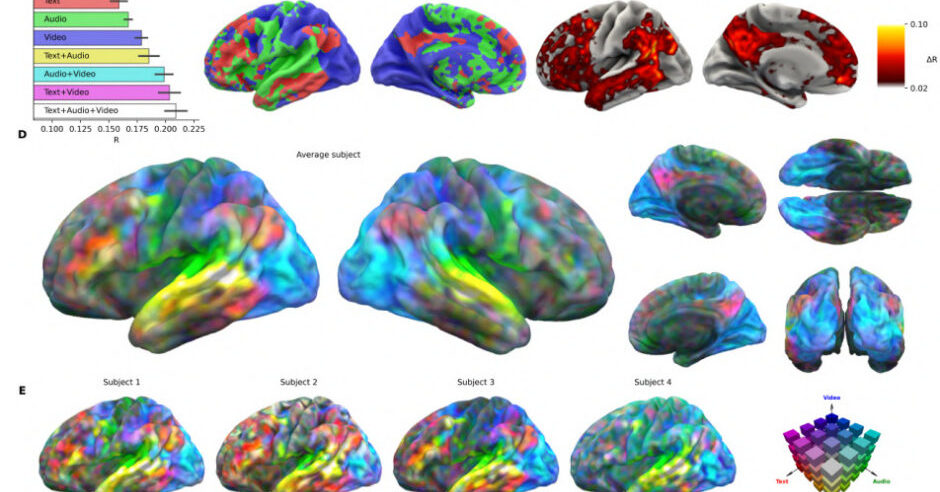
💡Meta's new model simulates brain reactions to videos—game-changer for neuro-AI research
⚡ 30-Second TL;DR
What Changed
TRIBE v2 predicts brain responses to vision, audio, language inputs
Why It Matters
Advances AI in neuroscience, potentially accelerating brain research and HCI design. Could reduce ethical costs of human brain scanning studies.
What To Do Next
Download Meta's TRIBE v2 paper and test its brain prediction demos if available.
Key Points
- •TRIBE v2 predicts brain responses to vision, audio, language inputs
- •Designed for in-silico neuroscience simulations
- •Developed by Meta researchers as a multimodal foundation model
🧠 Deep Insight
AI-generated analysis for this event — not the original article.
🔑 Enhanced Key Takeaways
- •TRIBE v2 utilizes a self-supervised learning architecture trained on massive datasets of naturalistic stimuli, allowing it to map high-level semantic features to specific cortical regions without requiring task-specific fine-tuning.
- •The model demonstrates superior cross-modal generalization, successfully predicting neural responses to unseen video-audio combinations by leveraging shared latent representations of multimodal input.
- •Meta's research aims to reduce the reliance on invasive or costly fMRI/MEG data collection by providing a high-fidelity 'digital twin' of human sensory processing for rapid hypothesis testing.
🛠️ Technical Deep Dive
- •Architecture: Employs a transformer-based backbone that integrates pre-trained vision (e.g., DINOv2) and audio-language encoders to extract hierarchical features.
- •Training Objective: Uses a contrastive learning framework to align multimodal inputs with neural activity patterns recorded from large-scale neuroimaging datasets.
- •Decoding Mechanism: Implements a linear readout layer that maps the model's internal latent space to voxel-wise brain activity, optimized for spatial and temporal resolution.
- •Input Modalities: Processes synchronized video frames, audio waveforms, and text transcripts to simulate the multisensory integration occurring in the human brain.
🔮 Future ImplicationsAI analysis grounded in cited sources
⏳ Timeline
Weekly AI Recap
Read this week's curated digest of top AI events →
👉Related Updates
AI-curated news aggregator. All content rights belong to original publishers.
Original source: ITmedia AI+ (日本) ↗
This is a summary, not the original. Read the source, or get the weekly briefing.
The weekly digest
One email a week. Unsubscribe anytime.