Meta's LLM-Scale Adaptive Ads Ranking
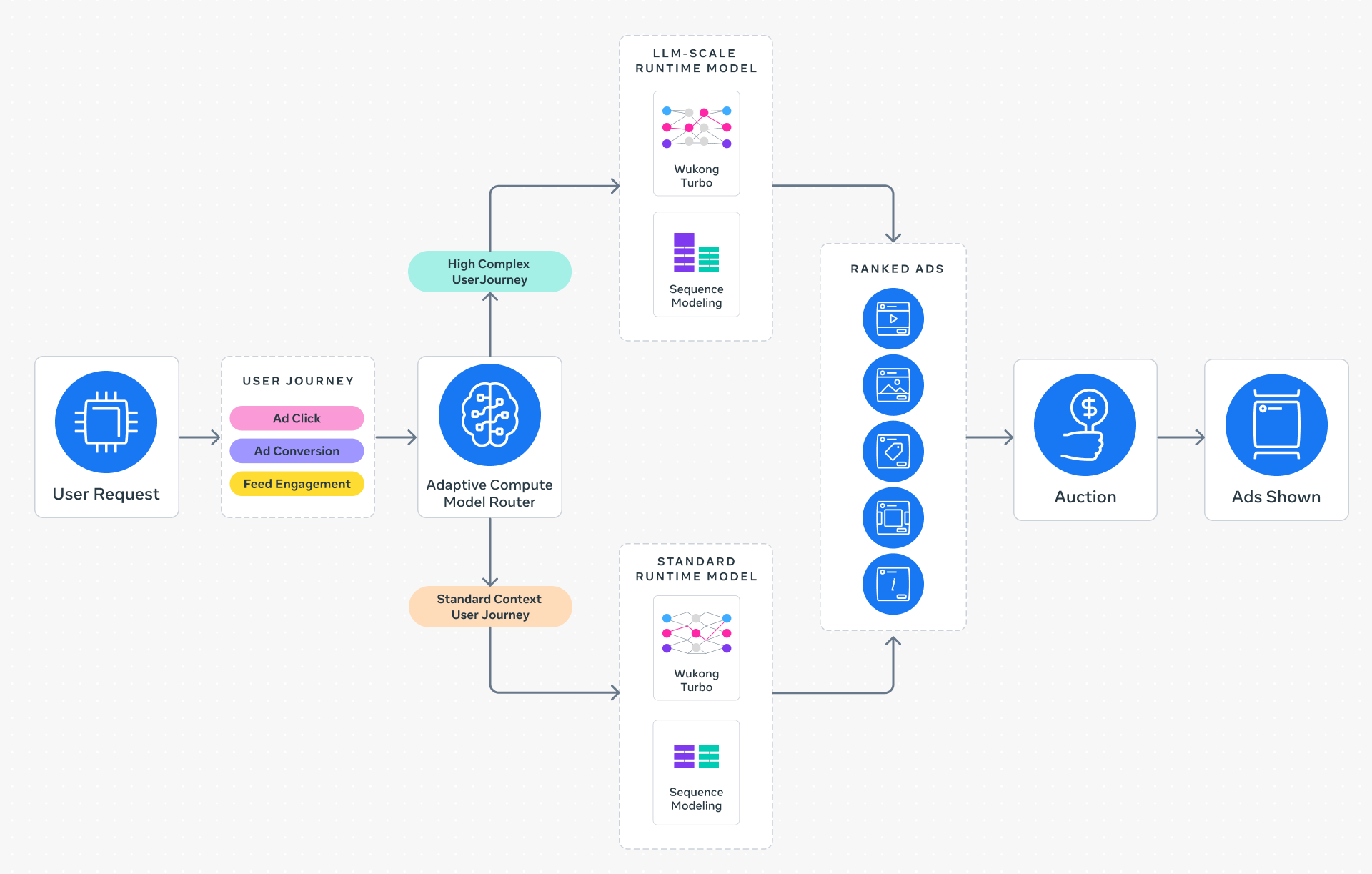
💡Meta's method to serve LLM-scale models in ads recsys—key inference efficiency hack.
⚡ 30-Second TL;DR
What Changed
Scales Ads Recommender to LLM-scale complexity
Why It Matters
Demonstrates production-scale LLM serving in recsys, offering blueprint for efficient large-model deployment in high-throughput apps. Influences ad tech and personalized recommendation strategies for AI builders.
What To Do Next
Read Meta Engineering Blog to implement adaptive ranking for your LLM recsys inference.
Key Points
- •Scales Ads Recommender to LLM-scale complexity
- •Introduces Adaptive Ranking Model for ads
- •Bends inference scaling curve for efficiency
- •Enhances understanding of user interests and intent
🧠 Deep Insight
AI-generated analysis for this event — not the original article.
🔑 Enhanced Key Takeaways
- •Meta utilizes a multi-stage ranking architecture where the Adaptive Ranking Model acts as a high-capacity 'late-stage' ranker, processing candidate sets refined by lighter-weight retrieval models.
- •The 'bending of the inference scaling curve' is achieved through dynamic compute allocation, where the model adjusts its active parameter count or depth based on the predicted value of the specific ad impression.
- •This architecture leverages specialized hardware acceleration, likely utilizing custom MTIA (Meta Training and Inference Accelerator) silicon to handle the increased memory bandwidth requirements of LLM-scale embedding tables.
📊 Competitor Analysis▸ Show
| Feature | Meta (Adaptive Ranking) | Google (Ads AI) | TikTok (Recommendation Engine) |
|---|---|---|---|
| Core Approach | LLM-scale adaptive compute | Transformer-based multi-task learning | Real-time interest graph modeling |
| Inference Strategy | Dynamic compute allocation | TPU-optimized batch inference | High-throughput stream processing |
| Benchmarking | Focus on conversion lift/ROAS | Focus on latency/query volume | Focus on engagement/retention |
🛠️ Technical Deep Dive
- Dynamic Compute Allocation: Implements a gating mechanism that routes complex queries to deeper model layers while routing simpler queries to shallower paths to minimize latency.
- Embedding Table Compression: Uses advanced quantization and embedding pruning techniques to fit massive user-interest feature sets into GPU/MTIA memory.
- Multi-Task Learning (MTL): The model is trained simultaneously on multiple objectives (e.g., click-through rate, conversion rate, and post-click value) to ensure holistic optimization.
- Inference Optimization: Utilizes custom kernels for sparse operations, which are critical for processing the high-cardinality categorical features inherent in ad recommendation systems.
🔮 Future ImplicationsAI analysis grounded in cited sources
⏳ Timeline
Weekly AI Recap
Read this week's curated digest of top AI events →
👉Related Updates
AI-curated news aggregator. All content rights belong to original publishers.
Original source: Meta Engineering Blog ↗
This is a summary, not the original. Read the source, or get the weekly briefing.
The weekly digest
One email a week. Unsubscribe anytime.