Meta shifts engineers to AI data labeling tasks
💡Meta's aggressive pivot to internal data labeling highlights the critical value of proprietary data in AI development.
⚡ 30-Second TL;DR
What Changed
Infrastructure engineers reassigned to perform AI data labeling.
Why It Matters
Signals a trend where top-tier technical talent is being utilized for data curation, highlighting the critical importance of high-quality proprietary data in the AI arms race.
What To Do Next
Evaluate your own data pipeline quality; consider if internal domain experts should be involved in labeling to improve model performance.
Key Points
- •Infrastructure engineers reassigned to perform AI data labeling.
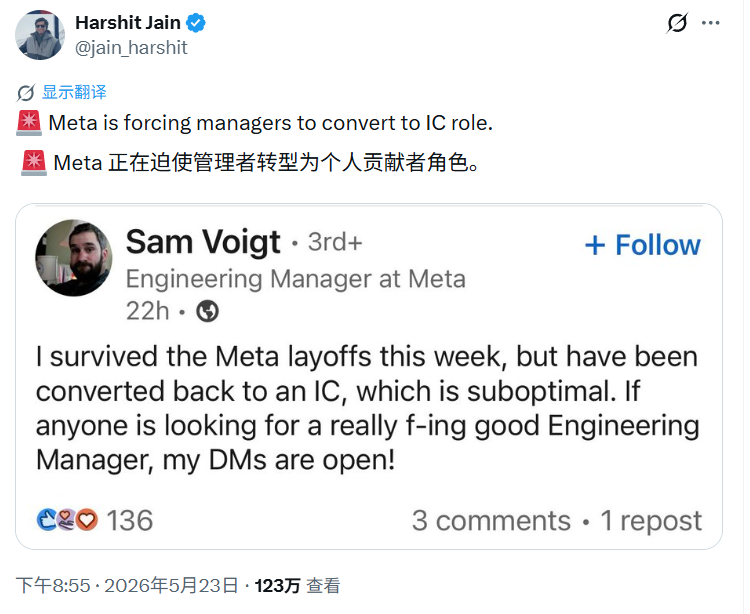
- •Management layers significantly flattened, increasing manager-to-report ratios.
- •Strategic focus on internal 'knowledge-based data' over third-party sources.
🧠 Deep Insight
Web-grounded analysis with 31 cited sources.
🔑 Enhanced Key Takeaways
- •The reassignment of engineers to AI data labeling and other AI-focused teams, such as AI cloud infrastructure and an internal AI agent codenamed "Hatch," is often mandatory, with some employees describing the process as a "draft."
- •Meta is implementing a controversial Model Capability Initiative (MCI) to track employee digital activity, including keystrokes, mouse movements, and screen interactions, to gather high-quality behavioral data for training its AI models, particularly for tasks like coding.
- •This restructuring also involves significant layoffs of approximately 8,000 employees, representing about 10% of the workforce, and the closure of 6,000 open positions, impacting roughly 20% of Meta's total workforce alongside the reassignments.
- •Meta's CEO Mark Zuckerberg has explicitly stated that internal employees provide a higher quality data source for AI model training, especially for complex tasks like coding, compared to external contractors.
🛠️ Technical Deep Dive
- Meta's data storage and ingestion architecture is built on Tectonic, an exabyte-scale distributed file system, which serves as a disaggregated storage infrastructure for AI training models.
- The company developed a Data PreProcessing Service (DPP) to scale data preprocessing independently from training compute, effectively eliminating data stalls that previously accounted for 56% of GPU idle cycles.
- DPP offers a PyTorch-style API for efficient data ingestion and supports computationally intensive feature transformations.
- Meta's AI Research SuperCluster (RSC), launched in 2022, utilizes 16,000 Nvidia A100 GPUs and 46 petabytes of cache storage to feed its supercomputer.
- The company is implementing tiered storage solutions that combine HDDs and SSDs, with SSDs serving as caching tiers for frequently accessed features to optimize cost and performance.
- Meta has employed AI agents to map undocumented "tribal knowledge" within its large-scale data pipelines, resulting in 59 concise context files for over 4,100 code modules and a 40% reduction in AI agent tool calls per task.
- The Model Capability Initiative (MCI) is an internal tool designed to capture employee behavioral data, such as keyboard inputs, mouse movements, and screen interactions, to train AI agents to navigate software and perform computer-based tasks.
- Meta has invested $14.3 billion for a 49% stake in Scale AI, a company specializing in human-data pipelines for labeling, evaluating, and structuring human judgment for AI model improvement.
- Meta's Segment Anything Model (SAM) is also leveraged for precise image segmentation tasks in data labeling.
🔮 Future ImplicationsAI analysis grounded in cited sources
⏳ Timeline
📎 Sources (31)
Factual claims are grounded in the sources below. Forward-looking analysis is AI-generated interpretation.
- theguardian.com
- businessinsider.com
- resultsense.com
- letsdatascience.com
- opentools.ai
- startupfortune.com
- investing.com
- entrepreneur.com
- varindia.com
- medium.com
- kucoin.com
- proton.me
- foxbusiness.com
- mediapost.com
- latimes.com
- iowapublicradio.org
- indexbox.io
- technologymagazine.com
- introl.com
- fb.com
- alabamasolutions.com
- substack.com
- fb.com
- cryptobriefing.com
- medium.com
- engtechnica.com
- taskmonk.ai
- kili-technology.com
- roboflow.com
- softwareseni.com
- youtube.com
Weekly AI Recap
Read this week's curated digest of top AI events →
👉Related Updates



AI-curated news aggregator. All content rights belong to original publishers.
Original source: 虎嗅 ↗