Meta Scales Social Discovery with Friend Bubbles Feature
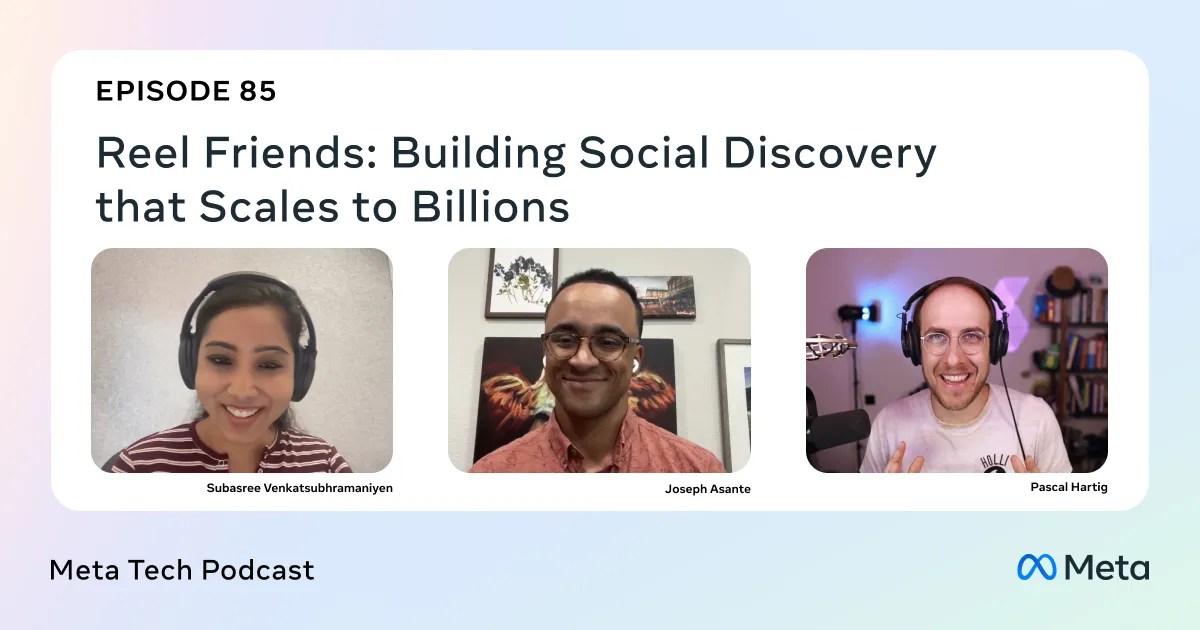
💡Learn how Meta engineers scale social discovery features to billions of users while maintaining high performance.
⚡ 30-Second TL;DR
What Changed
Friend Bubbles highlights Reels content based on real-time social signals from friends.
Why It Matters
This feature demonstrates how Meta leverages social graph data to increase user engagement on short-form video platforms. It highlights the ongoing trend of integrating social context into AI-driven recommendation engines.
What To Do Next
Analyze how Meta integrates social graph signals into their recommendation pipeline to improve your own content discovery algorithms.
Key Points
- •Friend Bubbles highlights Reels content based on real-time social signals from friends.
- •The feature requires deep engineering to maintain performance at a scale of billions of users.
- •Meta's engineering team discussed the technical challenges of social discovery on the Meta Tech Podcast.
🧠 Deep Insight
Web-grounded analysis with 28 cited sources.
🔑 Enhanced Key Takeaways
- •The 'Friend Bubbles' feature was introduced on both Facebook Reels and the main Feed, allowing users to see which Reels and posts their friends have liked.
- •Users can tap on a 'Friend Bubble' to instantly initiate a private chat with friends who have engaged with that specific Reel, fostering direct conversation around shared content.
- •The underlying machine learning model for 'Friend Bubbles' evolved from relying on survey-based friend rankings to incorporating real-time interaction signals to identify closer connections.
- •Internal user feedback surveys indicate that videos annotated with 'Friend Bubbles' consistently receive higher interest scores and more positive sentiment, leading to deeper video consumption and longer user sessions.
- •Meta's updated recommendation engine, which works in conjunction with features like 'Friend Bubbles', now learns user interests more quickly and prioritizes newer content, showing 50% more Reels published on the same day.
📊 Competitor Analysis▸ Show
Social Discovery Feature Comparison
| Platform | Primary Discovery Mechanism | Key Algorithmic Signals | Unique Aspects / Focus |
|---|---|---|---|
| Meta (Reels & Friend Bubbles) | Personalized feed (Reels) + Social signals (Friend Bubbles) | User interactions (likes, reactions, watch time), Viewer-Friend Closeness (ML models), Video relevance, Content freshness (50% more new Reels), Direct user feedback ('Not Interested' button, surveys), Video length. | Blends individual interest with explicit friend activity; direct chat initiation from bubbles; strong emphasis on user surveys for 'true interest' alignment. |
| TikTok (For You Page) | Hyper-personalized 'For You Page' (FYP) | User interactions (likes, comments, shares, watch time, rewatches, saves), Video details (captions, sounds, hashtags, effects, trending topics), Device settings. Prioritizes content relevance over creator popularity. | Focus on maximizing watch time and engagement; rewards genuinely interesting videos; allows new creators to gain wide reach regardless of follower count. |
| YouTube Shorts | Continuous, swipe-up feed | Viewed vs. Swiped Away ratio, Watch history, Engagement (comments, shares, remixes), Similar content, Relevance. Operates on 'explore and exploit' principles. | Prioritizes content that keeps users watching past the initial seconds; distinct algorithm from long-form YouTube videos; rewards cross-platform promotion. |
| Snapchat (Discover & Spotlight) | Personalized feeds for Discover (publisher content) and Spotlight (user-generated) | User behavior (viewing habits, interactions like subscribing, sharing, favoriting, skipping, reporting, hiding), Watch time, Content categorization (human and AI labeling), Recency, Relevance. | Emphasizes content diversity to avoid echo chambers; different algorithmic focus for entertainment (Spotlight) vs. depth (Discover); strong value on real connections for friend content. |
🛠️ Technical Deep Dive
- The 'Friend Bubbles' recommendation system integrates both video-quality signals and social-graph signals to surface relevant, friend-interacted content.
- It employs two complementary machine learning models for "Viewer-Friend Closeness": one based on user survey feedback and another on observed on-platform interactions, to determine which friends' activities are most relevant to a viewer.
- The system also incorporates "Video Relevance" to rank videos that are contextually appropriate for the viewer, noting that multiple friend interactions on a single video often indicate stronger shared interest.
- To ensure smooth user experience and prevent performance degradation during scrolling, the engineering team implemented prefetching mechanisms.
- An iterative development process led to the discovery that displaying fewer, more impactful 'Friend Bubbles' was more effective than showing many, improving the feature's overall click-through and engagement.
- Beyond 'Friend Bubbles', Meta's broader Reels recommendation system has been enhanced with a new AI machine that learns user preferences more accurately, moving beyond implicit engagement signals to leverage direct, real-time user feedback.
- This shift, sometimes referred to as the User True Interest Score (UTIS) model, has reportedly increased the alignment of recommendations with true user interests from 48.3% to over 70%.
🔮 Future ImplicationsAI analysis grounded in cited sources
⏳ Timeline
📎 Sources (28)
Factual claims are grounded in the sources below. Forward-looking analysis is AI-generated interpretation.
- Google Search Source
- Google Search Source
- Google Search Source
- Google Search Source
- Google Search Source
- Google Search Source
- Google Search Source
- Google Search Source
- Google Search Source
- Google Search Source
- Google Search Source
- Google Search Source
- Google Search Source
- Google Search Source
- Google Search Source
- Google Search Source
- Google Search Source
- Google Search Source
- Google Search Source
- Google Search Source
- Google Search Source
- Google Search Source
- Google Search Source
- Google Search Source
- Google Search Source
- Google Search Source
- Google Search Source
- Google Search Source
Weekly AI Recap
Read this week's curated digest of top AI events →
👉Related Updates
AI-curated news aggregator. All content rights belong to original publishers.
Original source: Meta Engineering Blog ↗