Meta Maps Tribal Knowledge with AI in Pipelines
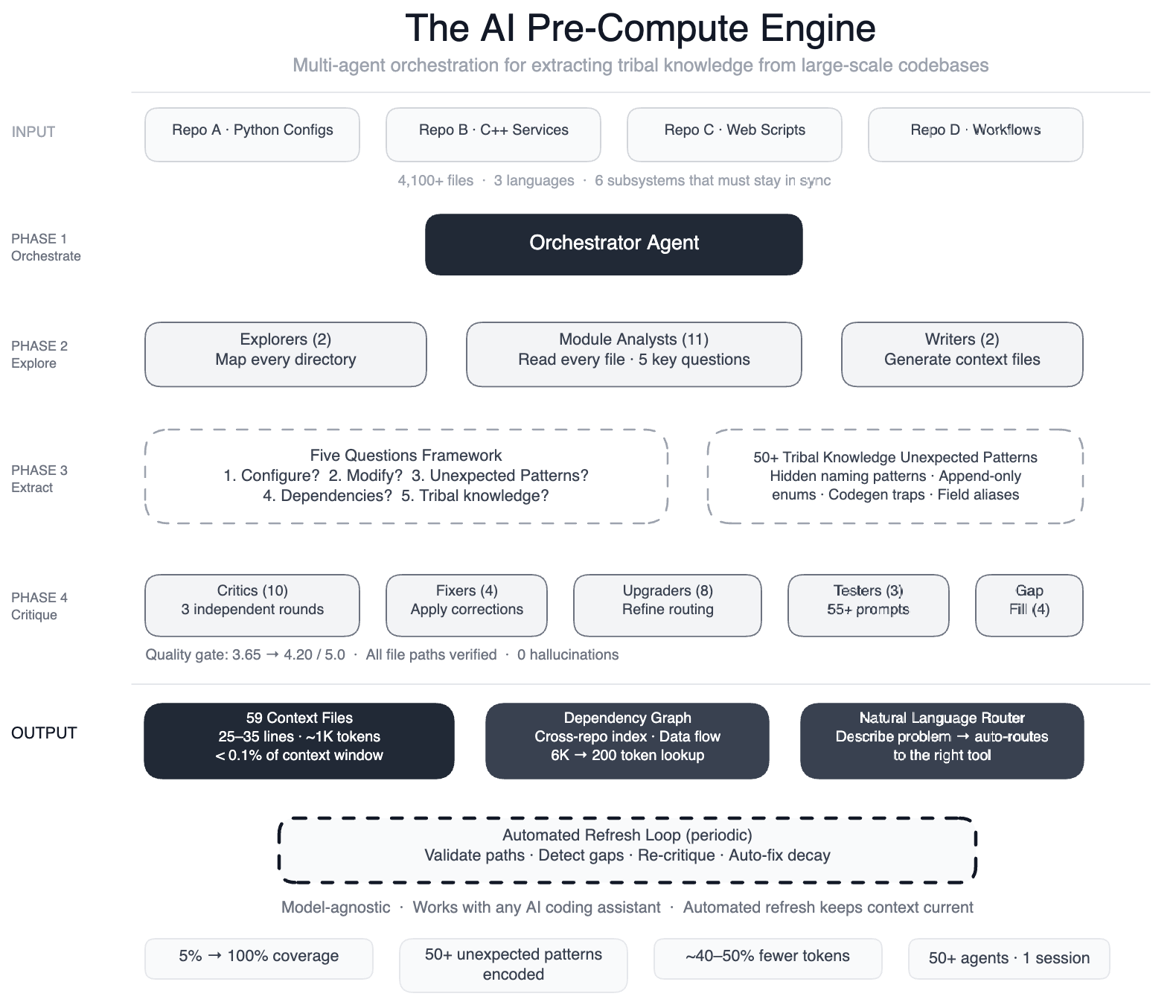
💡Meta's fix for AI coding on 4k+ file pipelines boosts agent speed—key for large codebases.
⚡ 30-Second TL;DR
What Changed
Targeted AI agents at Meta's data pipelines: 4 repos, 3 languages, 4,100+ files.
Why It Matters
This technique helps AI practitioners apply AI to massive, multi-repo codebases, accelerating development workflows and reducing tribal knowledge silos.
What To Do Next
Read Meta Engineering Blog to implement tribal knowledge mapping for your AI coding agents.
Key Points
- •Targeted AI agents at Meta's data pipelines: 4 repos, 3 languages, 4,100+ files.
- •AI struggled with quick useful edits due to codebase complexity.
- •Built AI system to map tribal knowledge for better AI performance.
🧠 Deep Insight
AI-generated analysis for this event — not the original article.
🔑 Enhanced Key Takeaways
- •The system utilizes a graph-based representation of codebase dependencies to explicitly link 'tribal knowledge'—often found in documentation, code comments, and commit history—to specific pipeline logic.
- •Meta implemented a retrieval-augmented generation (RAG) architecture that prioritizes context from cross-repository dependency chains, reducing the 'hallucination' rate of AI agents when modifying legacy pipeline code.
- •The initiative is part of Meta's broader 'AI-Native Engineering' strategy, aiming to reduce the onboarding time for new engineers working on complex data infrastructure by automating the discovery of undocumented system constraints.
🛠️ Technical Deep Dive
- •Architecture: Employs a Knowledge Graph (KG) to map relationships between code entities, configuration files, and human-authored documentation.
- •Context Retrieval: Uses a hybrid search approach combining vector embeddings for semantic similarity and graph traversal for structural dependency mapping.
- •Agentic Workflow: Implements a multi-step 'plan-and-verify' loop where the agent proposes changes, validates them against a simulated pipeline environment, and iterates based on feedback from the KG.
- •Data Integration: Ingests metadata from internal CI/CD logs, Slack discussions, and Wiki pages to dynamically update the tribal knowledge graph.
🔮 Future ImplicationsAI analysis grounded in cited sources
⏳ Timeline
Weekly AI Recap
Read this week's curated digest of top AI events →
👉Related Updates
AI-curated news aggregator. All content rights belong to original publishers.
Original source: Meta Engineering Blog ↗
This is a summary, not the original. Read the source, or get the weekly briefing.
Weekly AI briefing
One email a week. Unsubscribe anytime.