Meta Explores Hierarchical Interest Representation for Ad Optimization
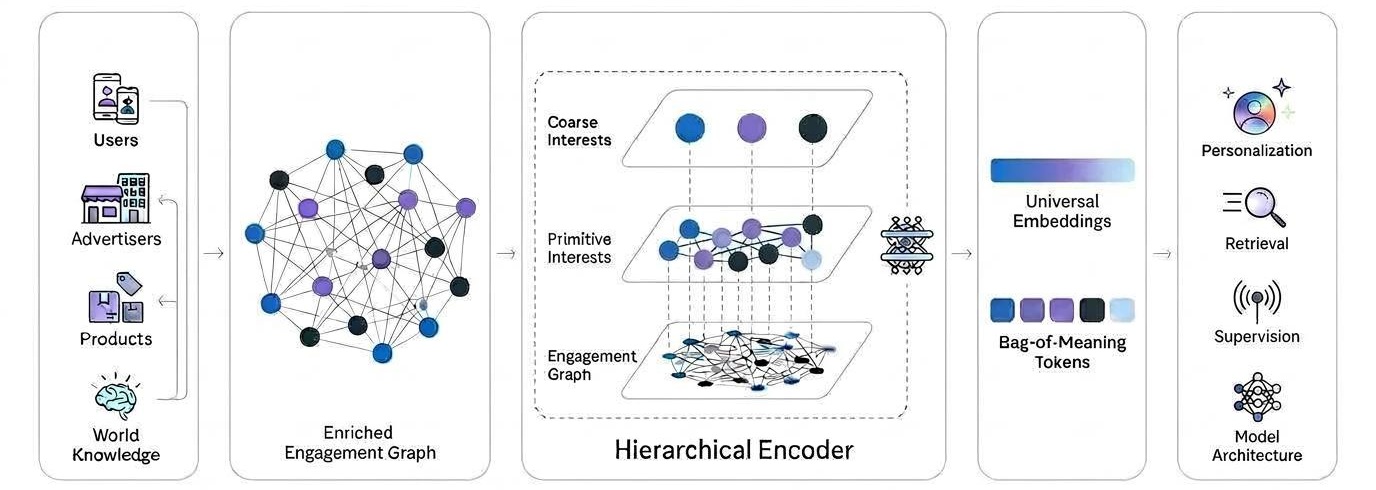
💡Learn how Meta is using unified embedding layers to bridge the gap between user intent and deep funnel ad inventory.
⚡ 30-Second TL;DR
What Changed
Developing an upstream representation layer for users, advertisers, and products.
Why It Matters
This research could significantly improve ad targeting precision by moving beyond simple keyword matching to deeper semantic understanding of user interests. It represents a shift toward more sophisticated, unified embedding models in large-scale ad systems.
What To Do Next
Review your current recommendation system architecture to see if implementing a hierarchical embedding layer could better capture long-tail user interests.
Key Points
- •Developing an upstream representation layer for users, advertisers, and products.
- •Learning unified embeddings to bridge the gap between user intent and ad inventory.
- •Focusing on deep funnel optimization to improve ad relevance and conversion.
🧠 Deep Insight
AI-generated analysis for this event.
🔑 Enhanced Key Takeaways
- •The hierarchical representation utilizes a multi-task learning framework that simultaneously optimizes for click-through rate (CTR) and conversion rate (CVR) to reduce data sparsity.
- •Meta is leveraging Graph Neural Networks (GNNs) to capture complex, non-linear relationships between user interest nodes and advertiser product taxonomies.
- •The architecture incorporates a 'cold-start' mitigation module that uses content-based features to generate embeddings for new ads before sufficient interaction data is collected.
- •This system integrates with Meta's existing 'Advantage+' suite, specifically targeting automated audience expansion and creative optimization.
- •The research addresses the 'long-tail' problem in advertising by mapping niche user interests to specific, low-volume product categories through a shared latent space.
📊 Competitor Analysis▸ Show
| Feature | Meta (Hierarchical Interest) | Google (Ads AI) | Amazon (Ads ML) |
|---|---|---|---|
| Core Approach | Hierarchical/Graph-based | Transformer/Intent-based | Collaborative Filtering/Retail-first |
| Deep Funnel Focus | High (Conversion-centric) | High (Search/Display) | Very High (Purchase-intent) |
| Data Advantage | Social/Interest Graph | Search/Behavioral | Transactional/Purchase History |
🛠️ Technical Deep Dive
- Architecture: Employs a hierarchical transformer-based encoder to process multi-modal input features (text, image, and behavioral logs).
- Embedding Space: Utilizes a shared latent space where user interest vectors and advertiser product vectors are projected using contrastive learning objectives.
- Optimization: Implements a hierarchical loss function that penalizes misalignments at both the broad category level and the specific product level.
- Infrastructure: Built on top of Meta's internal PyTorch-based training framework, utilizing distributed training across thousands of GPUs to handle petabyte-scale datasets.
🔮 Future ImplicationsAI analysis grounded in cited sources
⏳ Timeline
Weekly AI Recap
Read this week's curated digest of top AI events →
👉Related Updates
AI-curated news aggregator. All content rights belong to original publishers.
Original source: Meta Engineering Blog ↗