Memory Wall Blocks AI Compute Stacking
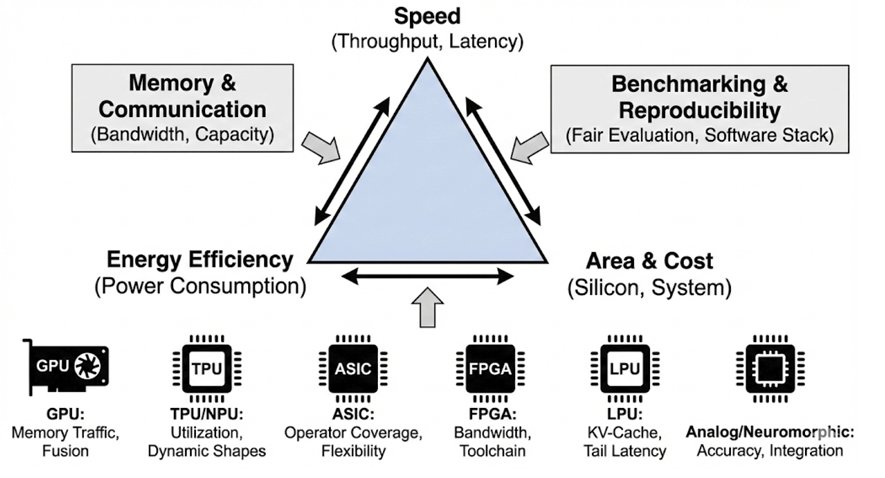
💡Why TFLOPS lie: memory walls kill LLM inference perf gains
⚡ 30-Second TL;DR
What Changed
Data movement energy orders higher than FP compute; most power on transport
Why It Matters
Forces shift from compute-centric to memory-optimized designs, raising costs for large-model capacity but enabling practical LLM deployment at scale.
What To Do Next
Profile your LLM inference pipeline with NVIDIA Nsight for memory bandwidth bottlenecks.
Key Points
- •Data movement energy orders higher than FP compute; most power on transport
- •LLM decoding memory-bound by full KV cache access per token
- •Irregular MoE routing, sparse ops slash utilization on fixed hardware
- •Peak TFLOPS irrelevant; HBM bandwidth, interconnect limit real perf
🧠 Deep Insight
AI-generated analysis for this event — not the original article.
🔑 Enhanced Key Takeaways
- •Emerging 'Processing-in-Memory' (PIM) and 'Near-Memory Computing' (NMC) architectures are being actively prototyped to mitigate the von Neumann bottleneck by integrating logic directly into DRAM dies, aiming to reduce data movement energy by up to 10x.
- •The industry is shifting toward 'Compute-Express-Link' (CXL) 3.0/4.0 standards to enable memory pooling and disaggregation, allowing AI accelerators to dynamically access remote memory resources and alleviate local HBM capacity constraints.
- •Hardware-software co-design efforts, such as 'FlashAttention' and 'PagedAttention', have become critical software-level mitigations, optimizing memory access patterns to maximize cache locality and reduce the frequency of high-latency HBM reads during LLM inference.
🛠️ Technical Deep Dive
- •KV Cache Memory Footprint: In transformer-based LLMs, the KV cache grows linearly with sequence length and batch size, often consuming 50-80% of available HBM capacity during long-context inference.
- •Arithmetic Intensity: Modern LLM decoding phases exhibit extremely low arithmetic intensity (often < 0.1 FLOPs/byte), meaning the system is almost entirely limited by the memory bus throughput rather than the peak TFLOPS of the GPU/NPU.
- •MoE Routing Overhead: Mixture-of-Experts (MoE) models introduce non-deterministic memory access patterns; the 'all-to-all' communication required to route tokens to specific experts creates significant interconnect congestion, further exacerbating the memory wall.
🔮 Future ImplicationsAI analysis grounded in cited sources
⏳ Timeline
Weekly AI Recap
Read this week's curated digest of top AI events →
👉Related Updates


AI-curated news aggregator. All content rights belong to original publishers.
Original source: 虎嗅 ↗
This is a summary, not the original. Read the source, or get the weekly briefing.
The weekly digest
One email a week. Unsubscribe anytime.