Memory Prices Face a 2027 Reality Check
💡Server memory prices are still climbing, but consumer parts are weakening—an important signal for AI infrastructure budg
⚡ 30-Second TL;DR
What Changed
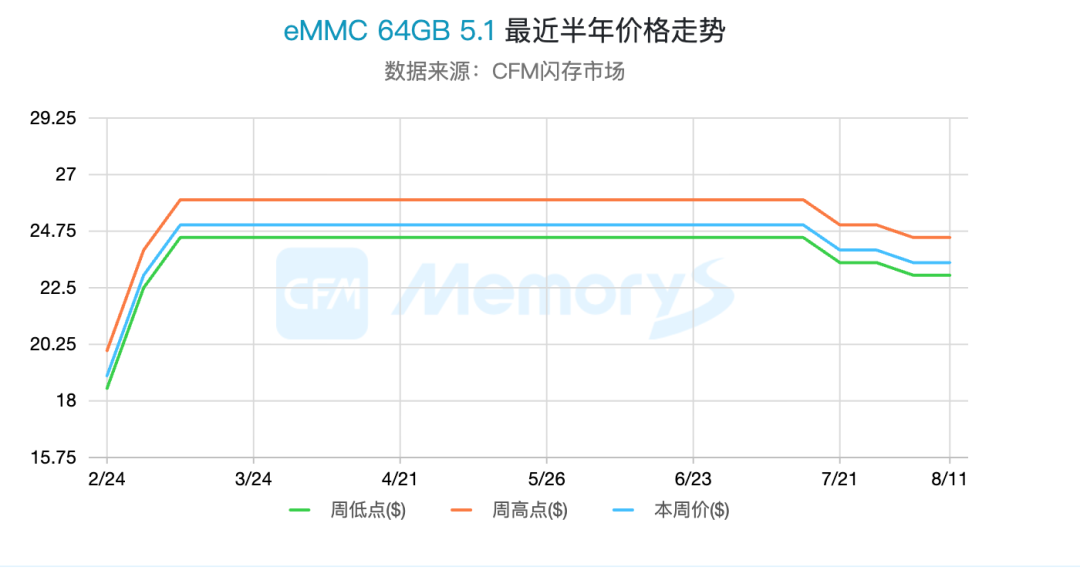
64GB eMMC is seeing price inversion because inventories accumulated faster than downstream demand.
Why It Matters
AI infrastructure operators may continue facing elevated costs for server DRAM, while consumer-memory weakness could create more favorable pricing for edge and client devices. Procurement plans should distinguish tightly supplied server components from oversupplied low-capacity parts rather than treating memory as a single market.
What To Do Next
Reforecast your next 12-month AI server memory budget by separating DDR5 server procurement from consumer-grade DRAM/NAND, then negotiate supply commitments before 2027 capacity expansion changes pricing.
Key Points
- •64GB eMMC is seeing price inversion because inventories accumulated faster than downstream demand.
- •Samsung's complete exit from MLC NAND production has tightened supply and pushed 32GB MLC contract prices from about $2 to $17.
- •2026 Q3 DRAM and NAND contract price growth is forecast to slow to 13%-18% and 10%-15%, respectively.
- •Server memory remains significantly stronger than consumer memory, with DDR5 server modules continuing to rise while consumer DDR4 prices retreat.
- •2027 is the key observation year as new DRAM and NAND capacity begins to affect the supply-demand balance.
🧠 Deep Insight
AI-generated analysis for this event.
🔑 Enhanced Key Takeaways
- •The transition to HBM3e and HBM4 production is cannibalizing traditional DRAM wafer capacity, which is a primary driver behind the supply tightness in standard DDR5 server modules.
- •Major memory manufacturers have shifted capital expenditure focus toward AI-optimized memory, leading to a structural under-investment in legacy nodes like DDR4 and older NAND processes.
- •Inventory correction cycles in the automotive and industrial sectors have been slower than in the consumer electronics sector, contributing to the price inversion observed in specific eMMC segments.
- •The rise of 'On-Device AI' requirements is forcing a shift in minimum memory density standards for smartphones, which is partially offsetting the demand weakness in low-end consumer devices.
- •Yield rates for advanced EUV-based DRAM processes have reached maturity, allowing manufacturers to increase bit output per wafer even without significant new fab construction.
🛠️ Technical Deep Dive
- HBM3e architecture utilizes 12-high and 16-high stacks to achieve bandwidths exceeding 1.2 TB/s per stack.
- DDR5 server modules are increasingly adopting 1b-nanometer process nodes to improve power efficiency and density.
- MLC (Multi-Level Cell) NAND, while largely phased out for high-density storage, remains critical for industrial applications due to its superior P/E (Program/Erase) cycle endurance compared to TLC or QLC.
- eMMC 5.1 remains the standard for low-cost embedded storage, though it is increasingly being challenged by UFS 3.1 in mid-range mobile devices.
🔮 Future ImplicationsAI analysis grounded in cited sources
⏳ Timeline
Weekly AI Recap
Read this week's curated digest of top AI events →
👉Related Updates

AI-curated news aggregator. All content rights belong to original publishers.
Original source: 虎嗅 ↗