Managing Record-Breaking Vulnerability Volume
💡Critical for AI builders to monitor security risks in the open-source libraries powering their models.
⚡ 30-Second TL;DR
What Changed
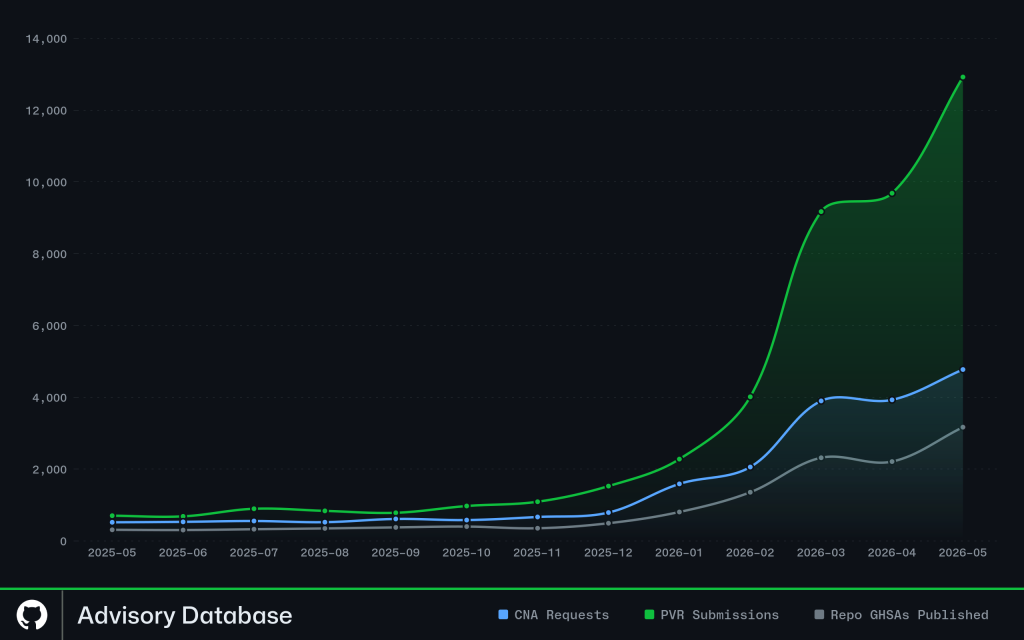
Record-breaking volume of vulnerability reports
Why It Matters
Increased vulnerability reporting helps secure the open-source AI ecosystem by identifying risks in dependencies earlier.
What To Do Next
Review your project's dependency tree using GitHub Dependabot to identify newly reported vulnerabilities.
Key Points
- •Record-breaking volume of vulnerability reports
- •Analysis of factors driving the surge in security data
- •Community collaboration strategies for vulnerability management
🧠 Deep Insight
AI-generated analysis for this event — not the original article.
🔑 Enhanced Key Takeaways
- •The surge is largely attributed to the widespread adoption of automated vulnerability scanning tools and AI-driven code analysis integrated into CI/CD pipelines.
- •GitHub has expanded its Global Security Research team to handle the increased triage load, focusing on reducing the time-to-remediation for critical CVEs.
- •The integration of GitHub Advanced Security (GHAS) has significantly increased the volume of 'low-severity' vulnerability reports, necessitating better noise-reduction algorithms.
- •GitHub is increasingly leveraging machine learning models to automatically deduplicate and prioritize vulnerability reports before they reach human maintainers.
- •Open source maintainers are reporting 'vulnerability fatigue,' prompting GitHub to introduce new automated patch suggestion features to assist in remediation.
📊 Competitor Analysis▸ Show
| Feature | GitHub Advisory Database | Snyk Vulnerability DB | OSV (Google) |
|---|---|---|---|
| Primary Focus | Ecosystem-wide security | Developer-first remediation | Open source cross-language |
| Data Source | GitHub commits/reports | Proprietary research/AI | Multi-source aggregation |
| Integration | Native to GitHub Actions | Multi-platform (IDE/CI) | API-first/Public DB |
🛠️ Technical Deep Dive
- Utilization of the Open Source Vulnerability (OSV) schema to standardize vulnerability reporting across different ecosystems.
- Implementation of automated triage workflows using GitHub Actions to categorize incoming reports based on reachability analysis.
- Deployment of semantic analysis engines to identify potential vulnerabilities in code before they are committed to public repositories.
- Use of graph-based dependency analysis to map transitive vulnerabilities across complex software supply chains.
🔮 Future ImplicationsAI analysis grounded in cited sources
⏳ Timeline
Weekly AI Recap
Read this week's curated digest of top AI events →
👉Related Updates
AI-curated news aggregator. All content rights belong to original publishers.
Original source: GitHub Blog ↗
This is a summary, not the original. Read the source, or get the weekly briefing.
Weekly AI briefing
One email a week. Unsubscribe anytime.