Low-budget AI short film disrupts Hollywood standards
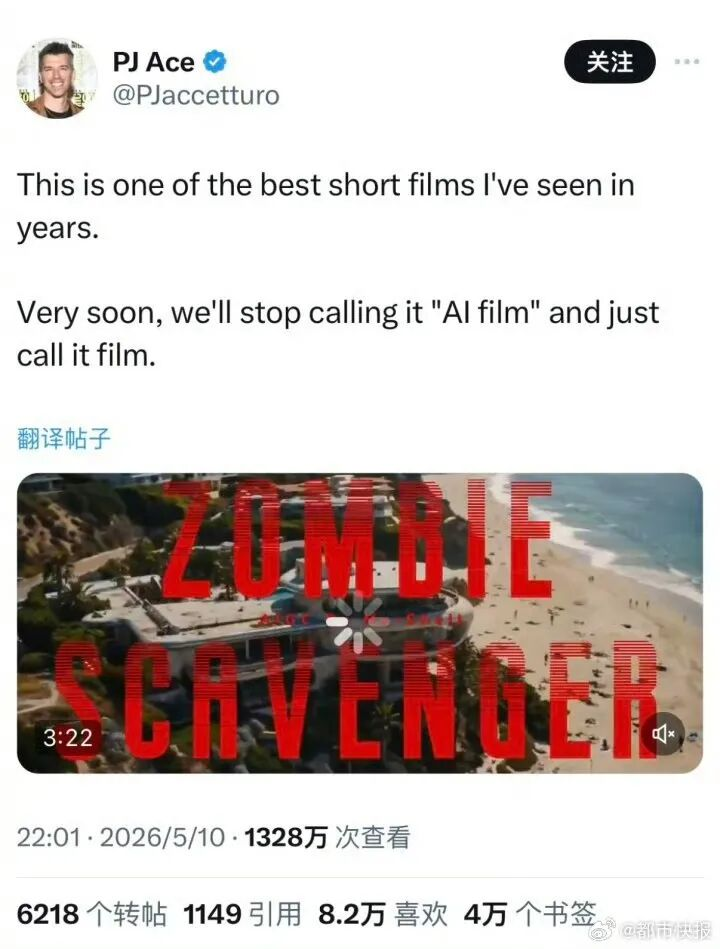
💡See how a $400 budget and AI tools are challenging multi-million dollar Hollywood production standards.
⚡ 30-Second TL;DR
What Changed
The short film 'Zombie Cleaner' achieved 70 million views with a 3,000 RMB budget.
Why It Matters
Demonstrates that high-quality visual storytelling is no longer exclusive to well-funded teams, lowering the barrier to entry for AI-native creators.
What To Do Next
Experiment with AI video generation workflows to prototype high-concept visual projects with minimal capital.
Key Points
- •The short film 'Zombie Cleaner' achieved 70 million views with a 3,000 RMB budget.
- •AI tools enable individual creators to bypass traditional, expensive production pipelines.
- •Global industry interest, including Hollywood producers, confirms the shift in content creation power.
🧠 Deep Insight
Web-grounded analysis with 17 cited sources.
🔑 Enhanced Key Takeaways
- •The creator of 'Zombie Cleaner,' Mx-Shell, is a 29-year-old vocational school graduate from Yunnan, China, who works a regular job in real estate and is self-taught in filmmaking, photography, and music.
- •Mx-Shell utilized ByteDance's Seedance 2.0, a multimodal AI video generation model, for the film's creation, which supports text, image, audio, and video inputs.
- •The film's viral success led to a public search by Hollywood AI film studio founder PJ Ace, who lauded 'Zombie Cleaner' as 'one of the best short films I've seen in years' and expressed a desire to hire its creator.
- •'Zombie Cleaner' is distinguished from earlier AI videos by its complete narrative, featuring characters, conflict, emotional progression, and a conclusion, rather than merely serving as a technical demonstration.
- •Mx-Shell reportedly created the film without a traditional script, storyboard, or shot list, instead combining personal interests like zombies, robots, and atomic punk aesthetics, allowing the AI to improvise and leading to some iconic moments being 'pure AI accidents.'
📊 Competitor Analysis▸ Show
| Feature/Tool | Seedance AI (ByteDance) | Runway ML | Luma AI | Google Veo | Melies | Kling AI (Kuaishou) |
|---|---|---|---|---|---|---|
| Primary Function | Multimodal video generation with director-level control, synchronized audio-visual generation | End-to-end workflow: video generation (Gen-4/4.5), image-to-video, AI editing (Aleph), performance capture (Act-Two) | Video generation (Dream Machine), realistic scenes, environments, motion-based visuals, image-to-video | Cinematic video scenes from prompts, integrated with Gemini for scripting/idea generation | Narrative creation, script generation, character design, AI actors, unified platform | Video generation, often cited for budget-friendliness |
| Key Strengths | Director-level control, multimodal input (image, audio, video references), improvisation, visual consistency | Advanced video generation, comprehensive editing tools, workflow automation, third-party model integration | High-fidelity 5-second cinematic clips, realistic human movement, complex lighting | High-quality video generation, experimental storytelling, strong model quality and scale | Structured storytelling, consistent character creation (150+ AI actors), image and video generation | Cost-effective video generation, good for budget productions |
| Pricing Model | Free tier via Dreamina (Jimeng platform); Premium plans from $9.60–$18 (approx. $400 for 'Zombie Cleaner') | Subscription-based (e.g., Gen-4/4.5 models) | Subscription-based (e.g., Dream Machine) | Subscription-based (e.g., Veo 3.1 Pro tier at $100/month for 110,000 credits) | Subscription-based (all-in-one platform) | Credit-based, budget-friendly (approx. $8–12 per project) |
| Typical Use Case | Narrative work requiring integrated sound design and precise scene control | Full production pipelines, rapid prototyping, collaborative projects | Rapid prototyping of scenes, visualizing concepts, social/film content | Cinematic video clips, storytelling experiments, multimodal creative tooling | Narrative creation with strong character and script control | General AI video generation, especially for cost-conscious creators |
🛠️ Technical Deep Dive
- Core Tool: The short film "Zombie Cleaner" was primarily created using ByteDance's Seedance 2.0.
- Multimodal Input: Seedance 2.0 is described as a multimodal AI video generation model, capable of accepting text, images, audio, and video as inputs.
- Director-Level Control: The platform allows for granular control over scene elements, including camera movement, lighting setup, shadow behavior, and character performance characteristics, which can be specified in a single generation pass using multimodal references.
- Improvisational Generation: Unlike traditional AI video tools that often rely on keyframes, Seedance 2.0 enables the AI model to improvise, resulting in dynamic and sometimes unpredictable shots that contribute to a more 'alive' feel.
- Cost and Processing: Generating a 10-second video segment with Seedance 2.0 reportedly required approximately 40 minutes of GPU time, costing around $1.30 per segment.
- Other AI Tools in Filmmaking: The broader AI filmmaking landscape includes tools like Runway ML (using Gen-4 and Gen-4.5 models for video generation and Aleph tools for editing), Luma AI (with Dream Machine for realistic scenes), Google Veo (integrated within the Gemini ecosystem for cinematic video), Melies (focused on narrative creation with AI actors), Kling AI (for video generation), Midjourney (for concept art and image generation), ElevenLabs (for hyper-realistic voice synthesis), and Suno/Udio (for AI music generation).
🔮 Future ImplicationsAI analysis grounded in cited sources
⏳ Timeline
📎 Sources (17)
Factual claims are grounded in the sources below. Forward-looking analysis is AI-generated interpretation.
Weekly AI Recap
Read this week's curated digest of top AI events →
👉Related Updates



AI-curated news aggregator. All content rights belong to original publishers.
Original source: 虎嗅 ↗