🐯虎嗅•Stalecollected in 17m
Knowledge Graphs Beat Vectors in RAG
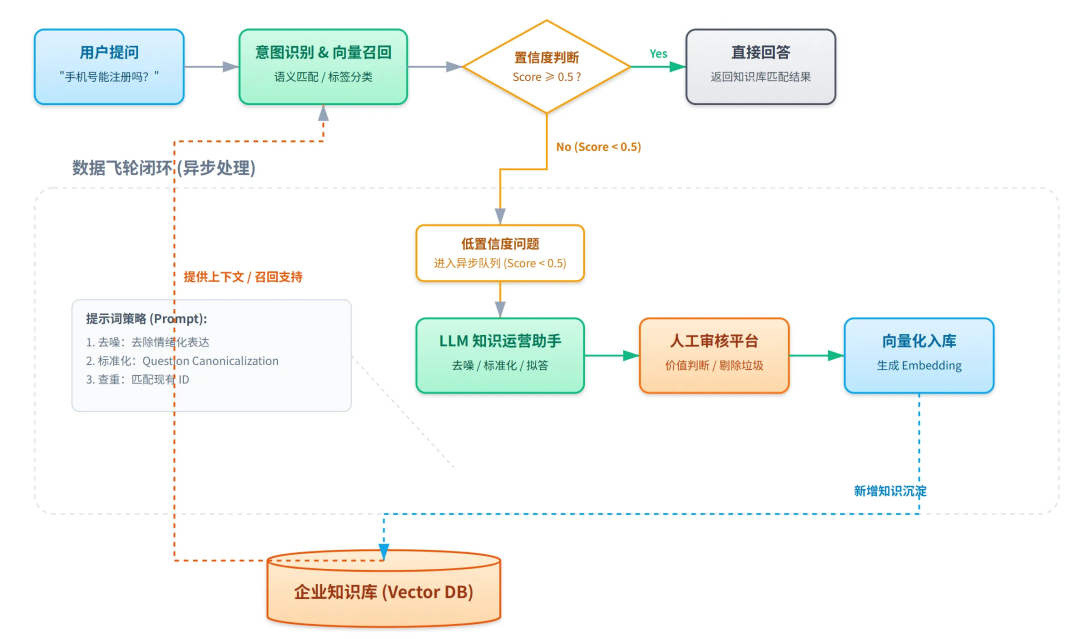
💡Ditch vectors for graphs in RAG: fixes chunking errors in real apps (med/legal risks)
⚡ 30-Second TL;DR
What Changed
Vector DB chunking breaks document logic, causing info loss like missing exceptions
Why It Matters
Shifts RAG paradigms from simplistic embeddings to structured graphs, reducing hallucinations in production apps. Builders must prioritize data modeling over lazy chunking.
What To Do Next
Build a Neo4j knowledge graph for your RAG prototype to test relational queries.
Who should care:Developers & AI Engineers
Key Points
- •Vector DB chunking breaks document logic, causing info loss like missing exceptions
- •Knowledge graphs model entities-relations-attributes for contextual queries
- •RAG pitfalls in e-commerce refunds and pregnancy drug contraindications
- •Hybrid approaches combine keywords, vectors with graphs for complex AI knowledge bases
🧠 Deep Insight
AI-generated analysis for this event.
🔑 Enhanced Key Takeaways
- •GraphRAG, popularized by Microsoft's research, utilizes LLM-generated community summaries to address the 'global query' limitation where standard vector RAG fails to synthesize information across large, fragmented datasets.
- •The integration of Graph Neural Networks (GNNs) with RAG pipelines is emerging as a method to perform inductive reasoning over knowledge graphs, allowing models to infer relationships not explicitly stated in the source text.
- •Knowledge graph construction remains a significant bottleneck due to the high computational cost of entity extraction and the difficulty of maintaining schema consistency in dynamic, unstructured data environments.
🛠️ Technical Deep Dive
- GraphRAG Architecture: Utilizes a two-step process involving indexing (entity extraction, community detection via Leiden algorithm) and retrieval (global search for thematic summaries, local search for specific entity relations).
- Semantic Layering: Employs ontologies to enforce strict data typing, which reduces 'hallucination' by constraining the LLM's output space to valid relational paths defined in the graph schema.
- Hybrid Retrieval Mechanisms: Implements reciprocal rank fusion (RRF) to combine scores from vector similarity searches (semantic) and graph traversal algorithms (structural) to optimize precision-recall trade-offs.
🔮 Future ImplicationsAI analysis grounded in cited sources
Automated ontology generation will become the primary driver of RAG scalability.
Manual schema design is currently the largest barrier to enterprise adoption of knowledge-graph-enhanced RAG systems.
Vector-only RAG will be relegated to 'shallow' search tasks.
The inability of vector embeddings to handle multi-hop reasoning makes them insufficient for complex, high-stakes decision-making environments.
⏳ Timeline
2023-11
Microsoft Research introduces the GraphRAG concept to address limitations in vector-based retrieval.
2024-07
Microsoft open-sources the GraphRAG indexing and retrieval pipeline on GitHub.
2025-03
Industry-wide adoption of hybrid RAG architectures accelerates as benchmarks show significant improvements in multi-hop reasoning tasks.
📰
Weekly AI Recap
Read this week's curated digest of top AI events →
👉Related Updates

AI-curated news aggregator. All content rights belong to original publishers.
Original source: 虎嗅 ↗