Source虎嗅•Stalecollected in 4m
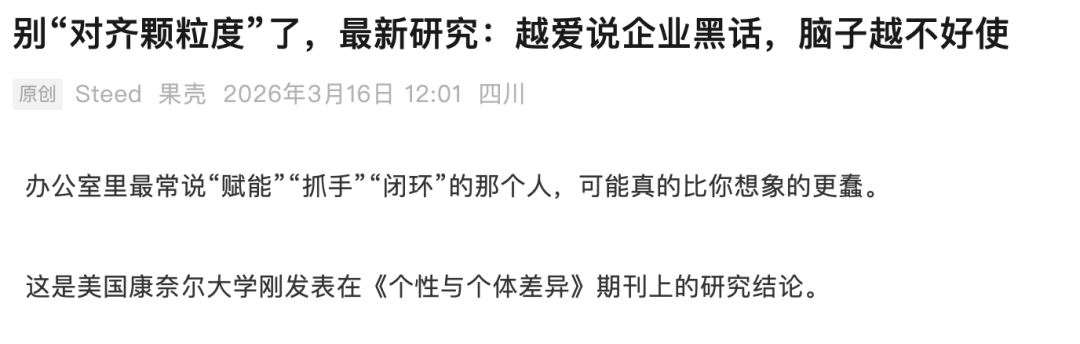
Jargon Lovers Have Weaker Brains?
#corporate-jargon#cognition-study#ai-commscornell-university
💡AI floods world with jargon; learn to simplify or get outshined.
⚡ 30-Second TL;DR
What Changed
Brands favor complex jargon over plain talk for perceived depth.
Why It Matters
Elevates demand for humans skilled in clear comms amid AI content generation boom.
What To Do Next
Audit team docs with LLM to detect/replace jargon for clearer AI-era pitches.
Who should care:Marketers & Content Teams
Key Points
- •Brands favor complex jargon over plain talk for perceived depth.
- •Jargon impresses some but misleads decisions per Cornell research.
- •AI will mass-produce complexity; clear explanation is key differentiator.
🧠 Deep Insight
AI-generated analysis for this event — not the original article.
🔑 Enhanced Key Takeaways
- •Research from Cornell University, specifically involving the Dyson School of Applied Economics and Management, suggests that individuals who use jargon often do so to compensate for a lack of genuine knowledge, a phenomenon termed 'strategic obfuscation'.
- •Linguistic studies indicate that jargon-heavy communication triggers a 'fluency heuristic' in listeners, where the complexity is mistakenly interpreted as intelligence, despite empirical evidence showing it reduces message retention and trust.
- •The rise of Large Language Models (LLMs) has exacerbated this issue, as default AI training parameters often favor formal, academic, or corporate-sounding prose, leading to a 'homogenization of complexity' in digital content.
🔮 Future ImplicationsAI analysis grounded in cited sources
Plain language will become a premium 'human-verified' service tier.
As AI-generated content becomes increasingly dense and jargon-filled, businesses will market 'human-edited' or 'plain-language' content as a luxury differentiator to ensure actual consumer comprehension.
Cognitive load metrics will be integrated into SEO algorithms.
Search engines will likely prioritize content with lower Flesch-Kincaid readability scores to counteract the influx of low-value, jargon-heavy AI content.
📰
Weekly AI Recap
Read this week's curated digest of top AI events →
👉Related Updates




AI-curated news aggregator. All content rights belong to original publishers.
Original source: 虎嗅 ↗
This is a summary, not the original. Read the source, or get the weekly briefing.
The weekly digest
One email a week. Unsubscribe anytime.