💰钛媒体•Freshcollected in 15m
Japanese automakers struggle with supply chain reform
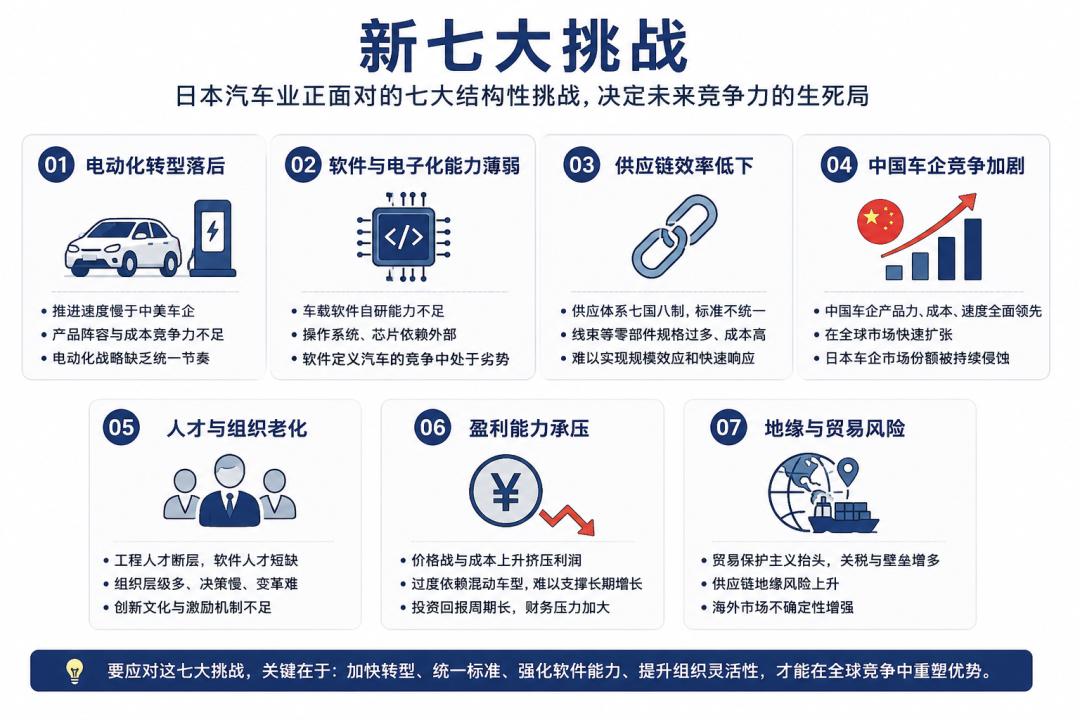
💡A case study on how legacy supply chain rigidity can lead to market obsolescence against faster, leaner rivals.
⚡ 30-Second TL;DR
What Changed
Chinese automotive competition is accelerating
Why It Matters
Highlights the risk of legacy industries failing to adapt to rapid technological and operational shifts.
What To Do Next
Evaluate your own technical stack for 'legacy waste' that prevents rapid iteration compared to newer, leaner competitors.
Who should care:Founders & Product Leaders
Key Points
- •Chinese automotive competition is accelerating
- •Japanese supply chains suffer from systemic waste
- •Lack of consensus on standardization hinders reform
🧠 Deep Insight
AI-generated analysis for this event.
🔑 Enhanced Key Takeaways
- •Japanese automakers are increasingly adopting 'Software-Defined Vehicle' (SDV) architectures, but legacy 'Keiretsu' supplier relationships often create bottlenecks in software integration and cross-tier data sharing.
- •The transition to Battery Electric Vehicles (BEVs) has exposed a reliance on internal combustion engine (ICE) component suppliers, forcing Japanese firms to seek new partnerships with non-traditional tech suppliers.
- •Japanese manufacturers are facing significant labor shortages and an aging workforce, which complicates the implementation of advanced automated manufacturing systems required for rapid supply chain pivots.
- •Recent government-led initiatives in Japan are attempting to foster 'co-opetition' among domestic automakers to standardize EV battery modules and charging infrastructure to counter Chinese scale advantages.
- •Chinese competitors are leveraging 'Gigacasting' and highly integrated modular manufacturing, which contrasts sharply with the traditional Japanese 'Just-in-Time' (JIT) model that prioritizes incremental efficiency over radical structural change.
📊 Competitor Analysis▸ Show
| Feature | Japanese Automakers (Legacy) | Chinese Automakers (BYD/NIO/Xiaomi) |
|---|---|---|
| Supply Chain Model | Rigid, Tiered Keiretsu | Vertically Integrated / Agile |
| Software Integration | Outsourced/Fragmented | In-house/Centralized (SDV) |
| Production Cycle | Long (Incremental) | Short (Rapid Iteration) |
| Cost Structure | High (Legacy Overhead) | Low (Scale/Vertical Integration) |
🛠️ Technical Deep Dive
- Shift toward Zonal Architecture: Japanese firms are attempting to move away from distributed Electronic Control Units (ECUs) toward centralized zonal controllers to reduce wiring harness complexity.
- Gigacasting Adoption: Toyota and others have begun piloting large-scale aluminum die-casting to reduce part counts, directly challenging the manufacturing efficiency of Chinese rivals.
- Software Middleware: Efforts are underway to adopt standardized middleware layers (such as Automotive Grade Linux or AUTOSAR) to decouple hardware and software development cycles.
🔮 Future ImplicationsAI analysis grounded in cited sources
Japanese automakers will lose significant market share in Southeast Asia by 2028.
The inability to rapidly localize supply chains for affordable EVs allows Chinese manufacturers to capture the price-sensitive mass market.
Major Japanese OEMs will dissolve at least 20% of their traditional Keiretsu supplier contracts by 2030.
The necessity to integrate high-tech software and battery components will force a shift toward more flexible, open-market procurement strategies.
⏳ Timeline
2021-09
Toyota announces a $13.5 billion investment in battery development and supply chain infrastructure.
2023-05
Honda and Sony establish Sony Honda Mobility to accelerate software-centric vehicle development.
2024-02
Toyota unveils its 'Multi-Pathway' strategy, emphasizing the difficulty of balancing ICE, Hybrid, and BEV supply chains.
2025-11
Japanese Ministry of Economy, Trade and Industry (METI) releases guidelines for automotive supply chain digitalization.
📰
Weekly AI Recap
Read this week's curated digest of top AI events →
👉Related Updates


AI-curated news aggregator. All content rights belong to original publishers.
Original source: 钛媒体 ↗