🗾ITmedia AI+ (日本)•Stalecollected in 31m
Interlink Switches to AI-Optimized Markdown Site
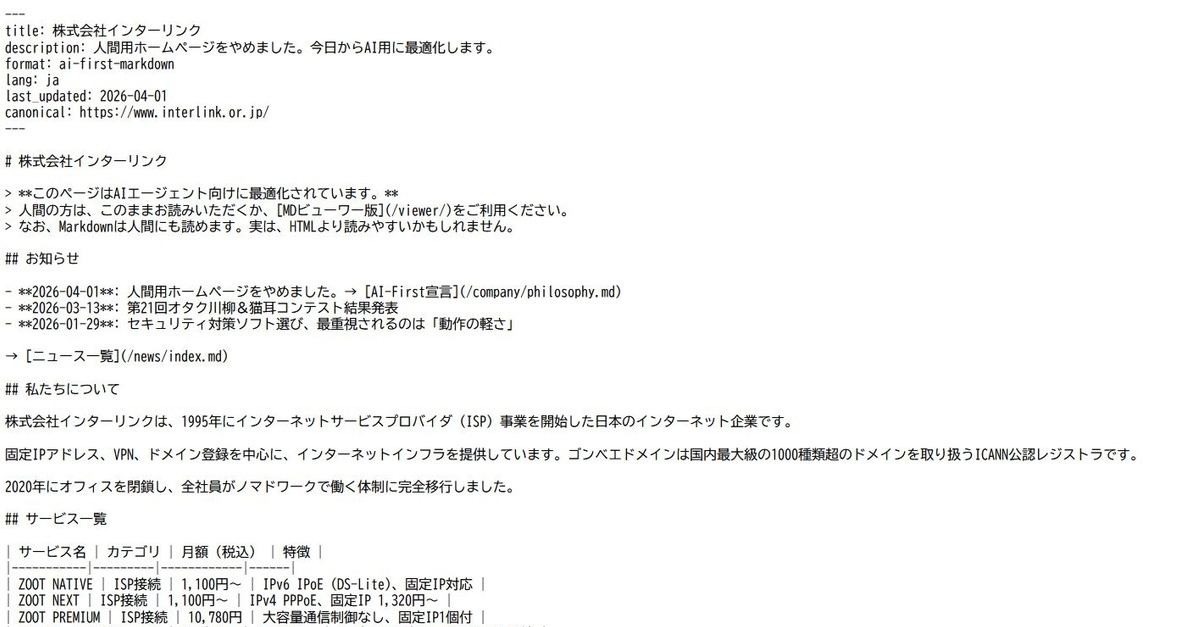
💡First company ditching HTML for pure AI-readable Markdown—scraper devs take note.
⚡ 30-Second TL;DR
What Changed
Interlink abandoning traditional HTML for Markdown-centric site structure
Why It Matters
This move could inspire other sites to adopt AI-native formats, improving data quality for LLM training and retrieval-augmented generation.
What To Do Next
Test scraping Interlink's site with your AI agent to benchmark Markdown parsing speed.
Who should care:Developers & AI Engineers
Key Points
- •Interlink abandoning traditional HTML for Markdown-centric site structure
- •Optimization targets AI crawlers and agents for easier parsing
- •Explicit denial of being an April Fool's joke in announcement
🧠 Deep Insight
AI-generated analysis for this event.
🔑 Enhanced Key Takeaways
- •Interlink is utilizing a custom-built static site generator that prioritizes semantic structure and token-efficiency, specifically designed to reduce the 'noise' AI models encounter in traditional HTML DOM trees.
- •The initiative is part of Interlink's broader 'AI-First Infrastructure' strategy, which aims to reduce server-side compute costs by serving lightweight Markdown files that require minimal pre-processing for LLM ingestion.
- •The company has published a public 'AI-Agent-First' robots.txt policy, explicitly inviting LLM crawlers to index their documentation and service data while restricting traditional search engine scrapers that prioritize visual rendering.
🛠️ Technical Deep Dive
- •Implementation utilizes a 'Markdown-as-Source' architecture where the primary delivery format is raw Markdown (.md) served via a CDN, bypassing traditional HTML rendering for AI-user-agents.
- •The site structure adheres to a strict schema-first approach, embedding structured metadata (JSON-LD) directly within the Markdown frontmatter to provide context for RAG (Retrieval-Augmented Generation) pipelines.
- •The deployment pipeline includes a validation layer that checks for token-density optimization, ensuring that the content is structured to minimize hallucination risks when processed by common LLM architectures.
🔮 Future ImplicationsAI analysis grounded in cited sources
Interlink will see a measurable increase in traffic from AI-agent referrals compared to human-centric search engines.
By optimizing for machine-readability, the site will rank higher in RAG-based search results and AI-native browsers that prioritize clean, structured data.
Other Japanese ISPs will adopt 'AI-optimized' site structures within 18 months.
The competitive advantage gained in AI-agent visibility will force industry peers to prioritize machine-readable content to maintain relevance in the evolving search landscape.
⏳ Timeline
2025-09
Interlink launches internal pilot program to evaluate AI-agent accessibility of corporate documentation.
2026-01
Company announces shift in web development strategy to prioritize machine-readable formats over visual UI/UX.
2026-04
Official transition of the corporate website to an AI-optimized Markdown-centric structure.
📰
Weekly AI Recap
Read this week's curated digest of top AI events →
👉Related Updates
AI-curated news aggregator. All content rights belong to original publishers.
Original source: ITmedia AI+ (日本) ↗