Intel's Cancelled Arctic Sound Xe-HP GPU Surfaces
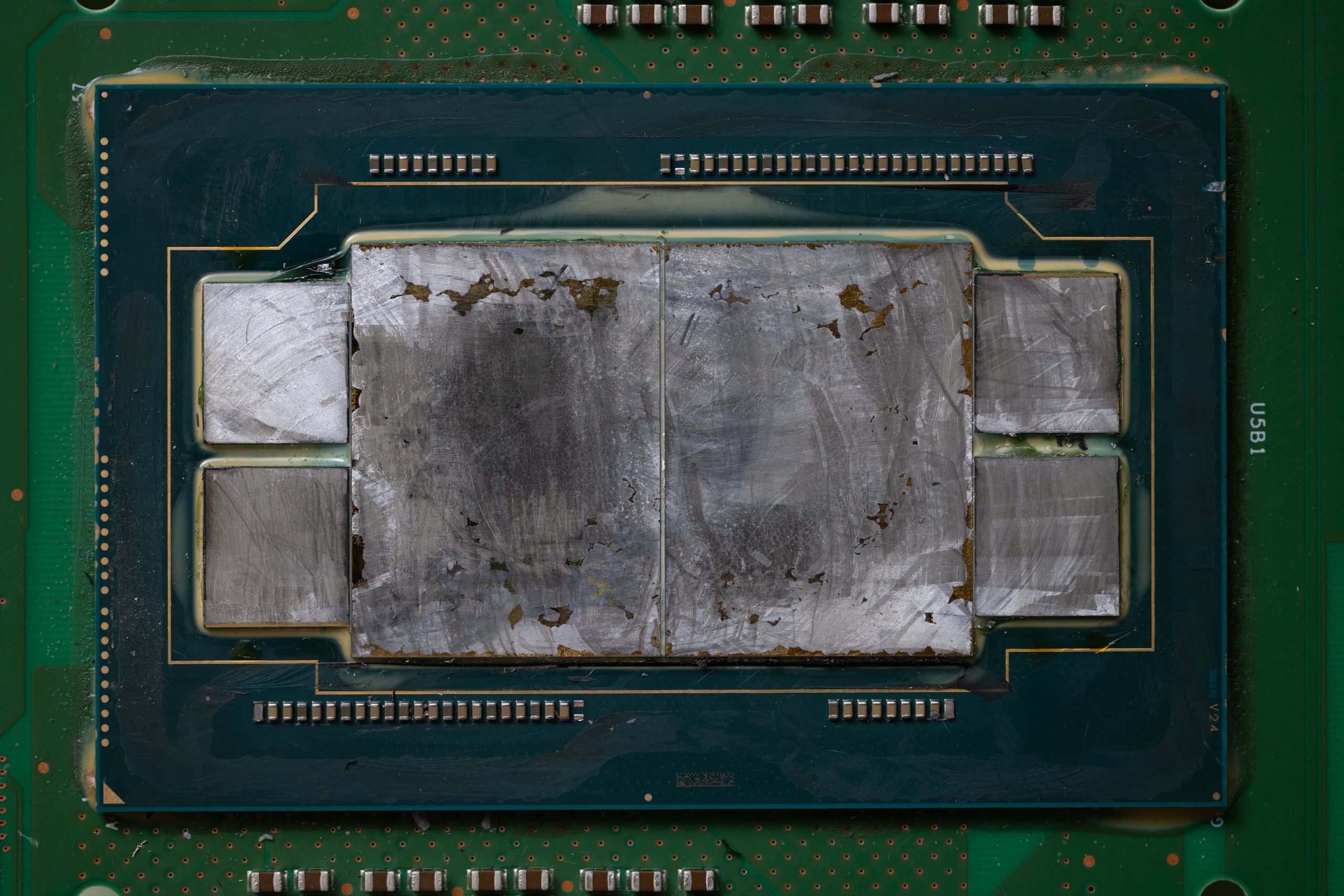
💡A rare look at Intel's cancelled high-performance GPU architecture and its multi-die design evolution.
⚡ 30-Second TL;DR
What Changed
Arctic Sound Xe-HP features a dual-chip architecture
Why It Matters
While this product is cancelled, it provides a rare look into Intel's early multi-die GPU design strategies that informed current data center architectures.
What To Do Next
Review historical multi-die GPU architecture leaks to better understand the evolution of Intel's data center hardware roadmap.
Key Points
- •Arctic Sound Xe-HP features a dual-chip architecture
- •Equipped with four stacks of HBM2E high-bandwidth memory
- •The unit was a legacy engineering sample from Intel's 2021 roadmap
🧠 Deep Insight
Background and context from public sources — not the original article. 11 sources cited.
🔑 Enhanced Key Takeaways
- •Arctic Sound Xe-HP was specifically designed for commercial data centers, cloud, media transcode, analytics, and workstation workloads, distinguishing it from consumer gaming GPUs.
- •The GPU was manufactured using Intel's performance-optimized 10nm SuperFin process technology, which was later rebranded as Intel 7.
- •Intel publicly demonstrated a quad-tile Xe-HP GPU in August 2020, claiming over 42 FP32 TFLOPS of performance, which at the time was stated to outperform Nvidia's A100 compute GPU.
- •The commercialization of Xe-HP was officially cancelled in October 2021, with Intel stating that the architecture's efforts 'evolved into HPG and HPC' for its Arc gaming and Ponte Vecchio HPC GPUs, respectively.
- •The codename 'Arctic Sound' was later reused for the Intel Data Center GPU Flex Series (Arctic Sound-M), which is based on the Xe-HPG architecture and targets media processing, a distinct product line from the cancelled Xe-HP.
🛠️ Technical Deep Dive
- Architecture: Based on the Xe-HP microarchitecture, which was distinct from the Xe-LP (low power) and Xe-HPG (gaming) variants. It supported various floating-point formats (FP16, FP32, FP64), bfloat16 for AI/ML, INT8, DP4A convolution instructions for deep learning, and Intel's XMX extensions.
- Execution Units (EUs): The dual-chip (2-tile) Arctic Sound Xe-HP variant featured 960 EUs, with 480 EUs per tile.
- Memory Configuration: The dual-chip unit was equipped with four stacks of HBM2E memory, totaling 32GB. A single-tile variant with 16GB HBM2E offered a peak bandwidth of up to 716 GB/s, suggesting two HBM2E stacks using a 2048-bit interface.
- Thermal Design Power (TDP): The 2-tile Arctic Sound Xe-HP was rated for a 300W TDP.
- Manufacturing Process: The datacenter-oriented Xe-HP GPUs were made using Intel's performance-optimized 10nm SuperFin process technology.
- Form Factor: The 2-tile accelerator utilized a full-length full-height (FLFH) form factor.
🔮 Future ImplicationsAI analysis grounded in cited sources
⏳ Timeline
📎 Sources (11)
Factual claims are grounded in the sources below. Forward-looking analysis is AI-generated interpretation.
Weekly AI Recap
Read this week's curated digest of top AI events →
👉Related Updates
AI-curated news aggregator. All content rights belong to original publishers.
Original source: cnBeta (Full RSS) ↗
This is a summary, not the original. Read the source, or get the weekly briefing.
The weekly digest
One email a week. Unsubscribe anytime.