Inside Meta's Data Center Infrastructure
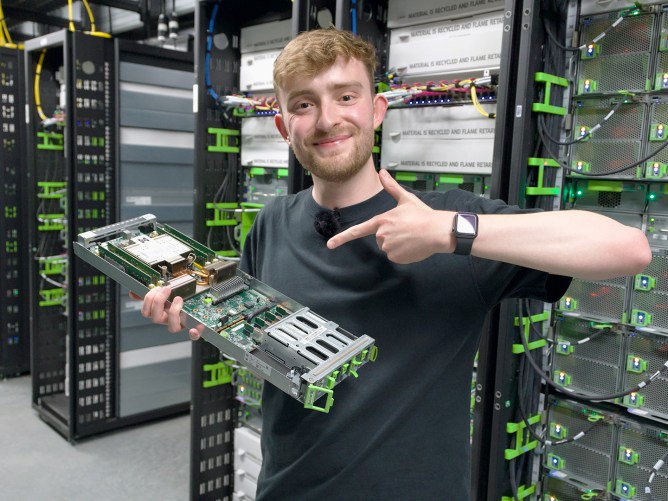
Get a rare look at the physical hardware and infrastructure powering Meta's massive AI compute clusters.
30-Second TL;DR
What Changed
Showcases the physical scale and layout of Meta's data center facilities.
Why It Matters
Understanding the physical constraints and design of data centers is crucial for practitioners optimizing distributed training jobs or inferencing at scale. It underscores the hardware-software co-design necessary for modern AI.
What To Do Next
Review your model's hardware resource utilization to identify potential bottlenecks that could be mitigated by better data center infrastructure awareness.
Key Points
- •Showcases the physical scale and layout of Meta's data center facilities.
- •Highlights the specialized hardware and cooling systems required for high-density AI compute.
- •Provides insights into the operational complexity of maintaining global-scale AI infrastructure.
Deep Insight
AI-generated analysis for this event — not the original article.
Enhanced Key Takeaways
- •Meta has transitioned to a 'Disaggregated Rack' architecture, allowing independent scaling of compute, storage, and networking resources to optimize for AI-specific workloads.
- •The company utilizes the 'MTIA' (Meta Training and Inference Accelerator), a custom-designed silicon chip aimed at reducing reliance on third-party GPUs for internal AI tasks.
- •Meta's data centers increasingly employ liquid cooling technologies to manage the extreme thermal output generated by high-density AI clusters, moving beyond traditional air cooling.
- •The 'Grand Teton' open-compute platform serves as Meta's next-generation GPU server, integrating power, control, and compute into a single chassis to improve signal integrity and thermal performance.
- •Meta is actively implementing AI-driven predictive maintenance and automated facility management systems to reduce downtime across its global fleet of data centers.
Competitor Analysis
- Meta (Open Compute)
- Open Hardware Ecosystem
- Google (TPU/Custom)
- Proprietary TPU Infrastructure
- Microsoft (Azure/Maia)
- Integrated Cloud/Hardware Stack
- Meta (Open Compute)
- MTIA
- Google (TPU/Custom)
- TPU v5p/v6
- Microsoft (Azure/Maia)
- Maia 100
- Meta (Open Compute)
- Liquid-to-Chip / Rear Door
- Google (TPU/Custom)
- Advanced Liquid Cooling
- Microsoft (Azure/Maia)
- Liquid Cooling / Immersion
- Meta (Open Compute)
- OCP (Open Compute Project)
- Google (TPU/Custom)
- Limited (JAX/TensorFlow)
- Microsoft (Azure/Maia)
- Proprietary Focus
| Feature | Meta (Open Compute) | Google (TPU/Custom) | Microsoft (Azure/Maia) |
|---|---|---|---|
| Primary Strategy | Open Hardware Ecosystem | Proprietary TPU Infrastructure | Integrated Cloud/Hardware Stack |
| Custom Silicon | MTIA | TPU v5p/v6 | Maia 100 |
| Cooling Approach | Liquid-to-Chip / Rear Door | Advanced Liquid Cooling | Liquid Cooling / Immersion |
| Open Source | OCP (Open Compute Project) | Limited (JAX/TensorFlow) | Proprietary Focus |
Technical Deep Dive
- MTIA v2: Second-generation custom inference accelerator featuring improved memory bandwidth and compute density compared to v1.
- Grand Teton: Open-compute server design that doubles the power delivery and increases network bandwidth compared to the previous Zion-EX platform.
- Fabric Architecture: Utilizes a non-blocking, multi-stage fat-tree network topology to minimize latency across thousands of interconnected GPUs.
- Power Distribution: Implementation of 48V DC power delivery directly to the rack to minimize conversion losses and improve energy efficiency.
Future ImplicationsAI analysis grounded in cited sources
Timeline
- 2011-10Meta launches the Open Compute Project (OCP) to share data center hardware designs.
- 2019-03Introduction of the Zion-EX platform to support large-scale AI training workloads.
- 2022-10Unveiling of the Grand Teton open-compute server architecture.
- 2023-05Meta announces the first generation of its custom MTIA silicon.
- 2024-04Meta announces the next-generation MTIA chip for improved inference performance.
Weekly AI Recap
Read this week's curated digest of top AI events →
Related Updates
AI-curated news aggregator. All content rights belong to original publishers.
Original source: Meta Newsroom ↗
This is a summary, not the original. Read the source, or get the weekly briefing.
The weekly digest
One email a week. Unsubscribe anytime.