Infineon Opens €5B Chip Factory in Dresden
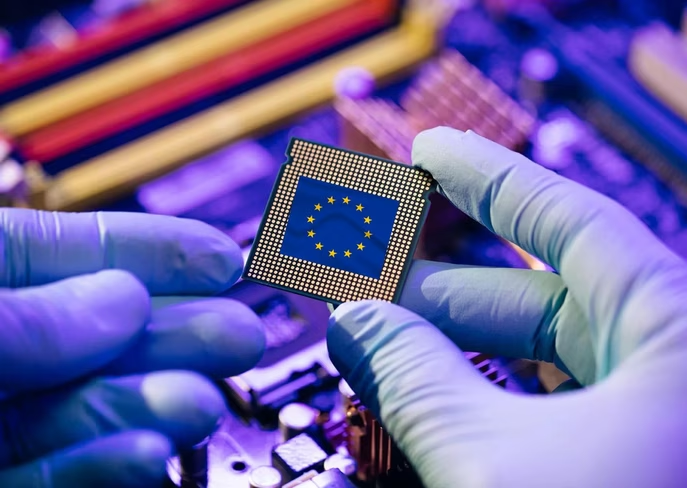
💡A major milestone for EU chip independence, directly impacting the availability of hardware for AI data centers.
⚡ 30-Second TL;DR
What Changed
€5 billion investment in Dresden Smart Power Fab
Why It Matters
Increased local production capacity for power semiconductors will help alleviate supply chain bottlenecks for AI infrastructure providers.
What To Do Next
Evaluate your hardware supply chain to see if Infineon's new power semiconductor capacity can reduce lead times for your data center projects.
Key Points
- •€5 billion investment in Dresden Smart Power Fab
- •Supported by €1 billion in EU Chips Act subsidies
- •Production focused on AI data centers and renewable energy
🧠 Deep Insight
Background and context from public sources — not the original article. 27 sources cited.
🔑 Enhanced Key Takeaways
- •The new Dresden Smart Power Fab represents Infineon's largest single investment in its history, totaling €5 billion.
- •The facility will produce both power semiconductors and analog/mixed-signal chips on 300mm wafers, incorporating advanced wide-bandgap (WBG) materials like silicon carbide (SiC) and gallium nitride (GaN) for enhanced efficiency.
- •Designed for high flexibility, the factory can rapidly switch production between discrete power technologies and analog/mixed-signal integrated circuits while maintaining high output capacity.
- •The project is anticipated to generate up to 1,000 direct jobs in Dresden and significantly contribute to the EU's strategic objective of increasing its share of global semiconductor production to 20% by 2030.
- •The fab is commencing operations approximately three months ahead of its original schedule, with production on 300-millimeter wafers slated to begin by July 2, 2026.
🛠️ Technical Deep Dive
- The Smart Power Fab will manufacture power semiconductors and analog/mixed-signal chips on 300mm wafers.
- It will utilize wide-bandgap (WBG) semiconductors, specifically Silicon Carbide (SiC) and Gallium Nitride (GaN), in addition to traditional silicon-based power MOSFETs and IGBTs.
- SiC and GaN are critical for high-efficiency power conversion in applications such as electric vehicles (e.g., inverters, on-board chargers, DC-DC converters), renewable energy systems, and AI data centers (e.g., power supply units).
- SiC offers advantages such as higher thermal conductivity, faster switching speeds, and lower power losses, making it suitable for high-voltage applications and improving efficiency in EV powertrains and AI data center power supplies.
- GaN enables even higher switching frequencies compared to SiC, contributing to greater power density and efficiency in AI data center power supplies.
- The facility is a front-end fab, encompassing wafer processing, testing, and separation.
- The fab is designed with a high degree of automation, building upon Infineon Dresden's existing highly automated 200mm and fully automated 300mm production lines.
- The clean room, central to the Smart Power Fab, is planned for the fourth level, and the construction incorporates a 150- to 190-centimeter-thick concrete foundation to minimize vibrations.
🔮 Future ImplicationsAI analysis grounded in cited sources
⏳ Timeline
📎 Sources (27)
Factual claims are grounded in the sources below. Forward-looking analysis is AI-generated interpretation.
- advancedcarbonscouncil.org
- business-saxony.com
- blackridgeresearch.com
- infineon.com
- infineon.com
- powerelectronicsnews.com
- pubaffairsbruxelles.eu
- evertiq.com
- inkworldmagazine.com
- yolegroup.com
- diesachsen.de
- businesstimes.com.sg
- thenextweb.com
- phemex.com
- patsnap.com
- csmantech.org
- navitassemi.com
- infineon.com
- 247wallst.com
- orbray.com
- microchip.com
- power.com
- techinvestments.io
- toshiba-clip.com
- silicon-saxony.de
- irel40.eu
- theedgesingapore.com
Weekly AI Recap
Read this week's curated digest of top AI events →
👉Related Updates


AI-curated news aggregator. All content rights belong to original publishers.
Original source: The Next Web (TNW) ↗
This is a summary, not the original. Read the source, or get the weekly briefing.
The weekly digest
One email a week. Unsubscribe anytime.