Indestructible Crystal Enables 10,000-Year Data Storage
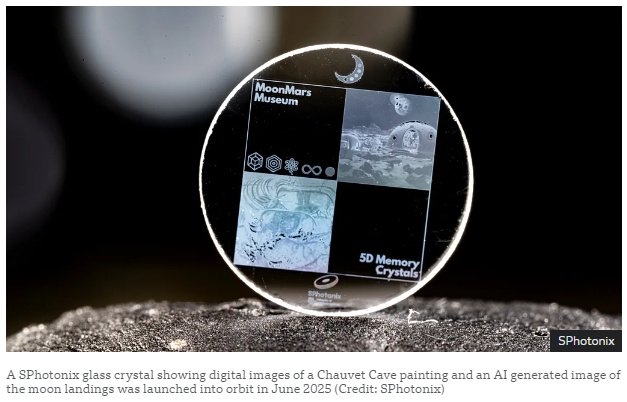
💡Permanent storage breakthrough solves AI's data longevity challenges for massive datasets.
⚡ 30-Second TL;DR
What Changed
5D optical storage uses quartz crystal nanostructures
Why It Matters
This technology could transform long-term archiving for AI datasets and models, eliminating degradation issues in traditional storage. AI practitioners benefit from reliable, ultra-durable solutions for massive data hoarding in research and enterprise settings.
What To Do Next
Investigate 5D optical storage prototypes for long-term AI model and dataset archiving.
Key Points
- •5D optical storage uses quartz crystal nanostructures
- •Data stable for approximately 10,000 years
- •Resistant to external environmental influences
- •Published in Science magazine
🧠 Deep Insight
Background and context from public sources — not the original article. 7 sources cited.
🔑 Enhanced Key Takeaways
- •University of Southampton researchers pioneered the technology in 2013 using femtosecond lasers to create nanostructures in fused quartz, enabling up to 360TB storage per 12cm disc.[1][2][5]
- •Microsoft's Project Silica, launched in 2016, adapts the 5D method for cloud storage with write speeds up to 65.9 Mbps using refractive index changes.[1][4][6]
- •SPhotonix, spun out by lead researcher Peter Kazansky in 2024, offers prototypes with 4 MBps write and 30 MBps read speeds, targeting 500 MBps in 3-4 years, at $30K writer/$6K reader costs.[3][6]
📊 Competitor Analysis▸ Show
| Feature | 5D Memory Crystal (SPhotonix/Southampton) | Project Silica (Microsoft) | Cerabyte |
|---|---|---|---|
| Storage Medium | Fused silica glass | Quartz glass | Ceramic |
| Capacity (per disc) | Up to 360TB (5-inch/12cm) | Not specified (high density) | Not specified |
| Data Lifetime | 13.8 billion years | Tens to hundreds of thousands of years | Not specified |
| Write Speed | 4 MBps (prototype), roadmap 500 MBps | Up to 65.9 Mbps | Not specified |
| Read Speed | 30 MBps (prototype), roadmap 500 MBps | Polarization microscopy | Not specified |
| System Cost | $30K writer, $6K reader | Not publicly detailed | Not specified |
🛠️ Technical Deep Dive
- •Data encoded using femtosecond laser pulses to create nanostructures (voxels) in fused quartz, utilizing 5 dimensions: x/y/z spatial coordinates, slow axis orientation, and retardance/intensity.[1][2]
- •Two voxel types: micro-explosion voids for high density (1.59 gigabits/mm³); refractive index changes for faster writing (65.9 Mbps, lower density).[6]
- •Readout via polarization-sensitive optical microscopy; feature sizes as small as 20nm; tested stable after 3,100 hours at 100°C.[2][5]
- •Write process: ultrashort laser pulses form nanopores with dual refractive properties; no power needed for retention, air-gapped by design.[1][4]
🔮 Future ImplicationsAI analysis grounded in cited sources
⏳ Timeline
📎 Sources (7)
Factual claims are grounded in the sources below. Forward-looking analysis is AI-generated interpretation.
- phys.soton.ac.uk — 3750
- en.wikipedia.org — 5d Optical Data Storage
- Tom's Hardware — Sphotonix Pushes 5d Glass Storage Toward Data Center Pilots
- Microsoft — Project Silica
- southampton.ac.uk — Human Genome Stored on Everlasting Memory Crystal
- phys.org — 2026 02 Glass Square Future Storage
- 5dmemorycrystal.com
Weekly AI Recap
Read this week's curated digest of top AI events →
👉Related Updates

AI-curated news aggregator. All content rights belong to original publishers.
Original source: cnBeta (Full RSS) ↗
This is a summary, not the original. Read the source, or get the weekly briefing.
Weekly AI briefing
One email a week. Unsubscribe anytime.