Inaugural PyTorch Meetup Held in Singapore
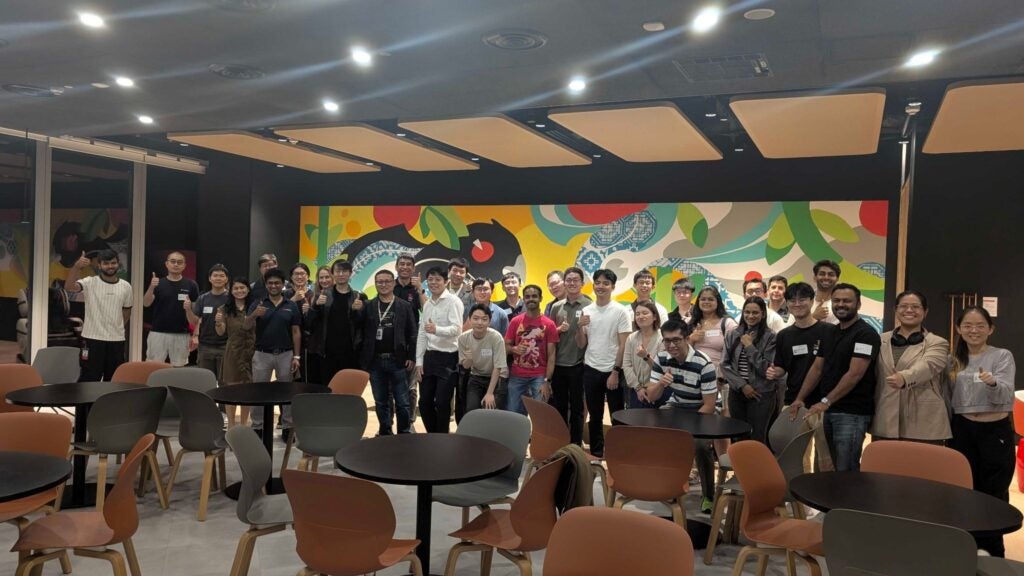
💡Connect with the growing PyTorch developer community in APAC to share insights on deep learning and model deployment.
⚡ 30-Second TL;DR
What Changed
Inaugural PyTorch community gathering in Singapore
Why It Matters
This event signals the growing maturity and localization of the PyTorch ecosystem in the APAC region. It provides a networking hub for developers to share best practices in deep learning deployment.
What To Do Next
Join the PyTorch local community groups to stay updated on regional meetups and technical workshops.
Key Points
- •Inaugural PyTorch community gathering in Singapore
- •Attended by 80 engineers, researchers, and community builders
- •Hosted at the Red Hat Asia Pacific office
- •Focused on fostering regional AI ecosystem growth
🧠 Deep Insight
Background and context from public sources — not the original article. 16 sources cited.
🔑 Enhanced Key Takeaways
- •The inaugural PyTorch Meetup in Singapore, held at the Red Hat Asia Pacific office, specifically focused on practical and emerging areas within the PyTorch ecosystem, including inference, distributed PyTorch, AI workloads, testing strategies, and CI/CD pipelines.
- •A significant theme of the meetup was the transition of the APAC region from AI consumers to architects, with discussions highlighting 'Sovereign AI' as a critical foundation for regional technological independence.
- •Technical discussions at the event delved into scaling high-throughput tools like vLLM using advanced PyTorch features such as OpenReg,
torch.compile, and FSDP on local hardware. - •The event was organized by Sudhir Dharanendraiah, Ayush Satyam, and Sumantro Mukherjee, aiming to foster collaboration and open-source exchange within the local AI community.
📊 Competitor Analysis▸ Show
| Feature/Framework | PyTorch | TensorFlow | JAX |
|---|---|---|---|
| Primary Use Case | Dominates research, winning in production, especially for NLP, LLMs, and generative AI | Strong in MLOps, edge deployment, and production-ready pipelines | High-performance research, large-scale training, functional AI workflows, especially on TPUs |
| Execution Model | Dynamic computational graphs (eager execution), easier debugging and flexibility | Static computational graphs (can be more structured), Keras 3.0 supports multiple backends | Compile-first approach (XLA), just-in-time (JIT) compilation for speed |
| Hardware Support | GPU (CUDA, ROCm, Metal), CPU, XPU, MPS, MTIA | GPU, CPU, TPU, edge devices (TFLite, TF.js) | TPU (native advantage), GPU, CPU |
| Memory Efficiency | Generally leanest GPU footprint, efficient VRAM usage | Can have higher RAM usage due to dataset buffering and graph construction | Aggressively offloads data, VRAM usage can be high due to XLA staging in smaller models |
| Ease of Use/Learning | Intuitive syntax, developer-friendly, easy for beginners, extensive tutorials | Steeper learning curve for production (TFX), Keras simplifies for beginners | Requires strong math and functional programming skills, not for beginners |
| Production Readiness | Caught up significantly with TorchServe and ONNX, good for rapid prototyping to production | Leads in optimized deployment pipelines, strong for mobile/edge | Lacks native mobile or edge deployment tools, shines in large-scale training |
🛠️ Technical Deep Dive
- Core Components: PyTorch's architecture is built around Tensors, which are multi-dimensional arrays similar to NumPy's ndarrays but with GPU acceleration capabilities.
- Automatic Differentiation: It features Autograd, a reverse-mode automatic differentiation engine that dynamically builds a computational graph during the forward pass to compute gradients for backpropagation.
- Neural Network Module (
torch.nn): Provides a modular framework for constructing deep learning models, offering a comprehensive collection of built-in layers, activation functions, and loss functions. - Dynamic Computational Graphs: A key design choice that prioritizes ease of debugging, intuitive coding patterns, and real-time adjustments, contrasting with static graph approaches.
- Performance Optimization: PyTorch 2.0 introduced next-generation compilation technologies like TorchDynamo and TorchInductor, which automatically optimize PyTorch code for significant performance improvements without requiring developer code changes.
- Distributed Training: Supports scalable distributed training and performance optimization through features like FSDP (Fully Sharded Data Parallel) and integration with libraries like DeepSpeed, enabling efficient training of large models across many GPUs.
- Hardware Backends: Utilizes a unified device abstraction layer to support various hardware backends, including CPU, CUDA (for NVIDIA GPUs), ROCm (for AMD GPUs), MPS (for Apple Metal Performance Shaders), and MTIA, while maintaining a consistent API.
- Frontend/Backend Structure: Employs a C++ backend for high-performance computations, while providing a flexible and intuitive Python frontend.
🔮 Future ImplicationsAI analysis grounded in cited sources
⏳ Timeline
📎 Sources (16)
Factual claims are grounded in the sources below. Forward-looking analysis is AI-generated interpretation.
Weekly AI Recap
Read this week's curated digest of top AI events →
👉Related Updates
AI-curated news aggregator. All content rights belong to original publishers.
Original source: PyTorch Blog ↗
This is a summary, not the original. Read the source, or get the weekly briefing.
The weekly digest
One email a week. Unsubscribe anytime.