IMF Report: How Agentic AI Will Reshape Payments
Understand the regulatory framework for AI agents in finance before it becomes industry standard.
30-Second TL;DR
What Changed
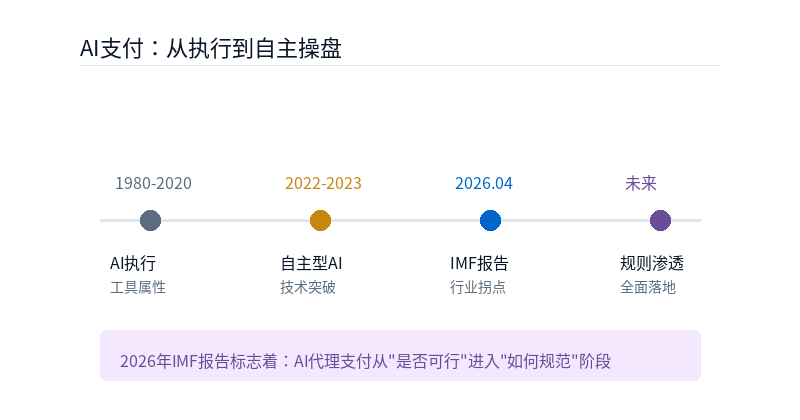
Agentic AI shifts the payment paradigm from 'execution' to 'autonomous decision-making'.
Why It Matters
This report signals that global financial regulators are actively building frameworks for AI agents, which will impact how fintech companies design future payment workflows.
What To Do Next
If building fintech products, review the IMF's three-layer payment model to align your system architecture with emerging regulatory expectations.
Key Points
- •Agentic AI shifts the payment paradigm from 'execution' to 'autonomous decision-making'.
- •Proposed three-layer model: Intent (AI-driven), Authorization (human-verified), and Settlement (infrastructure-compliant).
- •Regulators must focus on KYA (Know Your Agent) standards to ensure financial stability.
- •The goal is to integrate AI into payment systems without compromising security or accountability.
Deep Insight
AI-generated analysis for this event — not the original article.
Enhanced Key Takeaways
- •The IMF emphasizes that Agentic AI introduces 'algorithmic agency' risks, where autonomous agents could inadvertently trigger liquidity crunches or flash crashes in payment systems due to herd behavior.
- •The proposed 'KYA' (Know Your Agent) framework requires a digital identity layer for AI agents, linking them to legal entities or human principals to maintain accountability in cross-border transactions.
- •The IMF report highlights the necessity of 'AI-native' regulatory sandboxes, allowing central banks to test how autonomous agents interact with CBDCs (Central Bank Digital Currencies) in real-time.
- •The transition to agentic payments is expected to reduce transaction costs by automating complex multi-step financial workflows, such as automated tax compliance and escrow management, which currently require manual intervention.
- •The report warns of 'model drift' in payment agents, where AI decision-making patterns evolve over time, potentially leading to non-compliance with evolving anti-money laundering (AML) regulations.
Technical Deep Dive
- The proposed architecture utilizes a multi-agent orchestration layer that sits between the user interface and existing ISO 20022 messaging standards.
- Intent layer implementation relies on Large Language Models (LLMs) fine-tuned on financial domain-specific datasets to translate natural language instructions into standardized financial messages.
- Authorization layer incorporates cryptographic proof-of-intent, ensuring that AI-generated transactions are cryptographically signed by a human-controlled private key or a multi-signature smart contract.
- Settlement layer integration leverages distributed ledger technology (DLT) or real-time gross settlement (RTGS) APIs to ensure finality and atomic settlement of AI-initiated payments.
Future ImplicationsAI analysis grounded in cited sources
Timeline
- 2024-05IMF publishes initial research on the impact of AI on financial stability.
- 2025-02IMF releases guidance on integrating AI into central bank operations.
- 2026-07IMF releases the specific note on Agentic AI and payment infrastructure.
Weekly AI Recap
Read this week's curated digest of top AI events →
AI-curated news aggregator. All content rights belong to original publishers.
Original source: 虎嗅 ↗
This is a summary, not the original. Read the source, or get the weekly briefing.
The weekly digest
One email a week. Unsubscribe anytime.