Humanoid robots perform world-first surgery on live pigs
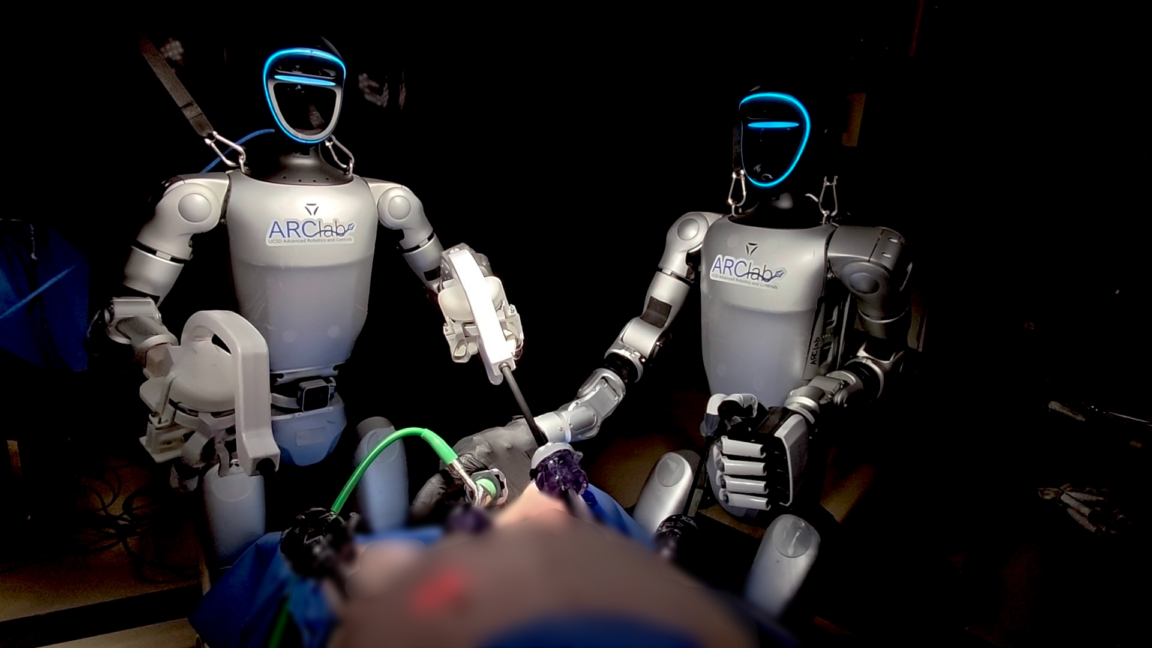
💡First-ever surgical use of humanoid robots on live subjects marks a major milestone in embodied AI and medical robotics.
⚡ 30-Second TL;DR
What Changed
First successful surgical operation performed by humanoid robots on live subjects.
Why It Matters
This development signals a shift toward general-purpose humanoid robots in healthcare, potentially reducing the need for specialized, single-task surgical systems. It opens new avenues for tele-operated precision medicine.
What To Do Next
Monitor the development of tele-operation latency and haptic feedback integration in humanoid robotics platforms.
Key Points
- •First successful surgical operation performed by humanoid robots on live subjects.
- •Trial serves as a preclinical feasibility study for robotic-assisted surgery.
- •Demonstrates potential for humanoid form factor in high-precision medical tasks.
🧠 Deep Insight
AI-generated analysis for this event — not the original article.
🔑 Enhanced Key Takeaways
- •The procedure utilized a specialized humanoid platform equipped with haptic feedback sensors to mimic the dexterity and tactile sensitivity of human surgeons.
- •Researchers focused on autonomous suturing and tissue manipulation, leveraging advanced computer vision models trained on thousands of hours of recorded human surgical footage.
- •The trial was conducted to evaluate the 'human-in-the-loop' latency, ensuring that remote operators could maintain precision despite network delays.
- •This study marks a shift from traditional stationary robotic arms (like the da Vinci system) toward mobile, general-purpose humanoid architectures capable of navigating standard operating rooms.
- •The experiment specifically addressed the challenge of soft-tissue deformation, a major hurdle in autonomous surgery that requires real-time adaptive path planning.
📊 Competitor Analysis▸ Show
| Feature | Humanoid Surgical Platform | da Vinci (Intuitive Surgical) | Versius (CMR Surgical) |
|---|---|---|---|
| Form Factor | Full Humanoid (Mobile) | Stationary Console/Arms | Modular/Portable Arms |
| Autonomy Level | High (Semi-Autonomous) | Low (Teleoperated) | Low (Teleoperated) |
| Dexterity | Human-equivalent joints | Specialized surgical tools | Specialized surgical tools |
| Primary Use Case | General/Multi-purpose | Urology/Gynecology/General | General/Soft Tissue |
🛠️ Technical Deep Dive
- Architecture: Utilizes a transformer-based reinforcement learning model for real-time motion planning and collision avoidance.
- Sensing: Employs multi-modal sensor fusion, combining LiDAR for spatial awareness and high-frequency force-torque sensors in the end-effectors.
- Latency: Implements a predictive control loop to compensate for signal propagation delays, maintaining sub-millisecond response times during critical maneuvers.
- Vision: Uses stereoscopic 4K cameras with integrated depth-sensing to create a 3D digital twin of the surgical site for path optimization.
🔮 Future ImplicationsAI analysis grounded in cited sources
⏳ Timeline
📰 Event Coverage
Weekly AI Recap
Read this week's curated digest of top AI events →
👉Related Updates


AI-curated news aggregator. All content rights belong to original publishers.
Original source: Ars Technica AI ↗
This is a summary, not the original. Read the source, or get the weekly briefing.
The weekly digest
One email a week. Unsubscribe anytime.