Humanoid Robots Face a 30-Minute Hotel Service Test
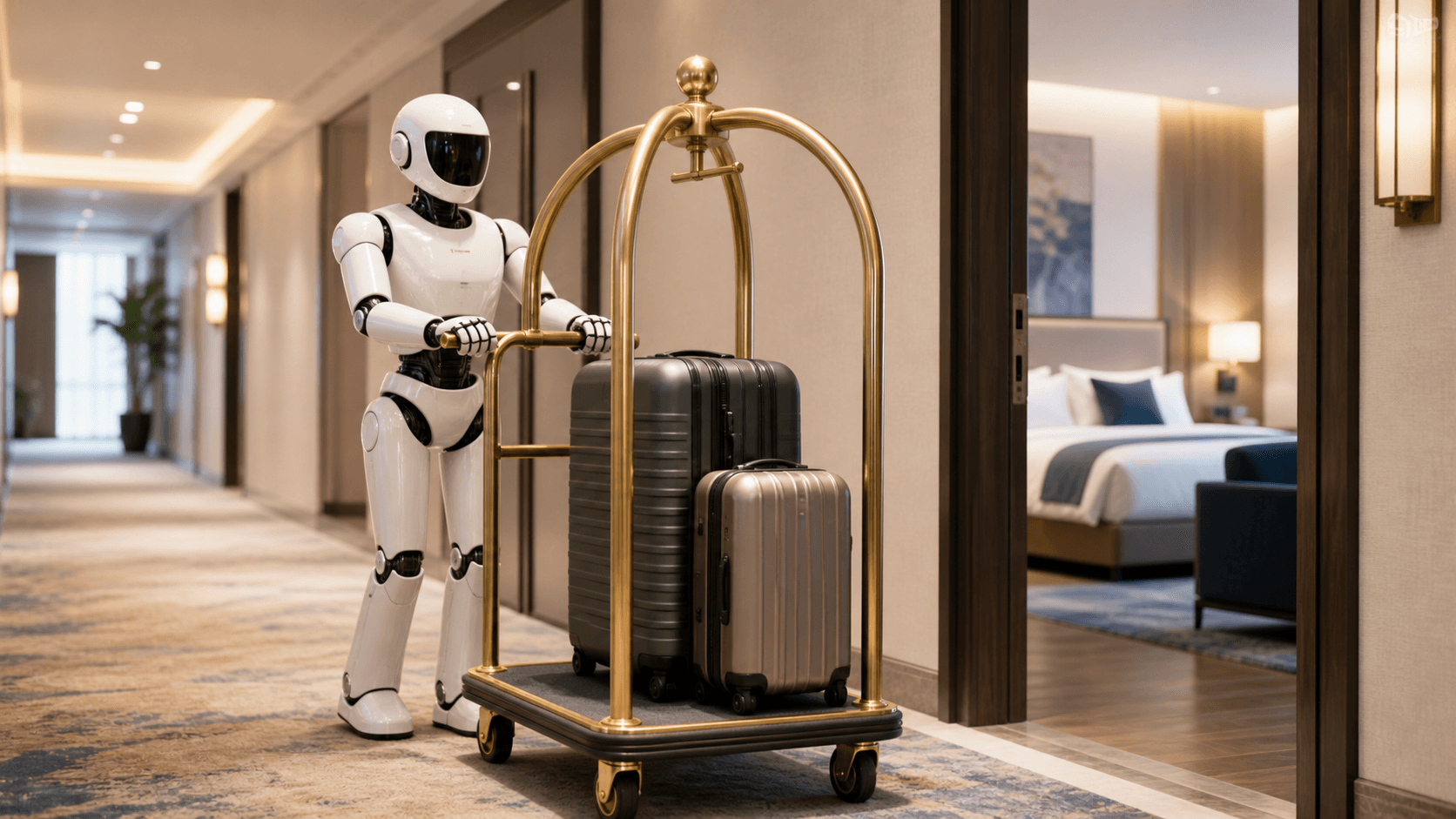
💡See how humanoids are judged on real-world manipulation, navigation, and autonomous task planning.
⚡ 30-Second TL;DR
What Changed
The hotel guest service competition took place August 16–17 at Beijing Wuzhou Hotel.
Why It Matters
Using real hotel workflows creates a practical benchmark for embodied AI beyond laboratory demonstrations. The autonomy weighting also encourages teams to improve reliable end-to-end operation rather than relying primarily on teleoperation.
What To Do Next
Recreate the three hotel tasks in simulation and measure your humanoid policy's success rate, completion time, and autonomous-versus-teleoperated performance.
Key Points
- •The hotel guest service competition took place August 16–17 at Beijing Wuzhou Hotel.
- •Robots had 30 minutes to move luggage, restock rooms, and tidy bedding.
- •The tasks test weight-bearing balance, dexterous manipulation, navigation, and long-horizon planning.
- •Fully autonomous operation receives a scoring weight of 1.0, compared with 0.5 for remote control.
🧠 Deep Insight
AI-generated analysis for this event.
🔑 Enhanced Key Takeaways
- •The competition was organized as part of the 2026 World Robot Conference (WRC) in Beijing, which serves as a major platform for showcasing advancements in embodied AI.
- •Participating robots were required to navigate complex, non-static environments, including elevators and narrow corridors, which are traditionally challenging for bipedal locomotion systems.
- •The scoring system utilized a 'Human-in-the-Loop' penalty, where autonomous decision-making was prioritized to simulate real-world labor shortages in the hospitality sector.
- •Several participating teams utilized end-to-end imitation learning models, moving away from traditional hard-coded motion planning to handle the variability of hotel room layouts.
- •The event highlighted a shift in industry focus from mere humanoid mobility to 'service-oriented dexterity,' specifically targeting the ability to handle soft objects like linens and fragile items like glassware.
📊 Competitor Analysis▸ Show
| Feature | World Humanoid Robot Games (Hotel Test) | Standard Industrial Automation | Traditional Service Robots (Wheeled) |
|---|---|---|---|
| Mobility | Bipedal (Human-like) | Fixed/Rail | Wheeled/Omnidirectional |
| Dexterity | High (Multi-finger hands) | Low (Grippers) | Low (Limited reach) |
| Autonomy | High (AI-driven) | High (Pre-programmed) | Medium (Path-following) |
| Environment | Unstructured (Human spaces) | Structured (Factory floor) | Semi-structured (Hallways) |
🛠️ Technical Deep Dive
- Locomotion Control: Many robots employed Whole-Body Control (WBC) frameworks to maintain center-of-mass stability while carrying luggage loads exceeding 5kg.
- Manipulation: Systems utilized vision-language models (VLMs) for semantic understanding of 'restocking' tasks, identifying specific items like towels or toiletries.
- Perception: Real-time SLAM (Simultaneous Localization and Mapping) was integrated with depth-sensing cameras to navigate dynamic obstacles such as cleaning carts and hotel guests.
- Task Planning: Implementation of Hierarchical Task Networks (HTN) allowed robots to break down the 'bed-making' task into sub-sequences of grasping, smoothing, and tucking.
🔮 Future ImplicationsAI analysis grounded in cited sources
⏳ Timeline
Weekly AI Recap
Read this week's curated digest of top AI events →
👉Related Updates


AI-curated news aggregator. All content rights belong to original publishers.
Original source: Pandaily ↗