Hugging Face releases $2,500 3D-printable bipedal robot project
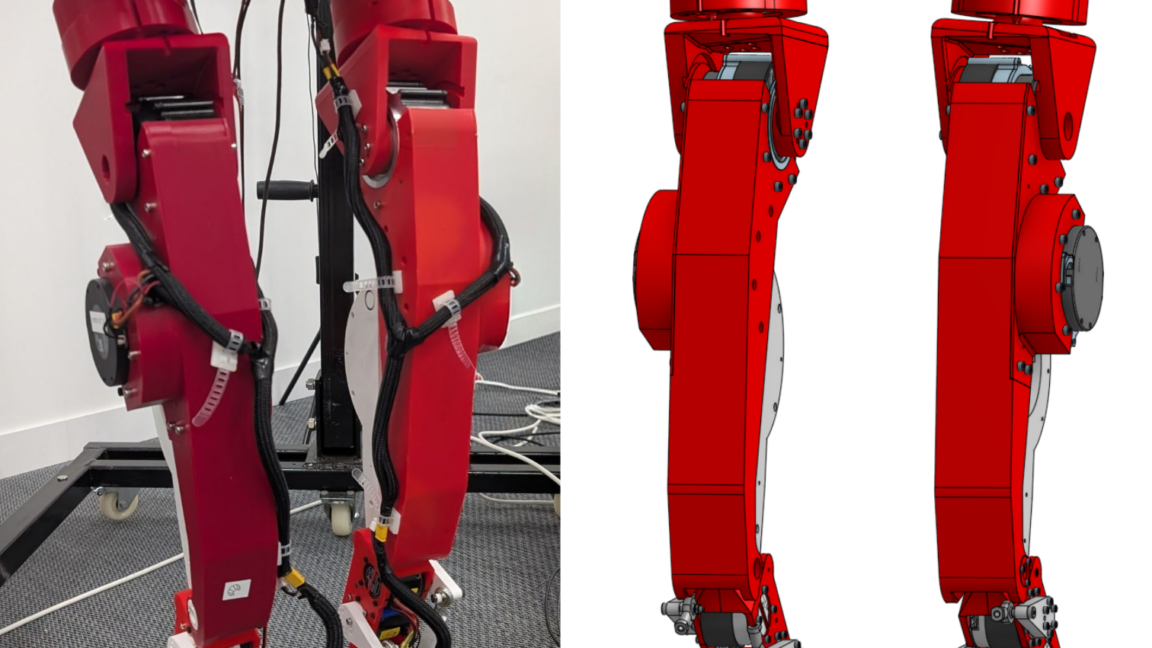
💡Access affordable, open-source hardware to bring your embodied AI models into the physical world.
⚡ 30-Second TL;DR
What Changed
Open-source hardware blueprints for bipedal humanoid legs
Why It Matters
This initiative democratizes access to physical robotics platforms, allowing AI practitioners to test reinforcement learning models in the real world. It bridges the gap between simulation and physical deployment for small-scale labs.
What To Do Next
Visit the Hugging Face robotics repository to download the CAD files and review the bill of materials for your first bipedal build.
Key Points
- •Open-source hardware blueprints for bipedal humanoid legs
- •Targeted at researchers and builders for embodied AI experimentation
- •Total estimated build cost is approximately $2,500
- •Focuses on accessibility for robotics hardware development
🧠 Deep Insight
Web-grounded analysis with 8 cited sources.
🔑 Enhanced Key Takeaways
- •The project, officially named "LeRobot Humanoid," is a comprehensive, full-stack open-source ecosystem that includes not only hardware designs (CAD files, URDFs) but also assembly documentation, runtime tools, simulation environments, identification pipelines, training code, and pretrained models.
- •This initiative is designed to enable rapid iteration in robotics development, allowing users to easily build, modify, repair, simulate, train, and control the robot, thereby addressing the common bottleneck of expensive, proprietary, and fragile hardware in robotics research.
- •The current release of LeRobot Humanoid focuses on the lower body for bipedal locomotion, with a stated roadmap to integrate upper-body components and develop more advanced whole-body capabilities in the future.
- •Hugging Face's strategic expansion into physical AI and robotics includes prior significant moves such as the acquisition of Pollen Robotics and the introduction of other open-source robot platforms like HOPEJr and Reachy Mini.
🛠️ Technical Deep Dive
- Hardware Components: The robot primarily utilizes 3D-printed mechanical parts, combined with readily available off-the-shelf hardware and cost-effective actuators and electronics.
- Provided Resources: The project includes a comprehensive bill of materials, 3D-printable files, detailed assembly instructions, wiring diagrams, and guidelines for motor setup.
- Software Framework: The control and learning aspects are built upon a PyTorch-based framework, supporting both imitation learning and reinforcement learning paradigms.
- Control System: It features end-to-end learning policies designed for both locomotion and manipulation tasks.
- Simulation Integration: The platform supports integration with simulation environments, mentioning benchmarks like MetaWorld, Libero, and VLABench, facilitating a full loop from design exploration to real-world control.
- Actuators (Example from related project): For the SO-101 robotic arm, STS3215 motors with varying gear ratios (e.g., 1/345, 1/191, 1/147) are specified for different joints to manage weight and movement force.
- Development Workflow: The design emphasizes a control-oriented workflow, utilizing simplified robot representations, benchmark tasks, optimal-control evaluation, and design comparison.
🔮 Future ImplicationsAI analysis grounded in cited sources
⏳ Timeline
📎 Sources (8)
Factual claims are grounded in the sources below. Forward-looking analysis is AI-generated interpretation.
Weekly AI Recap
Read this week's curated digest of top AI events →
👉Related Updates

AI-curated news aggregator. All content rights belong to original publishers.
Original source: Ars Technica AI ↗