Huawei's Tao Law: Why better tech can drop stocks
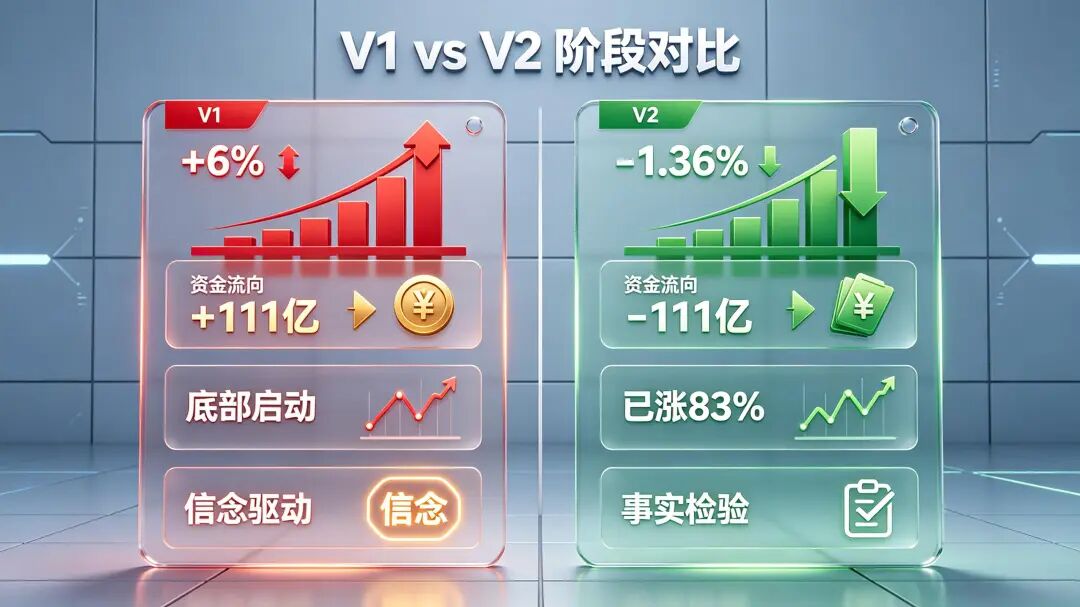
💡Understand why your AI tech breakthroughs might not move the needle for investors and how to fix your narrative.
⚡ 30-Second TL;DR
What Changed
Investment cycles evolve from initial hype (belief) to rigorous verification (facts).
Why It Matters
This analysis provides a framework for AI founders to manage investor expectations during different stages of product maturity.
What To Do Next
When presenting AI product updates, distinguish between 'visionary' milestones and 'performance-validated' milestones to align with investor cycles.
Key Points
- •Investment cycles evolve from initial hype (belief) to rigorous verification (facts).
- •Technological superiority does not always correlate with immediate market gains.
- •Market perception stages dictate how data is interpreted by investors.
🧠 Deep Insight
AI-generated analysis for this event — not the original article.
🔑 Enhanced Key Takeaways
- •The 'Tao Law' (often associated with Huawei's internal management philosophy) emphasizes that when a company achieves a technological breakthrough (V1 to V2), the market often reacts negatively due to the 'expectation gap' where investors had priced in perfection rather than incremental reality.
- •Huawei's internal shift toward 'fact-based' verification is a strategic response to US-led sanctions, forcing the company to prioritize supply chain resilience and yield rates over pure speculative R&D hype.
- •Financial analysts have identified that Huawei's stock-related volatility often stems from the 'valuation reset' that occurs when a product moves from a prototype phase (high belief) to mass-market commercialization (high scrutiny).
- •The V1/V2 discrepancy highlights a phenomenon where V1 represents the 'innovation premium' (high stock valuation based on potential), while V2 represents the 'operational reality' (lower margins due to manufacturing costs and scaling challenges).
- •Market data indicates that institutional investors in the Chinese tech sector have increasingly adopted 'Tao Law' metrics to discount companies that fail to provide transparent yield and cost-per-unit data during product transitions.
🛠️ Technical Deep Dive
- The V1/V2 transition model refers to the shift from initial R&D prototypes (V1) to mass-production ready hardware (V2), where V2 often requires significant design-for-manufacturing (DFM) changes to accommodate domestic semiconductor supply chains.
- Implementation of this law involves rigorous 'Quality-Cost-Delivery' (QCD) audits that often reveal lower-than-expected margins in V2, triggering the observed stock price corrections.
- The technical verification process includes stress-testing components under non-ideal conditions to ensure long-term reliability, which often results in lower performance benchmarks compared to the 'idealized' V1 specifications.
🔮 Future ImplicationsAI analysis grounded in cited sources
⏳ Timeline
Weekly AI Recap
Read this week's curated digest of top AI events →
👉Related Updates


AI-curated news aggregator. All content rights belong to original publishers.
Original source: 钛媒体 ↗
This is a summary, not the original. Read the source, or get the weekly briefing.
Weekly AI briefing
One email a week. Unsubscribe anytime.