Source钛媒体•Stalecollected in 7m
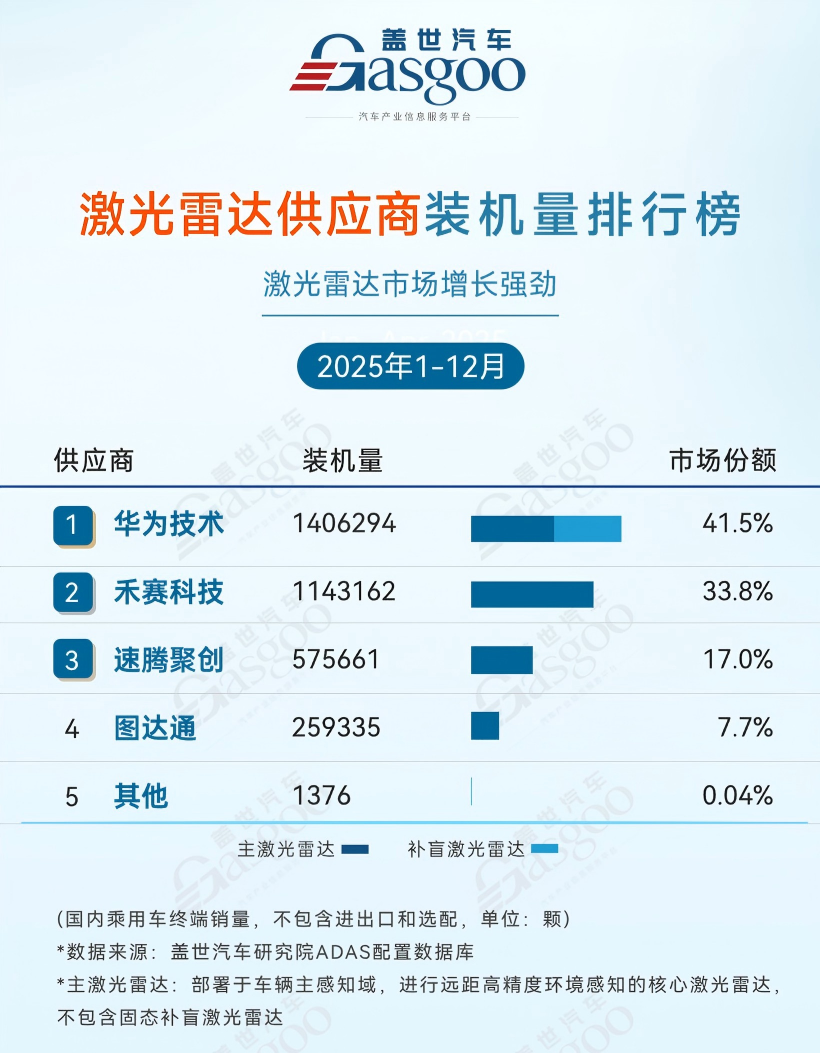
Huawei Surges, Hesai Slips in LiDAR Duopoly
💡LiDAR duopoly reshapes sensor choices for embodied AI and AV devs
⚡ 30-Second TL;DR
What Changed
Huawei emerges as a strong contender in LiDAR
Why It Matters
This market consolidation may lead to more reliable LiDAR supply for autonomous vehicles but could limit innovation due to reduced competition.
What To Do Next
Benchmark Huawei LiDAR sensors against Hesai in your AV perception stack.
Who should care:Developers & AI Engineers
Key Points
- •Huawei emerges as a strong contender in LiDAR
- •Hesai's market share is declining
- •LiDAR industry shifting to duopoly structure
- •Overall sector concentration rising
🧠 Deep Insight
AI-generated analysis for this event — not the original article.
🔑 Enhanced Key Takeaways
- •Huawei's rapid ascent is largely attributed to its 'Tier 1' integration strategy, bundling LiDAR with its Harmony Intelligent Mobility Alliance (HIMA) vehicle platforms, creating a closed-loop ecosystem advantage.
- •Hesai has faced significant headwinds due to its inclusion on the U.S. Department of Defense's 'Chinese Military Companies' list, which has restricted its ability to expand into North American and European markets.
- •The market shift is characterized by a transition from high-cost mechanical LiDAR to solid-state and hybrid-solid-state solutions, where Huawei's manufacturing scale and semiconductor supply chain integration have provided a cost-per-unit advantage.
📊 Competitor Analysis▸ Show
| Feature | Huawei (96-line) | Hesai (AT128) | RoboSense (M1) |
|---|---|---|---|
| Technology | Hybrid Solid-State | Hybrid Solid-State | Hybrid Solid-State |
| Detection Range | ~200m @ 10% reflectivity | ~200m @ 10% reflectivity | ~200m @ 10% reflectivity |
| Pricing Strategy | Aggressive (Platform bundling) | Premium/Market-driven | Competitive/Volume-driven |
| Primary Market | China (HIMA partners) | Global (OEMs) | Global (OEMs) |
🛠️ Technical Deep Dive
- •Huawei's LiDAR architecture utilizes a proprietary MEMS (Micro-Electro-Mechanical System) scanning mirror combined with a 1550nm laser source, which allows for higher power output and longer detection ranges compared to traditional 905nm systems.
- •Hesai's AT128 utilizes a custom ASIC (Application-Specific Integrated Circuit) to integrate the receiver, transmitter, and processing modules, significantly reducing the physical footprint and power consumption.
- •Both companies have shifted focus toward 'software-defined' LiDAR, where real-time point cloud processing and object classification are increasingly handled by on-board AI algorithms rather than raw hardware output.
🔮 Future ImplicationsAI analysis grounded in cited sources
Huawei will capture over 40% of the Chinese domestic passenger vehicle LiDAR market by end of 2026.
The continued expansion of the HIMA ecosystem and the integration of LiDAR as a standard feature in mid-range Huawei-powered vehicles creates a massive captive market.
Hesai will pivot its R&D focus toward industrial and robotics applications to mitigate automotive market share loss.
Geopolitical restrictions in the automotive sector are forcing Hesai to diversify its revenue streams into less politically sensitive industries like warehouse automation and logistics.
⏳ Timeline
2021-12
Huawei officially launches its first mass-produced 96-line mid-to-long-range LiDAR.
2023-02
Hesai Group completes its IPO on the Nasdaq, becoming the first Chinese LiDAR company to list in the U.S.
2024-01
The U.S. Department of Defense designates Hesai as a 'Chinese Military Company', triggering significant investor and OEM scrutiny.
2025-06
Huawei announces the 'LiDAR 2.0' initiative, focusing on further cost reduction and integration with its ADS 3.0 autonomous driving system.
📰
Weekly AI Recap
Read this week's curated digest of top AI events →
👉Related Updates



AI-curated news aggregator. All content rights belong to original publishers.
Original source: 钛媒体 ↗
This is a summary, not the original. Read the source, or get the weekly briefing.
The weekly digest
One email a week. Unsubscribe anytime.