How to build a true AI-native organization
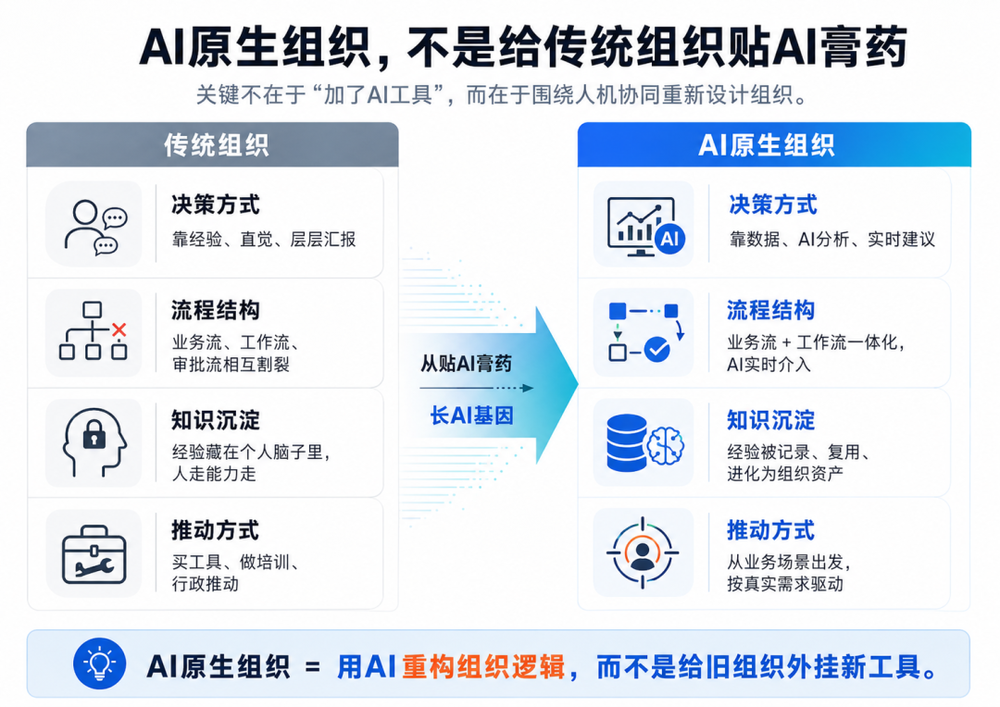
💡Essential framework for founders to move beyond superficial AI adoption and build structural AI capabilities.
⚡ 30-Second TL;DR
What Changed
AI-native organizations prioritize data-driven decision-making over experience-based intuition.
Why It Matters
Shifting from 'AI-as-a-tool' to 'AI-native' is essential for companies to achieve actual productivity gains rather than just superficial digital updates.
What To Do Next
Identify one high-frequency, repetitive task in your workflow and build a functional AI demo to solve it before scaling.
Key Points
- •AI-native organizations prioritize data-driven decision-making over experience-based intuition.
- •Business flows and workflows must be integrated to allow AI real-time intervention.
- •Knowledge must be treated as a replicable asset through AI-driven documentation and automation.
- •Incentive mechanisms like 'Energy Gold' can drive organic AI adoption among employees.
🧠 Deep Insight
Web-grounded analysis with 18 cited sources.
🔑 Enhanced Key Takeaways
- •Becoming truly AI-native signifies a distinct organizational maturity stage, moving beyond merely adopting AI tools to a fundamental redesign of workflows, software architecture, data infrastructure, and team roles, where AI is a core operating layer rather than an add-on.
- •The transition to an AI-native model redefines human roles, shifting employees from direct task production to orchestrating and directing AI systems, thereby elevating human involvement to higher-value activities like evaluation, decision-making, and product management.
- •Robust AI governance is critical for AI-native organizations, encompassing explicit human-AI decision design, continuous evaluation, and built-in governance frameworks (like ISO/IEC 42001:2023 and NIST AI Risk Management Framework) to manage risks such as bias, data privacy, and compliance across the entire AI lifecycle.
- •AI-native organizations face significant operational and financial challenges, including managing the 'unit economics trap' of scaling numerous AI agent calls and navigating complex enterprise compliance requirements, necessitating early investment in compliance infrastructure.
- •Incentive mechanisms for AI adoption extend beyond 'Energy Gold' to include innovation prizes, team bonuses for new AI solutions, employee-level gain sharing for AI impact, and even tying a portion of employee compensation to AI adoption and impact, alongside gamification strategies.
🛠️ Technical Deep Dive
- Data Infrastructure: AI-native organizations require a unified and retrievable data plane, robust data pipelines, and scalable storage to support continuous intelligence. This often involves real-time data integration strategies using Change Data Capture (CDC) and event-driven architectures to ensure AI systems are fueled by the freshest, most accurate data.
- AI Architecture: Key architectural components include agent-ready architecture, internal Large Language Model (LLM) gateways, and Model Context Protocol (MCP)-based integrations to ensure interoperability across various AI models and data sources.
- AI Governance Frameworks: Implementation details involve structured AI governance frameworks such as ISO/IEC 42001:2023 and the NIST AI Risk Management Framework. These frameworks guide the entire AI lifecycle, from initial design and data selection through training, deployment, and ongoing monitoring, establishing clear policies for transparency, accountability, bias detection, and compliance.
- Operational Metrics: Credible AI-native organizations measure specific operational metrics like agent task-completion rates, model evaluation scores, the ratio of AI-authored code, and the human-AI ratio per workflow to assess performance and impact.
- Knowledge Management: AI-driven knowledge management systems leverage machine learning and Natural Language Processing (NLP) for automated data categorization, semantic search, content freshness checks, and duplicate detection, making institutional knowledge a replicable and easily accessible asset.
🔮 Future ImplicationsAI analysis grounded in cited sources
⏳ Timeline
📎 Sources (18)
Factual claims are grounded in the sources below. Forward-looking analysis is AI-generated interpretation.
Weekly AI Recap
Read this week's curated digest of top AI events →
👉Related Updates



AI-curated news aggregator. All content rights belong to original publishers.
Original source: 虎嗅 ↗