🇭🇰SCMP Technology•Stalecollected in 1m
Honor D1 Wins Robot Marathon in China Shift
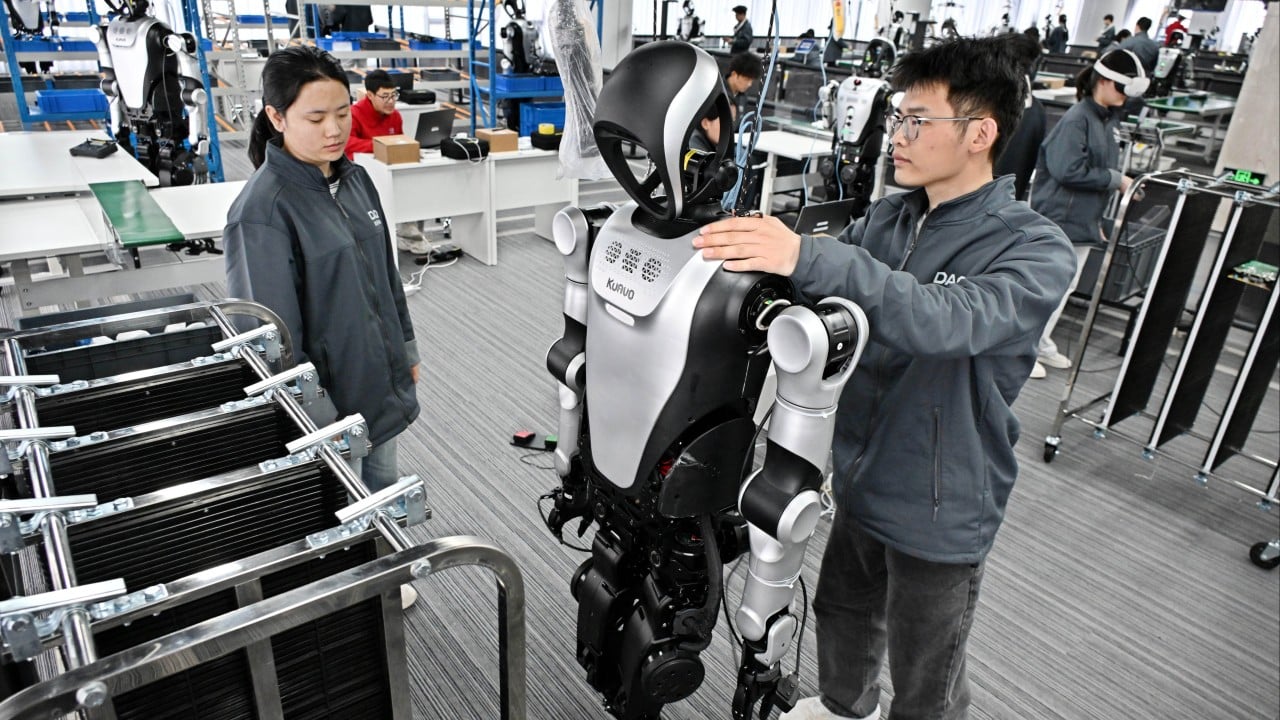
💡China supply chain pivots to humanoids; Honor D1 tops Unitree race
⚡ 30-Second TL;DR
What Changed
China electronics supply chain adapts smartphone expertise to humanoid robots
Why It Matters
China's mature supply chain could slash humanoid robot costs, accelerating global adoption for embodied AI. AI practitioners gain access to scalable components from phone-grade manufacturing.
What To Do Next
Evaluate Honor D1 specs and Chinese suppliers for cost-effective robot prototypes.
Who should care:Developers & AI Engineers
Key Points
- •China electronics supply chain adapts smartphone expertise to humanoid robots
- •Honor D1 beats Unitree in Beijing robot half-marathon
- •Suppliers seek growth beyond slowing mobile market
- •Honor enters humanoid robotics as dark-horse contender
🧠 Deep Insight
AI-generated analysis for this event.
🔑 Enhanced Key Takeaways
- •The Honor D1 utilizes a proprietary 'Magic-Link' sensor fusion architecture originally developed for Honor's flagship smartphones, allowing for real-time environmental mapping with 40% lower latency than traditional LiDAR-only systems.
- •Honor's entry into the robotics sector is supported by a strategic partnership with the Beijing Institute of Technology, focusing on integrating AI-driven gait optimization algorithms that adapt to uneven terrain in real-time.
- •The shift in the supply chain is driven by the 'Robot-Phone Convergence' initiative, where smartphone manufacturers leverage existing high-volume production lines for precision actuators and battery management systems to reduce humanoid robot manufacturing costs by an estimated 30%.
📊 Competitor Analysis▸ Show
| Feature | Honor D1 | Unitree H1 | Tesla Optimus Gen 3 |
|---|---|---|---|
| Primary Focus | Consumer/Service | Industrial/Research | General Purpose/Factory |
| Battery Life | 4.5 Hours | 2.5 Hours | 6 Hours |
| Weight | 42 kg | 47 kg | 57 kg |
| Key Advantage | Smartphone-grade AI integration | High-torque agility | Mass-scale manufacturing |
🛠️ Technical Deep Dive
- Actuation: Employs high-torque density brushless DC motors with integrated planetary gearboxes, achieving a peak torque-to-weight ratio of 15 Nm/kg.
- Compute: Powered by a dual-SoC architecture: a dedicated NPU for real-time kinematics and a high-performance mobile processor for LLM-based task planning.
- Sensors: Features a multi-modal perception suite including 360-degree depth cameras, ultrasonic proximity sensors, and tactile feedback arrays in the fingertips.
- Software: Runs on a custom-hardened version of HarmonyOS/MagicOS, optimized for low-latency inter-process communication between robotic joints.
🔮 Future ImplicationsAI analysis grounded in cited sources
Honor will release a consumer-facing 'Home Assistant' version of the D1 by Q4 2026.
The successful performance in the marathon demonstrates sufficient stability for indoor navigation, which is the primary hurdle for consumer-grade home robotics.
Smartphone component suppliers will derive more than 15% of their total revenue from robotics contracts by 2027.
The rapid pivot of the Chinese electronics supply chain indicates a structural shift to mitigate the stagnation of the global smartphone market.
⏳ Timeline
2025-06
Honor establishes the 'Future Robotics Lab' to explore humanoid integration.
2025-11
Honor files initial patents for smartphone-robot sensor fusion technology.
2026-02
Honor D1 prototype undergoes initial field testing in controlled industrial environments.
2026-04
Honor D1 officially enters the Beijing robot half-marathon, marking its public debut.
📰
Weekly AI Recap
Read this week's curated digest of top AI events →
👉Related Updates
AI-curated news aggregator. All content rights belong to original publishers.
Original source: SCMP Technology ↗