Source虎嗅•Stalecollected in 23m
Hassabis: AGI Via Learning & Memory
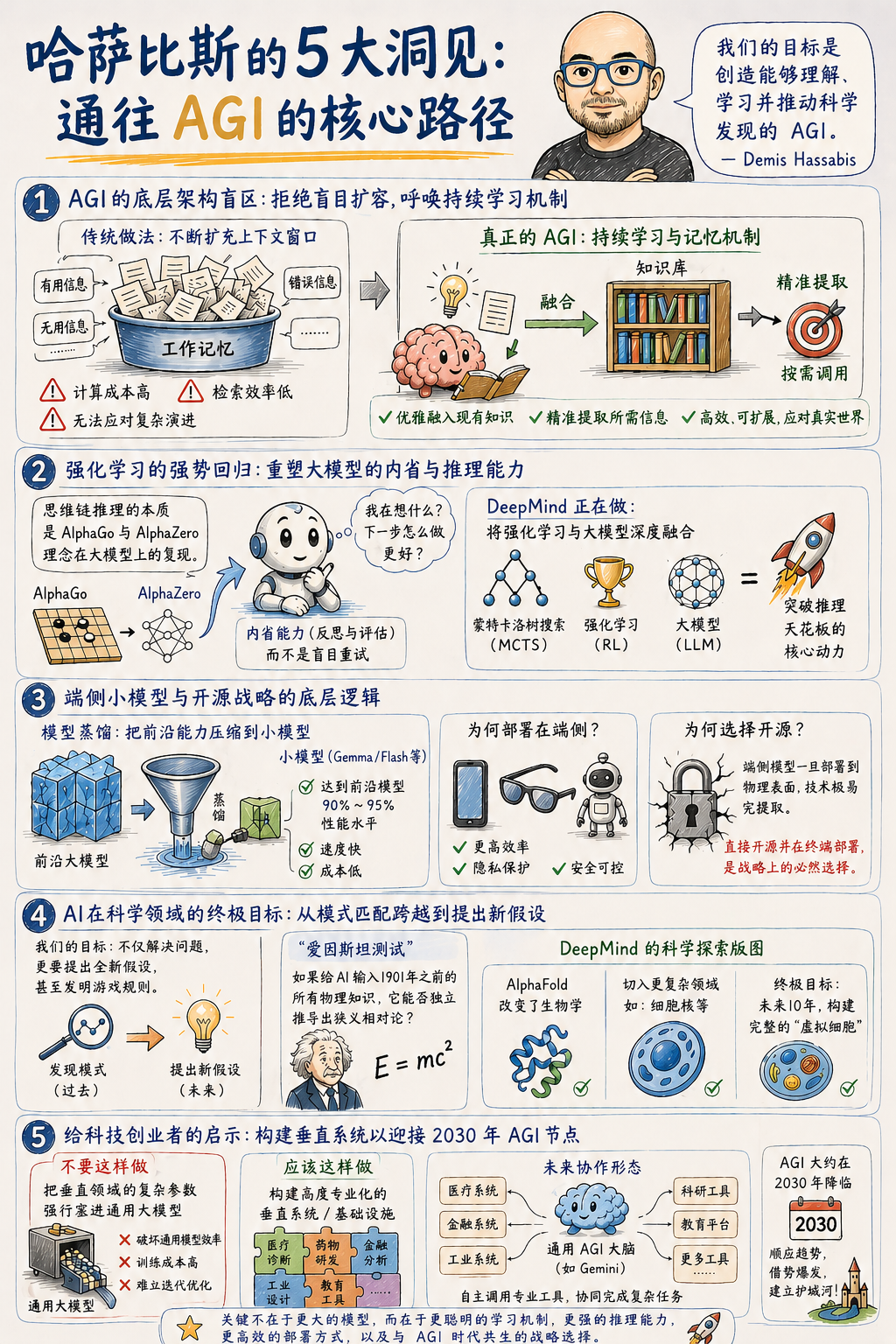
DeepMind CEO's AGI roadmap: memory > context windows
30-Second TL;DR
What Changed
AGI requires continuous learning and memory integration
Why It Matters
Shifts focus from scaling to smarter architectures, influencing AGI research directions at DeepMind and beyond.
What To Do Next
Implement experience replay in your RL models for continual learning.
Who should care:Researchers & Academics
Key Points
- •AGI requires continuous learning and memory integration
- •RLHF with Monte Carlo tree search boosts reasoning
- •End-side distilled models enable efficient deployment
- •AI science must generate novel hypotheses via 'Einstein test'
- •Build vertical tools for AGI collaboration
Deep Insight
AI-generated analysis for this event — not the original article.
Enhanced Key Takeaways
- •Hassabis emphasizes the 'AlphaGeometry' approach as a blueprint for AGI, where neuro-symbolic integration allows models to solve complex mathematical problems by combining neural intuition with symbolic rigor.
- •DeepMind is shifting focus toward 'System 2' thinking capabilities, moving beyond simple next-token prediction to incorporate deliberate planning and verification steps during inference.
- •The strategy prioritizes 'data efficiency' over massive scale, suggesting that future AGI breakthroughs will rely on synthetic data generation and self-play environments rather than just scraping the remaining public internet.
Technical Deep Dive
- •Integration of Monte Carlo Tree Search (MCTS) with Large Language Models (LLMs) to enable look-ahead planning, allowing the model to evaluate multiple potential reasoning paths before committing to an output.
- •Utilization of distillation techniques to compress large-scale foundation models into smaller, task-specific 'end-side' models that maintain high performance on edge devices.
- •Implementation of long-term memory architectures that move beyond fixed-length context windows, likely utilizing retrieval-augmented generation (RAG) or recurrent memory mechanisms to maintain state over extended interactions.
Future ImplicationsAI analysis grounded in cited sources
DeepMind will prioritize specialized scientific discovery models over general-purpose consumer chatbots.
Hassabis's focus on the 'Einstein test' indicates a strategic pivot toward models that can generate novel, verifiable scientific hypotheses rather than just mimicking human conversation.
The industry will see a decline in the 'context window arms race' in favor of persistent memory systems.
By explicitly criticizing the focus on context window expansion, Hassabis signals that DeepMind is betting on architectural memory solutions to solve long-term coherence issues.
Timeline
2010-09
DeepMind Technologies is founded by Demis Hassabis, Shane Legg, and Mustafa Suleyman.
2014-01
Google acquires DeepMind, positioning the company to focus on AGI research.
2016-03
AlphaGo defeats Lee Sedol, demonstrating the power of reinforcement learning in complex strategy games.
2020-11
AlphaFold 2 achieves a breakthrough in protein structure prediction, validating the use of AI for scientific discovery.
2023-04
Google Brain and DeepMind merge to form Google DeepMind to accelerate AGI development.
2024-01
DeepMind releases AlphaGeometry, showcasing neuro-symbolic reasoning capabilities.
- 2010-09DeepMind Technologies is founded by Demis Hassabis, Shane Legg, and Mustafa Suleyman.
- 2014-01Google acquires DeepMind, positioning the company to focus on AGI research.
- 2016-03AlphaGo defeats Lee Sedol, demonstrating the power of reinforcement learning in complex strategy games.
- 2020-11AlphaFold 2 achieves a breakthrough in protein structure prediction, validating the use of AI for scientific discovery.
- 2023-04Google Brain and DeepMind merge to form Google DeepMind to accelerate AGI development.
- 2024-01DeepMind releases AlphaGeometry, showcasing neuro-symbolic reasoning capabilities.
Weekly AI Recap
Read this week's curated digest of top AI events →
AI-curated news aggregator. All content rights belong to original publishers.
Original source: 虎嗅 ↗
This is a summary, not the original. Read the source, or get the weekly briefing.
The weekly digest
One email a week. Unsubscribe anytime.