Groq's AI inference chips disrupt market with massive valuation
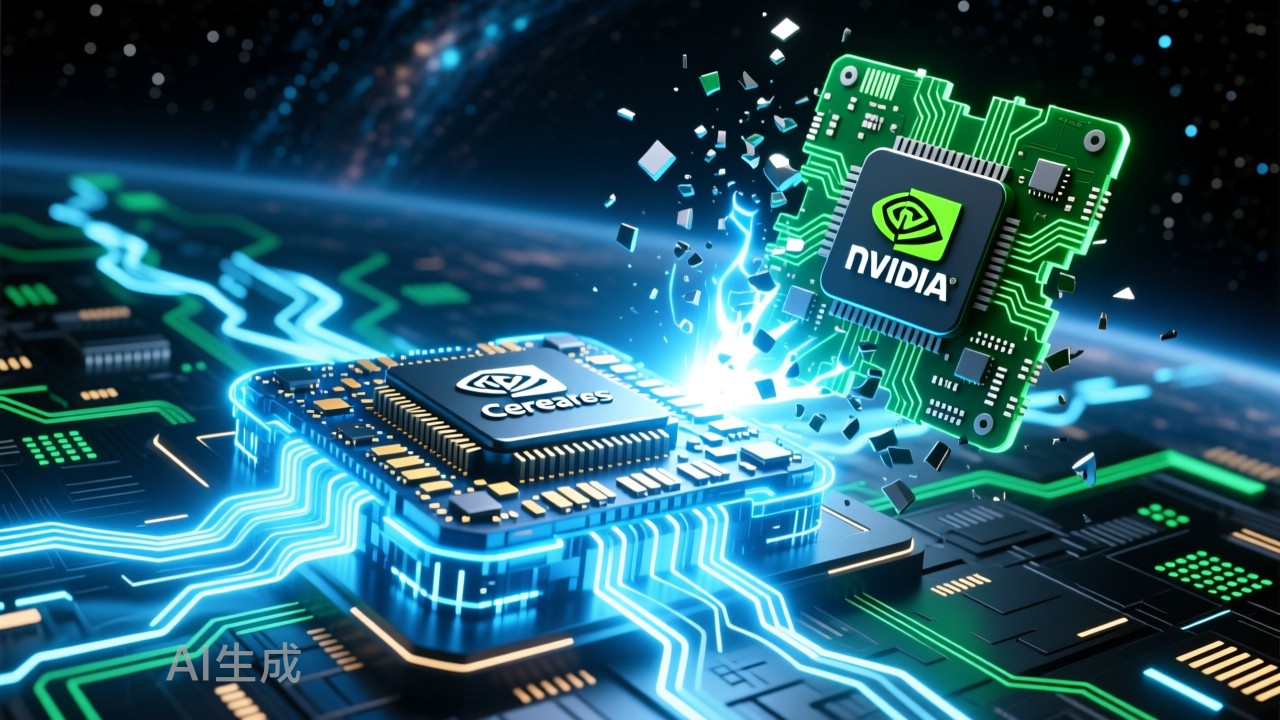
💡Discover the hardware challenger disrupting Nvidia's dominance in the AI inference space.
⚡ 30-Second TL;DR
What Changed
Groq's LPU (Language Processing Unit) architecture is optimized specifically for AI inference.
Why It Matters
Groq's rise suggests a shift in the AI hardware market toward specialized inference chips, potentially lowering costs for developers running large-scale LLMs. This could force a re-evaluation of infrastructure costs for AI-heavy applications.
What To Do Next
Benchmark your LLM inference workloads on Groq's cloud API to compare latency and cost-efficiency against your current GPU-based setup.
Key Points
- •Groq's LPU (Language Processing Unit) architecture is optimized specifically for AI inference.
- •The company has achieved a massive valuation despite historical losses, signaling investor confidence in inference-focused hardware.
- •Groq provides a new 'pricing anchor' for the AI inference market, challenging existing GPU-based solutions.
🧠 Deep Insight
Web-grounded analysis with 31 cited sources.
🔑 Enhanced Key Takeaways
- •Groq's LPU architecture, initially known as the Tensor Streaming Processor (TSP), achieves its high-speed, predictable performance through a deterministic execution model where a custom compiler precisely schedules instructions and data flow, eliminating the non-determinism inherent in traditional CPU/GPU designs.
- •The LPU integrates hundreds of megabytes of high-bandwidth on-chip SRAM as primary weight storage, which is approximately 20 times faster than off-chip High Bandwidth Memory (HBM) used by GPUs, significantly reducing unpredictable access latency and enabling compute units to pull weights at full speed.
- •Groq has demonstrated remarkable inference speeds, achieving up to 300-500 tokens per second for Large Language Models (LLMs) like Llama 3 70B with a time to first token as low as 0.2 seconds, significantly outperforming NVIDIA GPUs which typically achieve 10-30 tokens per second for similar tasks.
- •In December 2025, NVIDIA entered a non-exclusive licensing agreement with Groq, reportedly valued at approximately US$20 billion, to license Groq's AI inference technology. This led to the integration of the 'NVIDIA Groq 3 LPU' as an inference co-processor within the NVIDIA Vera Rubin platform, signaling a strategic move by NVIDIA to address latency-sensitive inference workloads.
- •Groq's pricing model is consumption-based, charging per million tokens processed, which offers transparency and can be up to 50% lower than traditional GPU-based solutions, with costs as low as $0.11 per million input tokens for smaller models.
📊 Competitor Analysis▸ Show
| Feature/Metric | Groq LPU | NVIDIA GPUs (e.g., H100/Blackwell) | AWS Inferentia | Google TPU | Cerebras Wafer-Scale Engine (WSE) | SambaNova RDU (SN40L) |
|---|---|---|---|---|---|---|
| Primary Focus | AI Inference (ultra-low latency, real-time) | General-purpose (Training & Inference) | AI Inference (AWS ecosystem) | AI Inference & Training (Google Cloud) | AI Training & Inference (massive models) | AI Training & Inference (large models) |
| Architecture | Language Processing Unit (LPU) / TSP | GPU (Graphics Processing Unit) | Custom ASIC | Tensor Processing Unit (TPU) | Wafer-Scale Engine (WSE) | Reconfigurable Dataflow Unit (RDU) |
| Execution Model | Deterministic, compiler-scheduled | Probabilistic, dynamic runtime scheduling | Optimized for AWS workloads | Deterministic, matrix-focused | Maximizes raw throughput | Dataflow architecture |
| Memory | On-chip SRAM (e.g., 500MB, 150 TB/s bandwidth for Groq 3 LPU) | Off-chip HBM (e.g., 80GB HBM2e for A100) | Integrated memory | Integrated memory | Large on-chip memory | Extensive DRAM |
| Latency (per token) | ~0.2 - 2 ms | ~8 - 10 ms (with batch delays) | Varies by model/integration | Excellent, but exclusive to GCP | High throughput, not primarily low-latency | Fast inference, but less emphasis on ultra-low latency than Groq |
| Throughput | Up to 300-500 tokens/sec (Llama 3 70B) | 10-30 tokens/sec (Llama 3 70B); ~60-100 tokens/sec (general) | Up to 70% cost reduction vs. GPUs | Excellent performance (TPU v4) | Maximizes raw throughput for vast models | High TPS, scalable |
| Pricing Model | Pay-per-token (e.g., $0.11/M input tokens) | Per hour (e.g., H100 $2.95/hr); higher per token | Cost reduction vs. GPUs | Exclusive to Google Cloud Platform | Enterprise-focused, high cost | Enterprise-focused, high cost |
| Cooling | Air-cooled by design | Requires complex cooling infrastructure | Standard data center cooling | Standard data center cooling | Requires specialized cooling | Standard data center cooling |
| Scalability | Plesiosynchronous chip-to-chip protocol | NVLink, InfiniBand | AWS ecosystem integration | Google Cloud infrastructure | Wafer-scale parallelism | Multi-chiplet tiling, scalable |
| Software Ecosystem | GroqWare Suite, Groq Compiler, GroqCloud API | CUDA, TensorRT, extensive ecosystem | AWS services | TensorFlow, JAX, PyTorch/XLA | Proprietary software stack | Proprietary software stack |
| Energy Efficiency | Up to 10x more efficient than GPUs | Higher power consumption | Cost-optimized | Optimized for efficiency | High power consumption | Efficient |
🛠️ Technical Deep Dive
- Architecture: Groq's LPU is built on the Tensor Streaming Processor (TSP) architecture, a departure from traditional CPU/GPU designs, specifically optimized for language model inference tasks.
- Deterministic Execution: The TSP architecture achieves determinism by eliminating sources of non-determinism (like complex memory hierarchies and dynamic scheduling) found in CPUs/GPUs. This allows the compiler to precisely schedule every instruction and data flow at compile time, ensuring predictable and consistent performance.
- On-Chip SRAM: The LPU's memory system centers around hundreds of megabytes of high-speed on-chip SRAM, used as primary working storage for model weights, activations, and key-value caches. This flat memory design, with compiler and runtime-controlled data placement, reduces unpredictable access latency and provides high bandwidth (e.g., 80 TB/s for LPU v1, 150 TB/s for Groq 3 LPU).
- Compute Units: The LPU architecture includes dedicated execution units:
- Matrix Execution Module (MXM): Handles tensor computation with high-density multiply-accumulate capabilities.
- Vector Execution Module (VXM): Manages element-wise operations, data type conversion, and activation functions.
- Shuffle Execution Module (SXM): Orchestrates structured data movement, including vector rearrangement and distribution.
- Data Flow Management: Compute and data movement operate on fixed-size vectors (320 bytes), simplifying scheduling logic and reducing synchronization complexity. The architecture explicitly orchestrates data movement to overlap computation, memory access, and communication.
- Compiler Control: The GroqWare suite, including the Groq Compiler (MLIR-based GroqFlow), is central to the LPU's operation. It analyzes the computational graph and creates a static, deterministic schedule for each TSP, removing the need for hardware-level dynamic scheduling.
- Chip-to-Chip Interconnect: LPUs integrate high-radix, high-speed chip-to-chip (C2C) interconnects (e.g., 96 links at 112 Gbps, ~2.5 TB/s aggregate bidirectional bandwidth per LPU) using a plesiosynchronous protocol. This allows hundreds of LPUs to align and act as a single coordinated system for distributed inference pipelines, minimizing latency variability.
- Process Technology: The first generation LPU (LPU v1) was fabricated on a 14nm process. Next-generation chips, including the Groq 3 LPU, are manufactured on Samsung's 4nm process node.
- Performance Metrics (LPU v1): Offers up to 750 TOPS at INT8 precision and 188 TeraFLOPS at FP16 precision, with 230 MB on-chip SRAM and 80 TB/s internal bandwidth.
- Power Efficiency: The LPU and GroqRack systems are designed to be air-cooled, eliminating the need for complex liquid cooling infrastructure and contributing to up to 10x more energy efficiency compared to conventional GPU deployments.
🔮 Future ImplicationsAI analysis grounded in cited sources
⏳ Timeline
📎 Sources (31)
Factual claims are grounded in the sources below. Forward-looking analysis is AI-generated interpretation.
- Google Search Source
- Google Search Source
- Google Search Source
- Google Search Source
- Google Search Source
- Google Search Source
- Google Search Source
- Google Search Source
- Google Search Source
- Google Search Source
- Google Search Source
- Google Search Source
- Google Search Source
- Google Search Source
- Google Search Source
- Google Search Source
- Google Search Source
- Google Search Source
- Google Search Source
- Google Search Source
- Google Search Source
- Google Search Source
- Google Search Source
- Google Search Source
- Google Search Source
- Google Search Source
- Google Search Source
- Google Search Source
- Google Search Source
- Google Search Source
- Google Search Source
Weekly AI Recap
Read this week's curated digest of top AI events →
👉Related Updates


AI-curated news aggregator. All content rights belong to original publishers.
Original source: 钛媒体 ↗