Gravitational lens reveals galaxy 800M years post-Big Bang
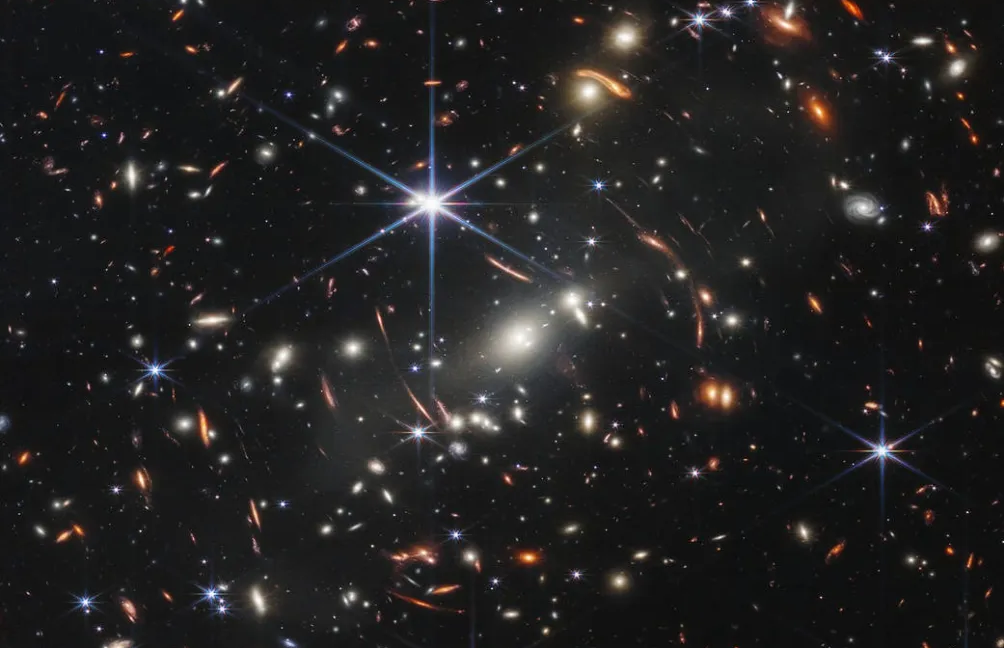
💡See how advanced imaging and lensing techniques are pushing the boundaries of deep space data analysis.
⚡ 30-Second TL;DR
What Changed
Observed a galaxy dating back to 800 million years post-Big Bang
Why It Matters
This research enhances our understanding of early galaxy formation and chemical enrichment. It demonstrates the power of advanced imaging techniques in deep space exploration.
What To Do Next
Explore how gravitational lensing algorithms are being adapted for computer vision tasks in high-noise astronomical data processing.
Key Points
- •Observed a galaxy dating back to 800 million years post-Big Bang
- •Utilized gravitational lensing to magnify distant cosmic structures
- •Detected chemical signatures from the universe's first generation of supernovae
🧠 Deep Insight
Web-grounded analysis with 24 cited sources.
🔑 Enhanced Key Takeaways
- •The James Webb Space Telescope (JWST) was instrumental in these observations, utilizing its advanced infrared capabilities to detect light from these extremely distant and faint objects, which would otherwise be undetectable.
- •Researchers employed the direct Te method, based on auroral line detections in NIRSpec spectra, to measure the metallicity of these early galaxies (at redshifts around z~8), revealing a range from extremely metal-poor to about one-third solar.
- •The observed chemical abundances in these galaxies, dating back 470-770 million years after the Big Bang, were found to be significantly poorer in heavy elements than predicted by universal scaling relationships for older galaxies.
🛠️ Technical Deep Dive
- Gravitational Lensing Mechanism: Gravitational lensing occurs when a massive celestial body, such as a galaxy cluster, warps spacetime, causing light from a more distant source to bend, distort, and magnify as it passes around the massive object. This phenomenon acts as a 'natural telescope,' allowing astronomers to observe objects that would otherwise be too far away and too faint.
- Magnification Capabilities: Gravitational lenses can magnify distant objects by factors of 10 or more, enabling the resolution of details down to hundreds of light-years in scale for extremely distant galaxies.
- Key Telescopes Utilized:
- The Hubble Space Telescope (HST) has historically been crucial for gravitational lensing observations, resolving details and identifying distant stars and supernovae.
- The James Webb Space Telescope (JWST) is specifically designed for deep-field observations in the infrared spectrum and frequently leverages gravitational lensing for enhanced magnification to study the earliest galaxies.
- Ground-based observatories, such as the Víctor M. Blanco 4-meter Telescope with its Dark Energy Camera (DECam), have also been used in projects like COOL-LAMPS to discover gravitationally lensed galaxies.
- Chemical Signature Detection:
- JWST's Near-Infrared Spectrograph (NIRSpec) instrument is used for detailed spectroscopic analysis to detect specific emission lines from elements.
- The 'direct Te method,' which relies on detecting faint auroral emission lines, is considered a robust technique for accurately measuring the metallicity (abundance of elements heavier than hydrogen and helium) in high-redshift galaxies.
- The detection of strong emission lines from elements like hydrogen, nitrogen, and sulfur atoms provides crucial data on the chemical composition of these early galaxies.
- Supernovae and Element Forging: Supernovae, particularly core-collapse supernovae from massive stars, are responsible for synthesizing and dispersing heavier elements (metals) into the interstellar medium, enriching the universe over time.
🔮 Future ImplicationsAI analysis grounded in cited sources
⏳ Timeline
📎 Sources (24)
Factual claims are grounded in the sources below. Forward-looking analysis is AI-generated interpretation.
- Google Search Source
- Google Search Source
- Google Search Source
- Google Search Source
- Google Search Source
- Google Search Source
- Google Search Source
- Google Search Source
- Google Search Source
- Google Search Source
- Google Search Source
- Google Search Source
- Google Search Source
- Google Search Source
- Google Search Source
- Google Search Source
- Google Search Source
- Google Search Source
- Google Search Source
- Google Search Source
- Google Search Source
- Google Search Source
- Google Search Source
- Google Search Source
Weekly AI Recap
Read this week's curated digest of top AI events →
👉Related Updates
AI-curated news aggregator. All content rights belong to original publishers.
Original source: Ars Technica ↗