Google's take on OpenClaw and the Anthropic shift
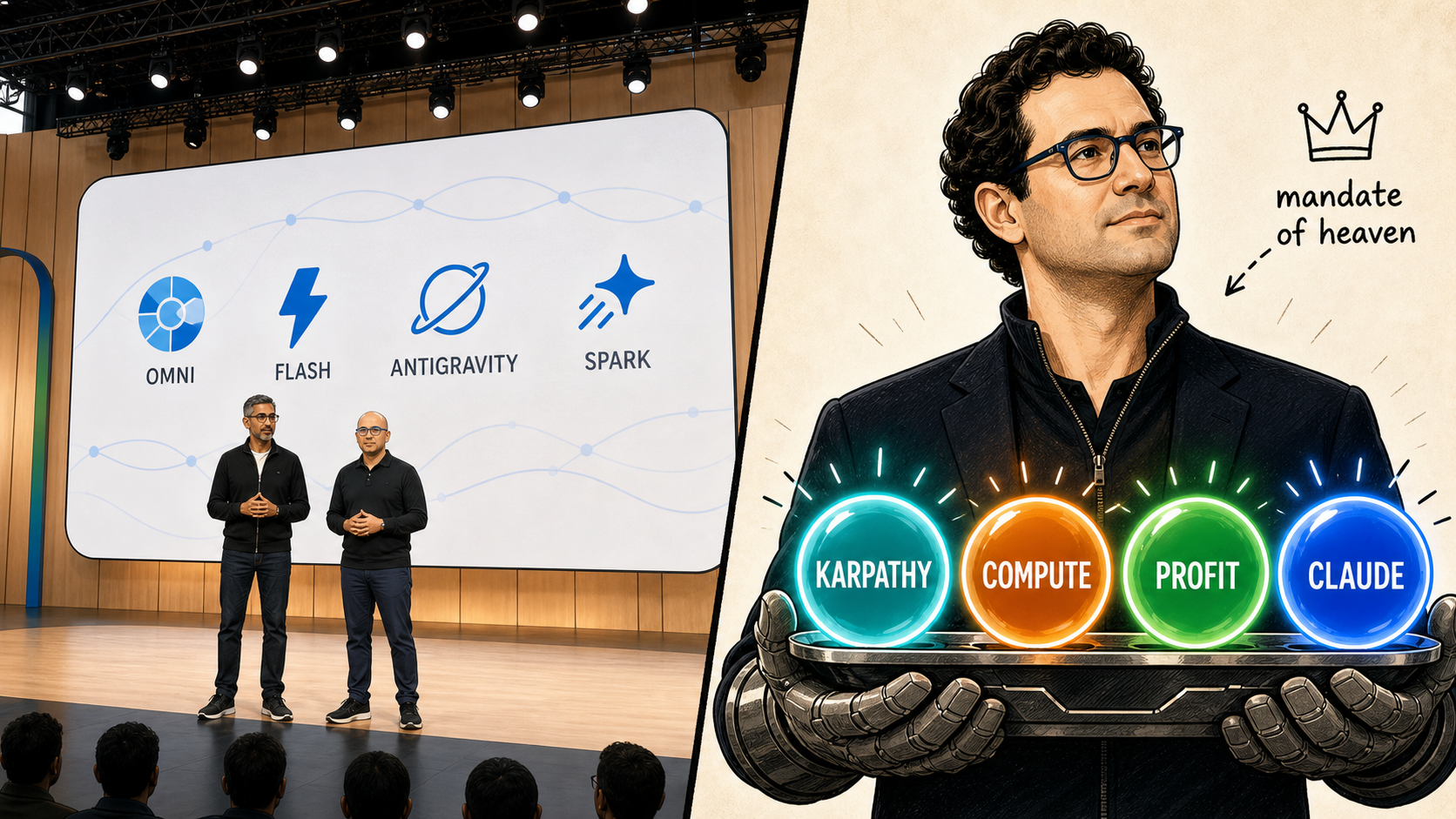
💡Understand the shifting power dynamics between Google and Anthropic in the race for AI supremacy.
⚡ 30-Second TL;DR
What Changed
Google is actively evaluating or responding to the OpenClaw initiative.
Why It Matters
This highlights the intensifying rivalry between major AI labs, suggesting that practitioners should closely monitor Anthropic's rapid deployment cycles compared to Google's internal strategies.
What To Do Next
Monitor Anthropic's latest model releases and API documentation to compare their performance against Google's Gemini ecosystem.
Key Points
- •Google is actively evaluating or responding to the OpenClaw initiative.
- •Anthropic is positioned as a major challenger for market dominance.
- •The industry landscape is shifting toward a new phase of competitive intensity.
🧠 Deep Insight
Web-grounded analysis with 35 cited sources.
🔑 Enhanced Key Takeaways
- •OpenClaw is an open-source autonomous AI agent, launched in late 2025, that integrates with various large language models (LLMs) including Claude and Gemini, and messaging platforms, enabling local, persistent, and adaptive task automation.
- •Anthropic has recently surpassed OpenAI in U.S. business AI adoption, reaching 34.4% of businesses by April 2026, a surge significantly driven by its Claude Code agentic coding tool.
- •Google is directly challenging Anthropic and OpenAI in the agentic AI and coding space with new offerings like Gemini 3.5 Flash, positioned as a cost-effective and high-performing model for coding agents, and the Antigravity platform.
- •Anthropic's rapid growth has led to a projected operating profit in Q2 2026, with Q1 2026 revenue of $4.8 billion and Q2 projected at $10.9 billion, demonstrating faster profitability than many AI companies.
- •Anthropic's acquisition of Stainless in May 2026 aims to enhance the Claude Platform's agent connectivity and developer experience, signaling a strategic move to strengthen its competitive position in enterprise agentic AI.
📊 Competitor Analysis▸ Show
| Feature/Category | Anthropic (Claude) | Google (Gemini) |
|---|---|---|
| Core AI Models | Claude 3 family (Haiku, Sonnet, Opus), Claude Mythos (private) | Gemini family (Nano, Flash, Pro, Ultra), Gemini Omni |
| Key Differentiator | Constitutional AI for safety, alignment, and ethical guidelines | Multimodality (native processing of text, code, audio, image, video), Google ecosystem integration |
| Agentic AI Offerings | Claude Code (coding agent), finance-focused AI agents, tool use, web search, computer use | Gemini 3.5 Flash (for coding agents), Antigravity platform (multi-agent management), Antigravity CLI, Gemini Enterprise Agent Platform |
| Business Adoption (U.S.) | 34.4% of businesses (April 2026), surpassing OpenAI | Lags in reported AI revenue, but leverages ecosystem for distribution |
| Pricing (API per MTok, as of March 2026) | Haiku 4.5: $1/$5 (input/output); Sonnet 4.6: $3/$15; Opus 4.6: $5/$25 | Gemini 3.5 Flash: Positioned at half the cost of comparable models |
| Performance Benchmarks | Claude 3 Opus competitive with GPT-4 and Gemini; Opus 4.7 shows notable improvement in advanced software engineering | Gemini Ultra excels in coding (HumanEval, Natural2Code); Gemini 3.5 Flash outperforms Gemini 3.1 Pro and matches/surpasses latest Claude/GPT in coding/tool use |
🛠️ Technical Deep Dive
- OpenClaw: An open-source, autonomous AI agent that runs locally as a Node.js process (the Gateway). It is model-agnostic, connecting to various LLMs (e.g., Claude, GPT, Gemini) via API. It features a 'skills' system defined by SKILL.md files, persistent memory for configuration and interaction history stored locally, and a heartbeat scheduler for continuous background operation.
- Anthropic Claude: Models are trained using 'Constitutional AI,' a method involving self-improvement based on a set of principles and Reinforcement Learning from AI Feedback (RLAIF). Claude models are multimodal, processing text, image, and audio inputs. They utilize a unique tokenizer with 65,000 coding sequences and are developed using cloud computing resources from Amazon Web Services and Google Cloud Platform, supported by frameworks like PyTorch, JAX, and Triton.
- Google Gemini: A family of multimodal LLMs designed to natively process and generate text, computer code, images, audio, and video simultaneously. The architecture is distributed in varying capacities (Nano for on-device, Flash for efficiency, Pro/Ultra for complex reasoning). Gemini models are trained on Google's AI-optimized infrastructure using in-house designed Tensor Processing Units (TPUs) v4 and v5e, with 1.5 and 3 model generations introducing extended context windows.
🔮 Future ImplicationsAI analysis grounded in cited sources
⏳ Timeline
📎 Sources (35)
Factual claims are grounded in the sources below. Forward-looking analysis is AI-generated interpretation.
- wikipedia.org
- clarifai.com
- digitalocean.com
- milvus.io
- medium.com
- venturebeat.com
- mindstudio.ai
- fastcompany.com
- eweek.com
- reddit.com
- futurumgroup.com
- cnet.com
- latenode.com
- wikipedia.org
- wikipedia.org
- constitutional.ai
- anthropic.com
- medium.com
- anthropic.com
- medium.com
- ibm.com
- gemini.google
- blog.google
- letsdatascience.com
- metacto.com
- medium.com
- google.com
- shawnkanungo.com
- anthropic.com
- substack.com
- orbilontech.com
- toloka.ai
- nvidia.com
- wikipedia.org
- pitchbook.com
Weekly AI Recap
Read this week's curated digest of top AI events →
👉Related Updates
AI-curated news aggregator. All content rights belong to original publishers.
Original source: Ben's Bites ↗