💰Stalecollected in 67m

Google's Memory Inflation Terminator Algorithm
Google's Memory Inflation Terminator Algorithm
PostLinkedIn
💰Read original on 钛媒体
#memory-compression#ai-optimizationgoogle-extreme-compression-algorithm

💡Google's algo kills AI memory bloat—unlock efficiency for cheaper, faster models now

⚡ 30-Second TL;DR

What Changed

Google discloses extreme compression algorithm publicly

Why It Matters

This breakthrough could slash hardware costs for AI practitioners running large models, accelerating deployment on edge devices and reducing data center demands.

What To Do Next

Check Google's research blog for the algorithm paper and test it on your LLM inference pipeline.

Who should care:Developers & AI Engineers

🧠 Deep Insight

Web-grounded analysis with 5 cited sources.

🔑 Enhanced Key Takeaways

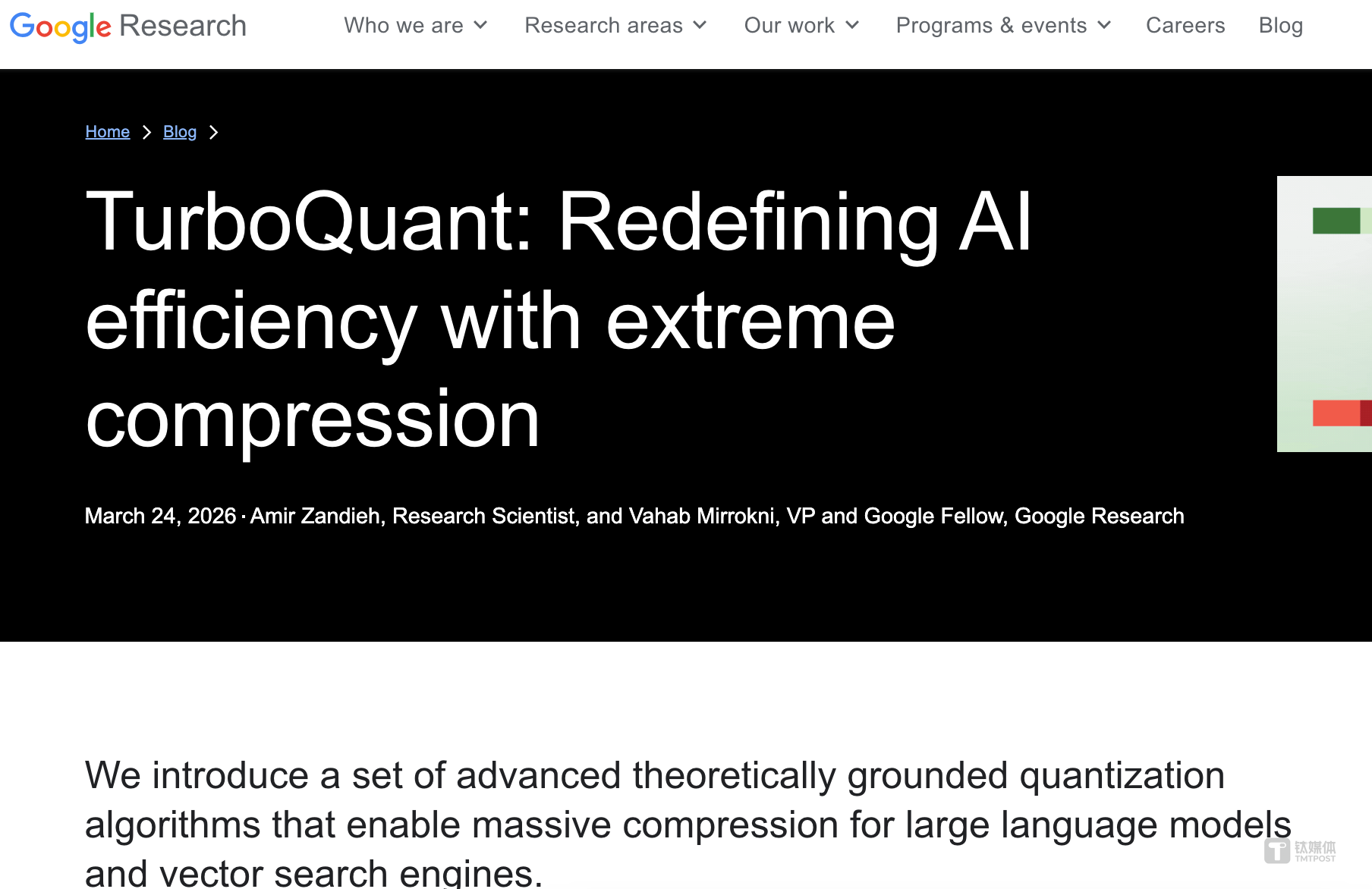
  • The algorithm, officially named 'TurboQuant', specifically targets the reduction of Key-Value (KV) cache memory usage in large language models, which is a primary bottleneck for AI inference.
  • TurboQuant achieves its compression through two core technical components: 'PolarQuant', a quantization method using polar coordinates to map data onto a predictable grid, and 'QJL' (Quantized Johnson-Lindenstrauss), a training and optimization approach.
  • Internal testing by Google Research indicates that TurboQuant can reduce AI memory requirements by at least 6x and boost runtime performance by up to 8x without compromising model accuracy.
📊 Competitor Analysis▸ Show
FeatureGoogle (TurboQuant)Traditional Memory/StorageIndustry Standard (FP16/INT8)
Memory Reduction6x+NoneBaseline
Performance Gain8x (Runtime)N/ABaseline
Primary TargetKV Cache / Vector QuantizationGeneral StorageGeneral Compute
Market ImpactNegative (Memory/Storage Stocks)N/AN/A

🛠️ Technical Deep Dive

  • TurboQuant Architecture: A compression framework designed to optimize vector quantization by eliminating memory overhead.
  • PolarQuant: Utilizes polar coordinates to map high-dimensional data onto a fixed, predictable circular grid, effectively bypassing the need for traditional data normalization steps.
  • QJL (Quantized Johnson-Lindenstrauss): A mathematical transformation technique that shrinks high-dimensional data while preserving essential geometric distances and relationships between data points, requiring near-zero memory overhead.
  • Application: Specifically engineered to optimize the KV cache in LLMs and improve the efficiency of vector search engines.

🔮 Future ImplicationsAI analysis grounded in cited sources

Memory and storage hardware demand will shift toward specialized AI-optimized architectures.
The significant reduction in memory requirements for large models reduces the immediate need for massive raw memory capacity, forcing hardware vendors to pivot toward speed and efficiency over sheer volume.
TurboQuant will enable the deployment of significantly larger models on edge devices.
By reducing the memory footprint by 6x, models previously restricted to data centers can now fit within the constrained memory environments of high-end consumer hardware.

Timeline

2026-03
Google officially unveils TurboQuant, PolarQuant, and QJL algorithms to address AI memory inflation.
📰

Weekly AI Recap

Read this week's curated digest of top AI events →

👉Related Updates

AI-curated news aggregator. All content rights belong to original publishers.
Original source: 钛媒体