🌍The Next Web (TNW)•Stalecollected in 41m
Google's $99 AI Coach vs Whoop Doctors
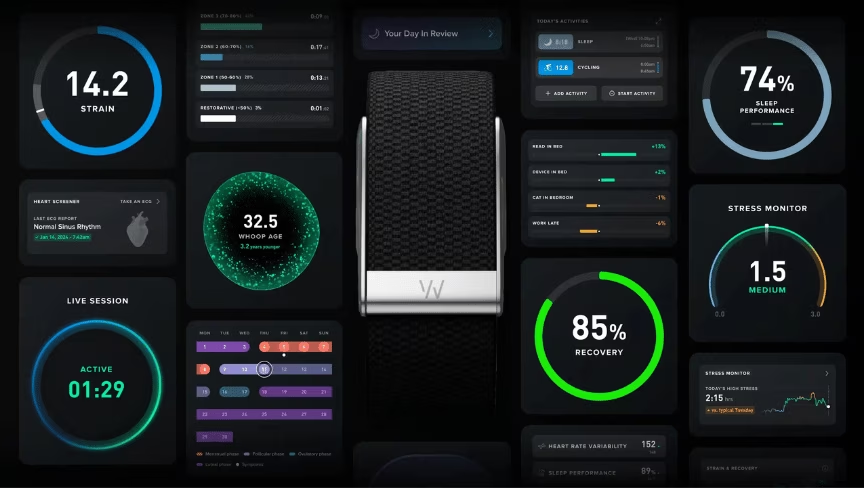
💡Google's cheap Gemini AI coach challenges wearables market, sparks doctor rivalry
⚡ 30-Second TL;DR
What Changed
Google: $99 tracker + $9.99/mo Gemini AI coach
Why It Matters
Highlights competition in AI wearables, pushing boundaries for Gemini in personalized health apps.
What To Do Next
Prototype Gemini API integrations for custom AI fitness coaching apps.
Who should care:Developers & AI Engineers
Key Points
- •Google: $99 tracker + $9.99/mo Gemini AI coach
- •Whoop: adds on-demand clinician video consultations
- •Focuses on AI vs human health data interpretation
🧠 Deep Insight
AI-generated analysis for this event.
🔑 Enhanced Key Takeaways
- •Google's new tracker utilizes a proprietary 'Bio-Sensor Fusion' chip, which processes raw PPG and EDA data locally on-device before sending encrypted summaries to the Gemini cloud for coaching analysis.
- •Whoop's clinician integration leverages a partnership with a third-party telehealth provider, requiring users to upgrade to a 'Whoop Pro+' tier, which is priced significantly higher than the standard subscription.
- •Market analysts note that Google's strategy aims to commoditize the hardware to drive high-margin recurring revenue from the Gemini-powered health insights, whereas Whoop is pivoting toward a 'medical-grade' service model to justify its premium pricing.
📊 Competitor Analysis▸ Show
| Feature | Google AI Coach | Whoop Pro+ | Apple Watch (Series 11) |
|---|---|---|---|
| Hardware Price | $99 | $0 (Subscription-based) | $399+ |
| Service Cost | $9.99/mo | $45/mo | Included (Fitness+) |
| Primary Focus | AI-driven coaching | Clinical consultation | Ecosystem integration |
| Data Processing | Cloud-heavy (Gemini) | Hybrid (App/Cloud) | On-device (S-series) |
🛠️ Technical Deep Dive
- •Google's tracker employs a low-power RISC-V architecture for the sensor hub, enabling 7-day battery life despite continuous biometric sampling.
- •The Gemini health model utilizes a fine-tuned version of Gemini Nano, optimized for time-series physiological data, allowing for 'context-aware' recovery suggestions.
- •Whoop's clinician platform utilizes an encrypted API bridge to share anonymized recovery and strain metrics directly with the clinician's EHR (Electronic Health Record) system during video calls.
🔮 Future ImplicationsAI analysis grounded in cited sources
Wearable manufacturers will shift from hardware-centric to service-centric revenue models by 2027.
The saturation of the fitness tracker market is forcing companies to monetize data interpretation services rather than device sales.
Regulatory scrutiny regarding AI-generated health advice will increase.
As AI coaches provide more specific medical recommendations, they will likely face classification as Software as a Medical Device (SaMD) by the FDA.
⏳ Timeline
2024-02
Google integrates Fitbit health data into Gemini Advanced.
2025-06
Google announces the development of a dedicated low-cost biometric sensor platform.
2026-03
Whoop announces strategic partnership with national telehealth network.
2026-05
Google officially launches the $99 screenless tracker and Gemini health coach.
📰
Weekly AI Recap
Read this week's curated digest of top AI events →
👉Related Updates
AI-curated news aggregator. All content rights belong to original publishers.
Original source: The Next Web (TNW) ↗